
Researchers have disclosed details of a newly discovered macOS
variant of a malware implant developed by a Chinese espionage
threat actor known to strike attack organizations across Asia.
Attributing the attacks to a group tracked as Storm Cloud[1], cybersecurity firm
Volexity characterized the new malware, dubbed
Gimmick, a “feature-rich, multi-platform malware
family that uses public cloud hosting services (such as Google
Drive) for command-and-control (C2) channels.”
The cybersecurity firm said it recovered the sample through
memory analysis of a compromised MacBook Pro running macOS 11.6
(Big Sur) as part of an intrusion campaign that took place in late
2021.
“Storm Cloud is an advanced and versatile threat actor, adapting
its tool set to match different operating systems used by its
targets,” Volexity researchers Damien Cash, Steven Adair, and
Thomas Lancaster said[2]
in a report.
“They make use of built-in operating system utilities,
open-source tools, and custom malware implants to achieve their
objectives. Leveraging cloud platforms for C2, such as using Google
Drive, increases the likelihood of operating undetected by network
monitoring solutions.”
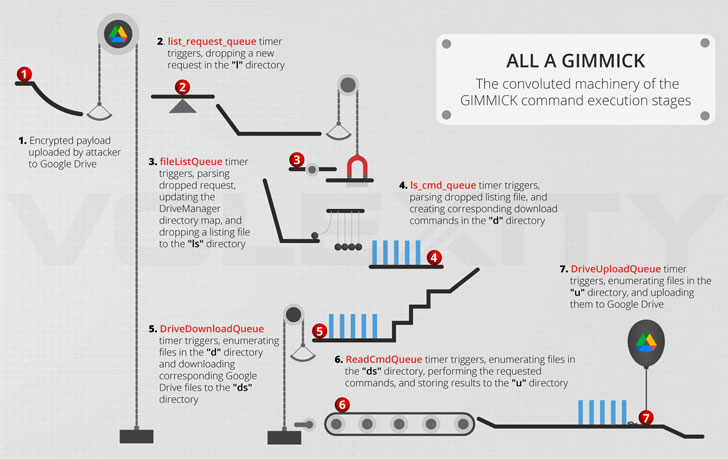
Unlike its Windows counterpart, which is coded in both .NET and
Delphi, the macOS version is written in Objective C. The choice of
the programming languages aside, the two versions of the malware
are known to share the same C2 infrastructure and behavioral
patterns.
Once deployed, Gimmick is launched either as a daemon or in the
form of a customized application that’s engineered to impersonate a
program frequently launched by the targeted user. The malware is
configured to communicate with its Google Drive-based C2 server
only on working days in order to further blend in with the network
traffic in the target environment.
What’s more, the backdoor, besides retrieving arbitrary files
and executing commands from the C2 server, comes with its own
uninstall functionality that allows it to erase itself from the
compromised machine.
To protect users against malware, Apple has issued new signatures[3]
to its built-in anti-malware protection suite known as XProtect as
of March 17, 2022 to block and remove the infections via its
Malware Removal Tool (MRT).
“The work involved in porting this malware and adapting its
systems to a new operating system (macOS) is no light undertaking
and suggests the threat actor behind it is well resourced, adept,
and versatile,” the researchers said.
References
- ^
Storm
Cloud (www.volexity.com) - ^
said
(www.volexity.com) - ^
new
signatures (support.apple.com)
Read more https://thehackernews.com/2022/03/new-variant-of-chinese-gimmick-malware.html