Four security vulnerabilities discovered in the Microsoft Office
suite, including Excel and Office online, could be potentially
abused by bad actors to deliver attack code via Word and Excel
documents.
“Rooted from legacy code, the vulnerabilities could have granted
an attacker the ability to execute code on targets via malicious
Office documents, such as Word, Excel and Outlook,” researchers
from Check Point research said in a report published[1]
today.
Three of the four flaws — tracked as CVE-2021-31174,
CVE-2021-31178, CVE-2021-31179 — have been fixed by Microsoft as
part of its Patch Tuesday update[2]
for May 2021, with the fourth patch (CVE-2021-31939) to be issued
in June’s update rolling out later today.
In a hypothetical attack scenario, the researchers said the
vulnerability could be triggered as simply as opening a malicious
Excel (.XLS) file that’s served via a download link or an
email.
Arising out of parsing mistakes made in legacy code found in
Excel 95 file formats, the vulnerabilities were found by fuzzing[3] MSGraph
(“MSGraph.Chart.8”), a relatively under-analyzed component in
Microsoft Office component that’s at par to Microsoft Equation
Editor in terms of the attack surface. Equation Editor, a
now-defunct feature in Word, has become a part of the arsenal of
several -related threat actors at least since late 2018.
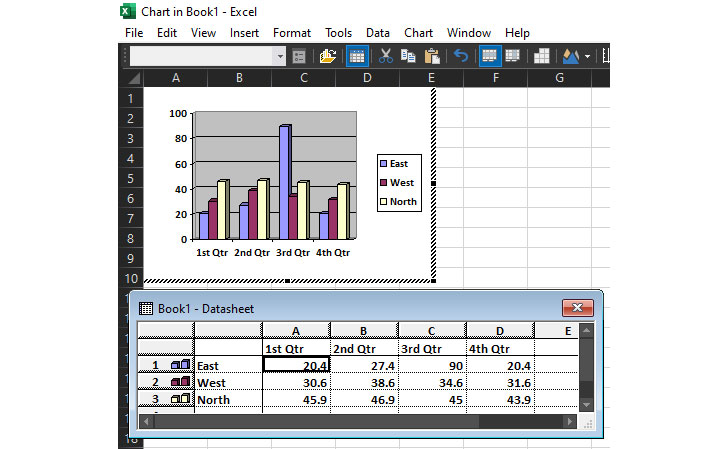
“Since the entire Office suite has the ability to embed Excel
objects, this broadens the attack vector, making it possible to
execute such an attack on almost any Office software, including
Word, Outlook and others,” Check Point researchers said.
The list of four vulnerabilities are as follows –
- CVE-2021-31179[4]
– Microsoft Office Remote Code Execution Vulnerability - CVE-2021-31174[5]
– Microsoft Excel Information Disclosure Vulnerability - CVE-2021-31178[6]
– Microsoft Office Information DisclosureChinese Vulnerability - CVE-2021-31939[7]
– Microsoft Office use-after-free vulnerability
Microsoft, in its advisory for CVE-2021-31179, had previously
noted that exploitation of the vulnerability requires that a user
open a specially-crafted file, adding the adversary would have to
trick victims into clicking a link that redirects users to the
malicious document.
The exact technical details surrounding CVE-2021-31939 are
limited, likely in an attempt to allow a majority of users to
install the fixes and prevent other threat actors from creating
exploits targeting the flaw.
“The vulnerabilities found affect almost the entire Microsoft
Office ecosystem,” said Yaniv Balmas, Head of Cyber Research at
Check Point. “It’s possible to execute such an attack on almost any
Office software, including Word, Outlook and others. One of the
primary learnings from our research is that legacy code continues
to be a weak link in the security chain, especially in complex
software like Microsoft Office.”
Windows users are strongly recommended to apply the patches as
soon as possible to mitigate the risk and avoid attacks that could
exploit the aforementioned weaknesses.
References
- ^
published
(research.checkpoint.com) - ^
Patch
Tuesday update (thehackernews.com) - ^
fuzzing
(en.wikipedia.org) - ^
CVE-2021-31179
(msrc.microsoft.com) - ^
CVE-2021-31174
(msrc.microsoft.com) - ^
CVE-2021-31178
(msrc.microsoft.com) - ^
CVE-2021-31939
(msrc.microsoft.com)
Read more http://feedproxy.google.com/~r/TheHackersNews/~3/zjewBl9vWEU/new-uaf-vulnerability-affecting.html