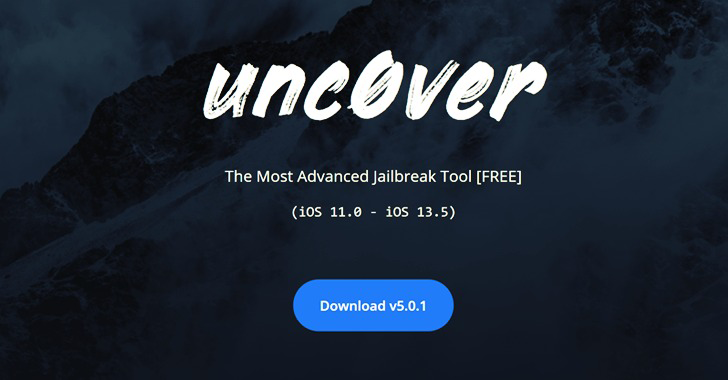
released a new version of the software that can unlock every single
iPhone, including those running the latest iOS 13.5 version.
Calling it the first zero-day jailbreak to be released since iOS
8, unc0ver’s lead developer Pwn20wnd[1] said “every other
jailbreak released since iOS 9 used 1day exploits that were either
patched in the next beta version or the hardware.”
The group did not specify which vulnerability in iOS was
exploited to develop the latest version.
The unc0ver website also
highlighted the extensive testing that went behind the scenes to
ensure compatibility across a broad range of devices, from iPhone
6S to the new iPhone 11 Pro Max models, spanning versions iOS 11.0
through iOS 13.5, but excluding versions 12.3 to 12.3.2 and 12.4.2
to 12.4.5.
“Utilizing native system sandbox exceptions, security remains
intact while enabling access to jailbreak files,” according to
unc0ver, meaning installing the new jailbreak will likely not
compromise iOS’ sandbox
protections[3].
Jailbreaking, analogous to rooting on Google’s Android, is a
privilege escalation that works by exploiting flaws in iOS to grant
users root access and full control over their devices. This allows
iOS users to remove software restrictions imposed by Apple, thereby
allowing access to additional customization and otherwise
prohibited apps.
But it also weakens the device’s security, opening the door to
all kinds of malware attacks. The added security risks, coupled
with Apple’s steady hardware and software lockdown, have made it
difficult to jailbreak devices deliberately.
Furthermore, jailbreaks tend to be very specific and based on
previously disclosed vulnerabilities, and very much dependent on
the iPhone model and iOS version, in order for them to be
successfully replicated.
The development comes as zero-day exploit broker Zerodium said it
would no longer purchase iOS RCE
vulnerabilities for the next few months, citing “a high number
of submissions related to these vectors.”
Last August, Pwn20wnd exploited a SockPuppet flaw
(CVE-2019-8605) uncovered by Googler Ned Williamson to release a
public version of
the jailbreak[5]
— making it the first time an up-to-date firmware was unlocked in
years — after Apple accidentally reintroduced a previously patched
flaw in iOS 12.4. The company later rolled out a fix in iOS 12.4.1[6] to address the privilege
escalation vulnerability.
Then in September, a security researcher published details of a
permanent unpatchable bootrom exploit, dubbed checkm8[7], that could be employed
to jailbreak virtually every type of Apple mobile device released
between 2011 and 2017, including iPhones, iPads, Apple Watches, and
Apple TVs.
While the new jailbreak leverages an as-yet-unknown zero-day
vulnerability, the iPhone maker will likely roll out a security
update in the coming weeks to plug the flaw exploited by
unc0ver.
The new Unc0ver 5.0.0 jailbreak can be installed from iOS,
macOS, Linux, and Windows devices. The usage instructions are
available on the unc0ver
website[8] here.
References
- ^
Pwn20wnd
(twitter.com) - ^
unc0ver
website (unc0ver.dev) - ^
iOS’ sandbox protections
(developer.apple.com) - ^
iOS RCE vulnerabilities
(twitter.com) - ^
public version of the jailbreak
(thehackernews.com) - ^
iOS 12.4.1
(support.apple.com) - ^
checkm8
(thehackernews.com) - ^
unc0ver
website (unc0ver.dev)
Read more http://feedproxy.google.com/~r/TheHackersNews/~3/eWqxVGVq6i8/iphone-ios-jailbreak-tools.html