
An advanced persistent threat (APT) actor codenamed
ToddyCat has been linked to a string of attacks aimed at
high-profile entities in Europe and Asia since at least December
2020.
The relatively new adversarial collective is said to have
commenced its operations by targeting Microsoft Exchange servers in
Taiwan and Vietnam using an unknown exploit to deploy the China
Chopper web shell and activate a multi-stage infection chain.
Other prominent countries targeted include Afghanistan, India,
Indonesia, Iran, Kyrgyzstan, Malaysia, Pakistan, Russia, Slovakia,
Thailand, the U.K., and Uzbekistan, just as the threat actor
evolved its toolset over the course of different campaigns.
“The first wave of attacks exclusively targeted Microsoft
Exchange Servers, which were compromised with Samurai, a
sophisticated passive backdoor that usually works on ports 80 and
443,” Russian cybersecurity company Kaspersky said[1] in a report published
today.
“The malware allows arbitrary C# code execution and is used with
multiple modules that allow the attacker to administrate the remote
system and move laterally inside the targeted network.”
ToddyCat, also tracked under the moniker Websiic by Slovak
cybersecurity firm ESET, first came to light in March 2021 for its
exploitation of ProxyLogon Exchange flaws[2] to target email servers
belonging to private companies in Asia and a governmental body in
Europe.
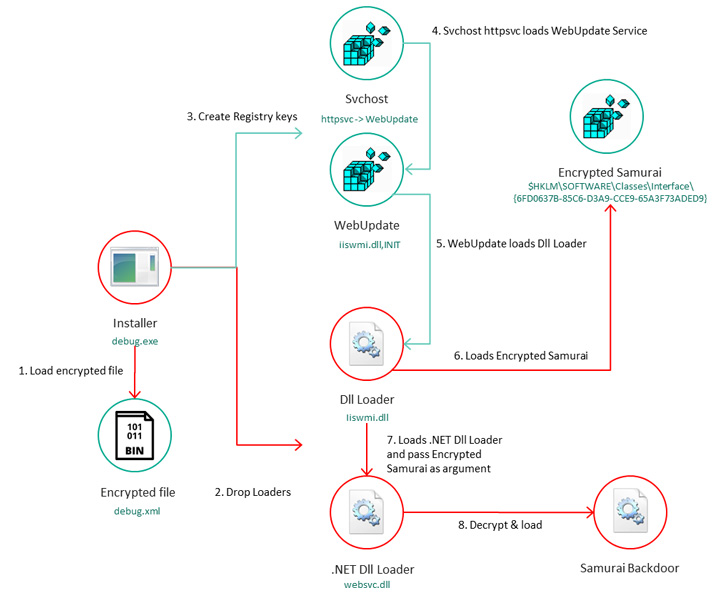
The attack sequence post the deployment of the China Chopper web
shell leads to the execution of a dropper that, in turn, is used to
make Windows Registry modifications to launch a second-stage
loader, which, for its part, is designed to trigger a third-stage
.NET loader that’s responsible for running Samurai.
The backdoor, besides using techniques like obfuscation and
control flow flattening to make it resistant to reverse
engineering, is modular in that it the components make it possible
to execute arbitrary commands and exfiltrate files of interest from
the compromised host.
Also observed in specific incidents is a sophisticated tool
named Ninja that’s spawned by the Samurai implant and likely
functions as a collaborative tool allowing multiple operators to
work on the same machine simultaneously.
Its feature similarities to other post-exploitation toolkits
like Cobalt Strike notwithstanding, the malware enables the
attacker to “control remote systems, avoid detection, and penetrate
deep inside a targeted network.”
Despite the fact that ToddyCat victims are related to countries
and sectors traditionally targeted by Chinese-speaking groups,
there is no evidence tying the modus operandi to a known threat
actor.
“ToddyCat is a sophisticated APT group that uses multiple
techniques to avoid detection and thereby keeps a low profile,”
Kaspersky security researcher Giampaolo Dedola said.
“The affected organizations, both governmental and military,
show that this group is focused on very high-profile targets and is
probably used to achieve critical goals, likely related to
geopolitical interests.”
References
- ^
said
(securelist.com) - ^
ProxyLogon Exchange flaws
(thehackernews.com)
Read more https://thehackernews.com/2022/06/new-toddycat-hacker-group-on-experts.html