A new academic study has highlighted a number of privacy and
security pitfalls associated with recycling mobile phone numbers
that could be abused to stage a variety of exploits, including
account takeovers, conduct phishing and spam attacks, and even
prevent victims from signing up for online services.
Nearly 66% of the recycled numbers that were sampled were found
to be tied to previous owners’ online accounts at popular websites,
potentially enabling account hijacks by simply recovering the
accounts tied to those numbers.
“An attacker can cycle through the available numbers shown on
online number change interfaces and check if any of them are
associated with online accounts of previous owners,” the
researchers said[1]. If so, the attacker can
then obtain these numbers and reset the password on the accounts,
and receive and correctly enter the OTP sent via SMS upon
login.”
The findings are part of an analysis of a sample of 259 phone
numbers available to new subscribers of U.S. telecom majors
T-Mobile and Verizon Wireless. The study was undertaken by
Princeton University’s Kevin Lee and Prof. Arvind Narayanan, who is
one of the executive committee members at the Center for
Information Technology Policy.
Phone number recycling refers to the standard practice of
reassigning disconnected phone numbers to other new subscribers of
the carrier. According to the Federal Communications Commission
(FCC), an estimated 35 million phone
numbers[2] are disconnected each
year in the U.S.
But this can also pose serious dangers when an attacker does a
reverse lookup by randomly entering such numbers in the online
interfaces offered by the two carriers, and upon encountering a
recycled number, buy them and successfully log in to the victim
account to which the number is linked.
At the heart of the attack, strategy is the lack of query limits
for available numbers imposed by the carriers on their prepaid
interfaces to change numbers, in addition to displaying “full
numbers, which gives an attacker the ability to discover recycled
numbers before confirming a number change.”
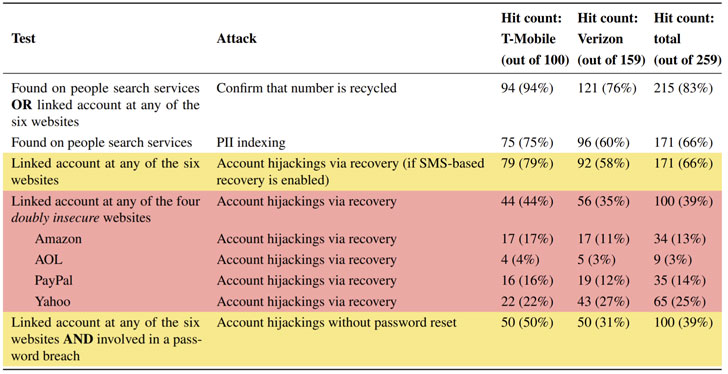
What’s more, 100 of the sampled phone numbers were identified as
associated with email addresses that had been involved in a data
breach in the past, thereby allowing account hijacks of a second
kind that circumvent SMS-based multi-factor authentication. In a
third attack, 171 of the 259 available numbers were listed on
people search services like BeenVerified, and in the process,
leaked sensitive personal information of prior owners.
“Once they obtain the previous owner’s number, they can perform
impersonation attacks to commit fraud or amass even more PII on
previous owners,” the researchers explained.
Beyond the aforementioned three reverse lookup attacks, five
additional threats enabled by phone number recycling target both
previous and future owners, permitting a malicious actor to
impersonate past owners, hijack the victims’ online phone account
and other linked online accounts, and worse, carry out
denial-of-service attacks.
“Attacker obtains a number, signs up for an online service that
requires a phone number, and releases the number,” the researchers
said. “When a victim obtains the number and tries to sign up for
the same service, they will be denied due to an existing account.
The attacker can contact the victim through SMS and demand payment
to free up the number on the platform.”
In response to the findings, T-Mobile said it has updated its
“Change your phone number[3]” support page with
information about reminding users to “update your contact number on
any accounts that may have your number saved, such as notifications
for bank accounts, social media, etc.” and specify the FCC-mandated number aging period[4] of 45 days to allow
reassignment of old numbers.
Verizon, likewise, has made similar revisions to its “Manage Verizon mobile service[5]” support page. But
neither of the carriers appear to have made any concrete changes
that make the attacks harder to pull off.
If anything, the study is another evidence of why SMS-based
authentication is a risky method, as the attacks outlined above
could allow an adversary to hijack an SMS 2FA-enabled account
without having to know the password.
“If you need to give up your number, unlink it from online
services first,” Narayanan said[6]
in a tweet. “Consider low-cost number ‘parking’ services. Use more
secure alternatives to SMS-2FA such as authenticator apps.”
References
- ^
said
(recyclednumbers.cs.princeton.edu) - ^
estimated 35 million phone numbers
(docs.fcc.gov) - ^
Change
your phone number (www.t-mobile.com) - ^
FCC-mandated number aging period
(docs.fcc.gov) - ^
Manage
Verizon mobile service (www.verizon.com) - ^
said
(twitter.com)