Chinese cyber espionage group APT41 has been linked to seemingly
disparate malware campaigns, according to fresh research that has
mapped together additional parts of the group’s network
infrastructure to hit upon a state-sponsored campaign that takes
advantage of COVID-themed phishing lures to target victims in
India.
“The image we uncovered was that of a state-sponsored campaign
that plays on people’s hopes for a swift end to the pandemic as a
lure to entrap its victims,” the BlackBerry Research and
Intelligence team said in a report[1]
shared with The Hacker News. “And once on a user’s machine, the
threat blends into the digital woodwork by using its own customized
profile to hide its network traffic.”
APT41 (aka Barium or Winnti) is a moniker assigned to a prolific
Chinese cyber threat group that carries out state-sponsored
espionage activity in conjunction with financially motivated
operations for personal gain as far back as 2012. Calling the group
“Double Dragon[2],” citing its twin
objectives, Mandiant (formerly FireEye) pointed out the
collective’s penchant for striking healthcare, high-tech, and
telecommunications sectors for establishing long-term access and
facilitating the theft of intellectual property.
In addition, the group is known for staging cybercrime
intrusions that are aimed at stealing source code and digital
certificates, virtual currency manipulation, and deploying
ransomware, as well as executing software supply chain compromises
by injecting malicious code into legitimate files prior to
distribution of software updates.
The latest research by BlackBerry builds on previous findings by
Mandiant in March 2020, which detailed a “global intrusion campaign[3]” unleashed by APT41 by
exploiting a number of publicly known vulnerabilities affecting
Cisco and Citrix devices to drop and execute next-stage payloads
that were subsequently used to download a Cobalt Strike Beacon
loader on compromised systems. The loader was notable for its use
of a malleable command-and-control (C2) profile that allowed the
Beacon to blend its network communications with a remote server
into legitimate traffic originating from the victim network.
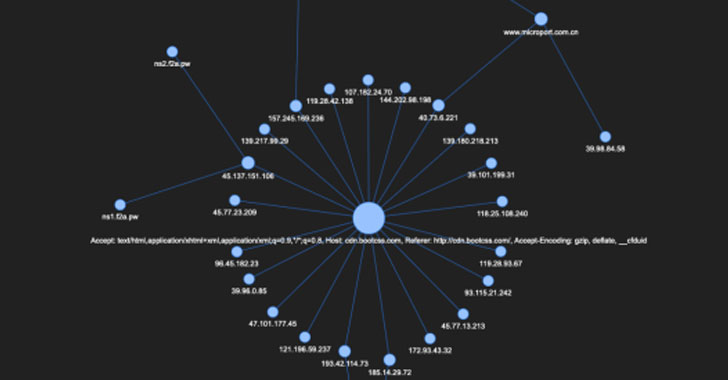
BlackBerry, which found a similar C2 profile[4]
uploaded to GitHub on March 29 by a Chinese security researcher
with the pseudonym “1135,” used the metadata configuration data to
identify a fresh cluster of domains related to APT41 that attempt
to masquerade Beacon traffic look like legitimate traffic from
Microsoft sites, with IP address and domain name overlaps found in
campaigns linked to the Higaisa APT group[5], and that of Winnti[6]
disclosed over the past year.
Subsequent investigation into the URLs revealed as many as three
malicious PDF files that reached out to one of the newly discovered
domains that had also previously hosted a Cobalt Strike Team
Server. What’s more, the documents themselves act as phishing lures
claiming to be COVID-19 advisories issued by the government of
India or contain information regarding the latest income tax
legislation targeting non-resident Indians.
The spear-phishing attachments appear in the form of .LNK files
or .ZIP archives, which, when opened, result in the PDF document
being displayed to the victim, while, in the background, the
infection chain leads to the execution of a Cobalt Strike Beacon.
Although a set of intrusions using similar phishing lures and
uncovered in September 2020[7] were pinned on the
Evilnum[8]
group, BlackBerry said the compromise indicators point to an
APT41-affiliated campaign.
“With the resources of a nation-state level threat group, it’s
possible to create a truly staggering level of diversity in their
infrastructure,” the researchers said, adding by piecing together
the malicious activities of the threat actor via public sharing of
information, it’s possible to “uncover the tracks that the
cybercriminals involved worked so hard to hide.”
References
- ^
report
(blogs.blackberry.com) - ^
Double
Dragon (www.mandiant.com) - ^
global
intrusion campaign (www.mandiant.com) - ^
similar
C2 profile (github.com) - ^
Higaisa
APT group (www.prevailion.com) - ^
Winnti
(thehackernews.com) - ^
uncovered in September 2020
(www.subexsecure.com) - ^
Evilnum
(thehackernews.com)