
A computer retail company based in the U.S. was the target of a
previously undiscovered implant called SideWalk as part of a
recent campaign undertaken by a Chinese advanced persistent threat
group primarily known for singling out entities in East and
Southeast Asia.
Slovak cybersecurity firm ESET attributed the malware to an
advanced persistent threat it tracks under the moniker
SparklingGoblin, an adversary believed to be connected to the
Winnti umbrella group, noting its similarities to another backdoor
dubbed Crosswalk[1]
that was put to use by the same threat actor in 2019.
“SideWalk is a modular backdoor that can dynamically load
additional modules sent from its C&C [command-and-control]
server, makes use of Google Docs as a dead drop resolver[2], and Cloudflare workers[3]
as a C&C server,” ESET researchers Thibaut Passilly and Mathieu
Tartare said[4]
in a report published Tuesday. “It can also properly handle
communication behind a proxy.”
Since first emerging on the threat landscape in 2019,
SparklingGoblin has been linked to several attacks aimed at Hong
Kong universities using backdoors such as Spyder and ShadowPad[5], the latter of which has
become a preferred malware of choice among multiple Chinese threat
clusters in recent years.
Over the past year, the collective has hit a broad range of
organizations and verticals around the world, with a particular
focus on the academic institutions located in Bahrain, Canada,
Georgia, India, Macao, Singapore, South Korea, Taiwan, and the U.S.
Other targeted entities include media companies, religious
organizations, e-commerce platforms, computer and electronics
manufacturers, and local governments.
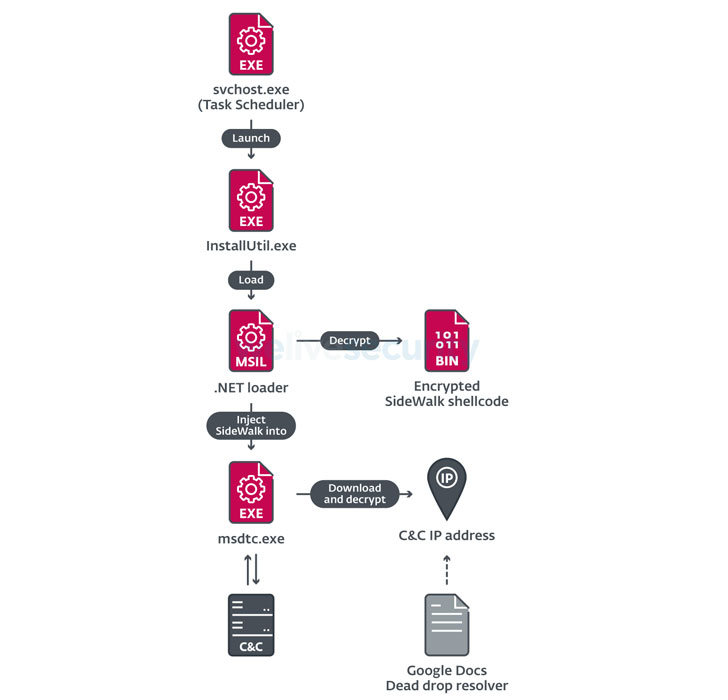
SideWalk is characterized as an encrypted shellcode, which is
deployed via a .NET loader that takes care of “reading the
encrypted shellcode from disk, decrypting it and injecting it into
a legitimate process using the process hollowing[6]
technique.” The next phase of the infection commences with SideWalk
establishing communications with the C&C server, with the
malware retrieving the encrypted IP address from a Google Docs
document.
“The decrypted IP address is 80.85.155[.]80. That C&C server
uses a self-signed certificate for the facebookint[.]com domain.
This domain has been attributed to BARIUM by Microsoft, which
partially overlaps with what we define as Winnti Group. As this IP
address is not the first one to be used by the malware, it is
considered to be the fallback one,” the researchers said.
Besides using HTTPS protocol for C&C communications,
SideWalk is designed to load arbitrary plugins sent from the
server, amass information about running processes, and exfiltrate
the results back to the remote server.
“SideWalk is a previously undocumented backdoor used by the
SparklingGoblin APT group. It was most likely produced by the same
developers as those behind CROSSWALK, with which it shares many
design structures and implementation details,” the researchers
concluded.
References
- ^
Crosswalk
(blogs.vmware.com) - ^
dead
drop resolver (attack.mitre.org) - ^
Cloudflare workers
(blog.cloudflare.com) - ^
said
(www.welivesecurity.com) - ^
ShadowPad
(thehackernews.com) - ^
process
hollowing (attack.mitre.org)