
Threat actors associated with the notorious Emotet malware are
continually shifting their tactics and command-and-control (C2)
infrastructure to escape detection, according to new research from
VMware.
Emotet[1]
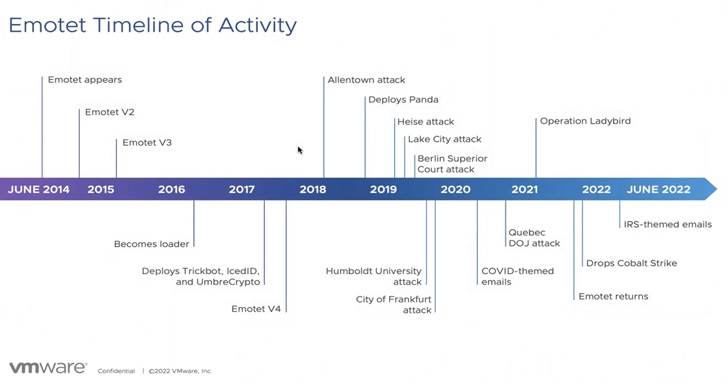
is the work of a threat actor tracked as Mummy Spider (aka TA542),
emerging in June 2014 as a banking trojan before morphing into an
all-purpose loader in 2016 that’s capable of delivering
second-stage payloads such as ransomware.
While the botnet’s infrastructure was taken down[2]
as part of a coordinated law enforcement operation in January 2021,
Emotet bounced back in November 2021 through another malware known
as TrickBot[3].
Emotet’s resurrection, orchestrated by the now-defunct Conti
team, has since paved the way for Cobalt Strike infections and,
more recently, ransomware attacks involving Quantum and BlackCat[4].
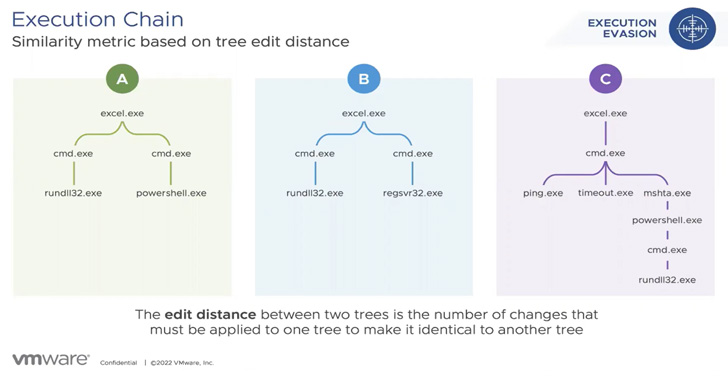
“The ongoing adaptation of Emotet’s execution chain is one
reason the malware has been successful for so long,” researchers
from VMware’s Threat Analysis Unit (TAU) said in a report shared
with The Hacker News.
Emotet attack flows are also characterized by the use of
different attack vectors in an attempt to stay covert for extended
periods of time.
These intrusions typically rely on waves of spam messages that
deliver malware-laced documents or embedded URLs, which, when
opened or clicked, lead to the deployment of the malware.
In January 2022 alone, VMware said it observed three different
sets of attacks in which the Emotet payload was delivered via an
Excel 4.0 (XL4) macro, an XL4 macro with PowerShell, and a Visual
Basic Application (VBA) macro with PowerShell.
Some of these infection lifecycles were also notable for the
abuse of a legitimate executable called mshta.exe[5]
to launch a malicious HTA file and then drop the Emotet
malware.
“Tools such as mshta and PowerShell, which are sometimes
referred to as living-off-the-land binaries (LOLBINs), are very
popular among threat actors because they are signed by Microsoft
and trusted by Windows,” the researchers said.
“This allows the attacker to perform a confused deputy attack,
in which legitimate tools are fooled into executing malicious
actions.”
Further analysis of nearly 25,000 unique Emotet DLL artifacts
shows that 26.7% of those were dropped by Excel documents. As many
as 139 distinctive program chains have been identified.
Emotet’s re-emergence has also been marked by a change in C2
infrastructure, with the threat actor operating two new botnet
clusters dubbed Epochs 4 and 5[6]. Prior to the takedown,
the Emotet operation ran atop three separate botnets referred to as
Epochs 1, 2, and 3[7].
On top of that, 10,235 Emotet payloads detected in the wild
between March 15, 2022, and June 18, 2022, reused C2 servers
belonging to Epoch 5.
The changes to both the execution chains and C2 IP addresses
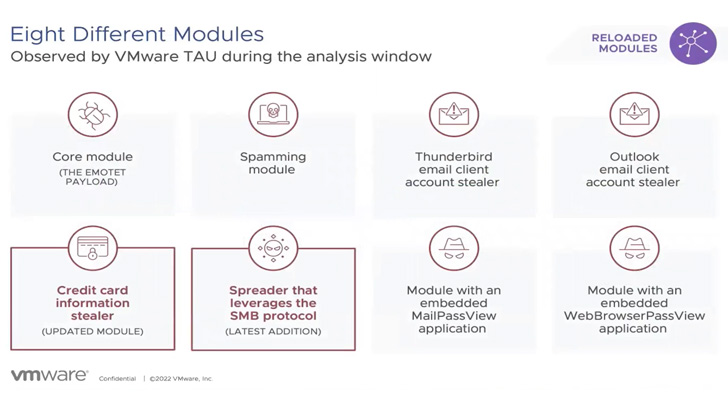
aside, Emotet has also been spotted distributing two new plugins,
one which is designed to capture credit card data from Google
Chrome browser, and a spreader module that uses the SMB protocol
for lateral movement.
Other significant components include a spamming module and
account stealers for Microsoft Outlook and Thunderbird email
clients.
A majority of the IP addresses used to host the servers were in
the U.S., Germany, and France. In contrast, most of the Emotet
modules were hosted in India, Korea, Thailand, Ghana, France, and
Singapore.
To protect against threats like Emotet, it’s recommended to
implement network segmentation, enforce a Zero Trust model, and
replace default authentication mechanisms in favor of stronger
alternatives.
References
- ^
Emotet
(www.cisa.gov) - ^
taken
down (thehackernews.com) - ^
TrickBot
(thehackernews.com) - ^
Quantum
and BlackCat (thehackernews.com) - ^
mshta.exe
(attack.mitre.org) - ^
Epochs 4
and 5 (unit42.paloaltonetworks.com) - ^
Epochs
1, 2, and 3 (heimdalsecurity.com)
Read more https://thehackernews.com/2022/10/new-report-uncovers-emotets-delivery.html