Industrial and government organizations, including enterprises
in the military-industrial complex and research laboratories, are
the targets of a new malware botnet dubbed
PseudoManyscrypt that has infected roughly 35,000
Windows computers this year alone.
The name comes from its similarities to the Manuscrypt[1]
malware[2], which is part of the
Lazarus[3]
APT group’s attack toolset, Kaspersky researchers said,
characterizing the operation as a “mass-scale spyware attack
campaign.” The Russian cybersecurity company said it first detected
the series of intrusions in June 2021.
At least 7.2% of all computers attacked by the malware are part
of industrial control systems (ICS) used by organizations in
engineering, building automation, energy, manufacturing,
construction, utilities, and water management sectors that are
located mainly in India, Vietnam, and Russia. Approximately a third
(29.4%) of non-ICS computers are situated in Russia (10.1%), India
(10%), and Brazil (9.3%).
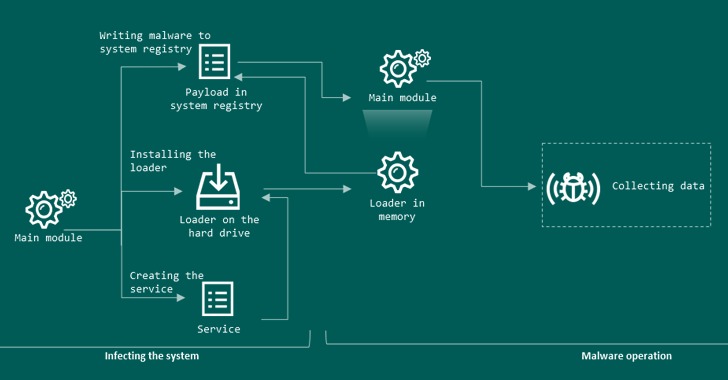
“The PseudoManuscrypt loader makes its way onto user systems via
a MaaS platform that distributes malware in pirated software
installer archives,” the Kaspersky ICS CERT team said[4]. “One specific case of
the PseudoManuscrypt downloader’s distribution is its installation
via the Glupteba botnet.”
Coincidentally, Glupteba’s operations have also taken a
significant hit when Google earlier this month disclosed[5]
that it acted to dismantle the botnet’s infrastructure and pursued
litigation against two Russian nationals, who are alleged to have
managed the malware along with 15 other unnamed individuals.
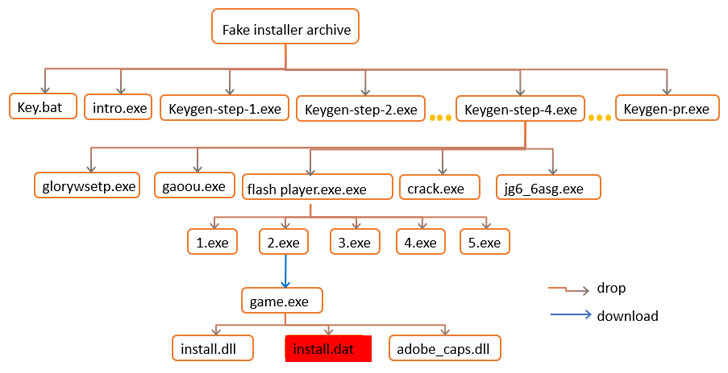
Among the cracked installers that are used to fuel the botnet
constitute Windows 10, Microsoft Office, Adobe Acrobat, Garmin,
Call of Duty, SolarWinds Engineer’s Toolset, and even Kaspersky’s
own antivirus solution. The pirated software installations are
driven by a method[6]
called search poisoning[7]
in which the attackers create malicious websites and use search
engine optimization (SEO) tactics to make them show up prominently
in search results.
Once installed, PseudoManuscrypt comes with an array of
intrusive capabilities that allows the attackers to full control of
the infected system. This consists of disabling antivirus
solutions, stealing VPN connection data, logging keystrokes,
recording audio, capturing screenshots and videos of the screen,
and intercepting data stored in the clipboard.
Kaspersky noted it has identified 100 different versions of the
PseudoManuscrypt loader, with the earliest test variants dating
back to March 27, 2021. Components of the trojan have been borrowed
from commodity malware like Fabookie[8]
and a KCP protocol library employed by the China-based APT41[9]
group.
The malware samples analyzed by the ICS CERT also featured
comments written in Chinese and were found specifying Chinese as
the preferred language, but these clues alone have been
inconclusive to make an assessment about the malware’s operators or
their origins. Also unclear are the ultimate goals of the campaign,
raising questions as to whether the attacks are financially
motivated or state-backed.
“The large number of engineering computers attacked, including
systems used for 3D and physical modeling, the development and use
of digital twins raises the issue of industrial espionage as one of
the possible objectives of the campaign,” the researchers said.
References
- ^
Manuscrypt
(malpedia.caad.fkie.fraunhofer.de) - ^
malware
(malpedia.caad.fkie.fraunhofer.de) - ^
Lazarus
(thehackernews.com) - ^
said
(securelist.com) - ^
disclosed
(thehackernews.com) - ^
method
(www.zscaler.com) - ^
search
poisoning (www.menlosecurity.com) - ^
Fabookie
(www.microsoft.com) - ^
APT41
(www.mandiant.com)
Read more https://thehackernews.com/2021/12/new-pseudomanuscrypt-malware-infected.html