
A new ransomware campaign targeted the transportation and
logistics sectors in Ukraine and Poland on October 11 with a
previously unknown payload dubbed Prestige.
“The activity shares victimology with recent Russian
state-aligned activity, specifically on affected geographies and
countries, and overlaps with previous victims of the FoxBlade[1]
malware (also known as HermeticWiper),” the Microsoft Threat
Intelligence Center (MSTIC) said[2].
The tech giant remarked the intrusions occurred within an hour
of each other across all victims, attributing the infections to an
unnamed cluster called DEV-0960. It did not disclose the scale of
the attacks, but stated it’s notifying all affected customers.
The campaign is also believed to be distinct from other recent
destructive attacks that have involved the use of HermeticWiper[3]
and CaddyWiper[4], the latter of which is
launched by a malware loader called ArguePatch[5]
(aka AprilAxe).
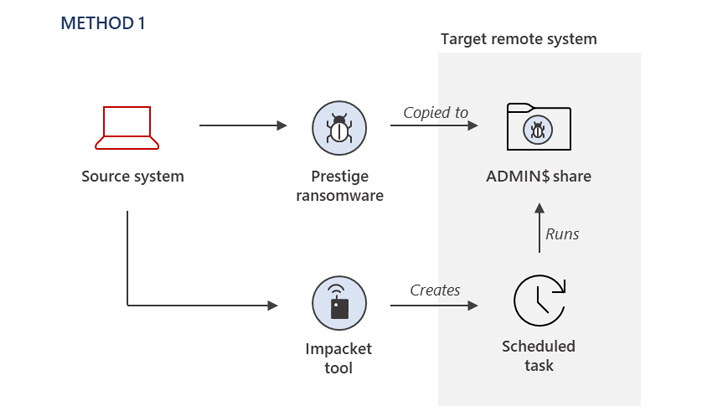
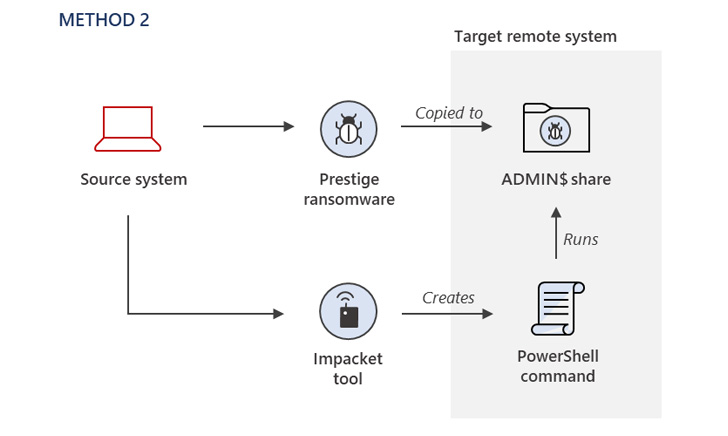
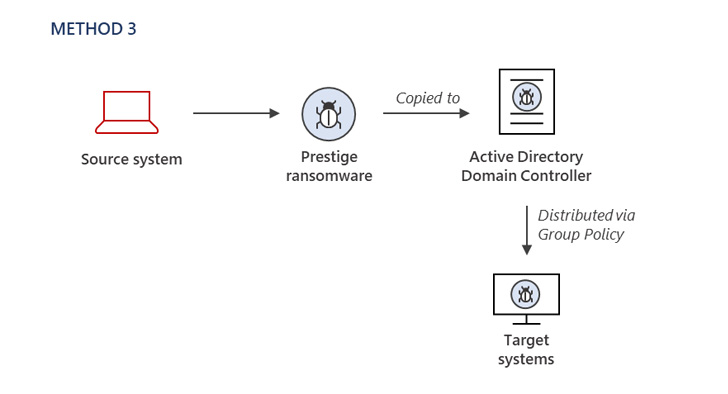
The method of initial access remains unknown, with Microsoft
noting that the threat actor had already obtained privileged access
to the compromised environment to deploy the ransomware using three
different methods.
In a related development, Fortinet FortiGuard Labs took the
wraps off a multi-stage attack chain[6] that leverages a
weaponized Microsoft Excel document, which masquerades as a
spreadsheet for generating salaries for Ukrainian military
personnel to drop Cobalt Strike Beacon.
“The threat landscape in Ukraine continues to evolve, and wipers
and destructive attacks have been a consistent theme,” Redmond
noted. “Ransomware and wiper attacks rely on many of the same
security weaknesses to succeed.”
The findings come amid an explosion of relatively new ransomware
strains that have been gaining traction on the threat landscape,
including that of Bisamware, Chile Locker[7], Royal[8], and Ransom Cartel[9], over the past few
months.
Ransom Cartel, which surfaced in mid-December 2021, is also
notable for sharing technical overlaps with REvil ransomware[10], which shut shop in
October 2021 following immense law enforcement scrutiny into its
operations after a string of high-profile attacks on JBS and
Kaseya.
It’s suspected that “Ransom Cartel operators had access to
earlier versions of REvil ransomware source code,” Palo Alto
Networks Unit 42 observed[11] on October 14, stating
that “there was a relationship between the groups at some point,
though it may not have been recent.”
REvil, earlier this January, suffered further setback[12] when Russian
authorities arrested multiple members, but there are indications
that the notorious cybercrime cartel may have staged a return[13] in some form.
Cybersecurity firm Trellix, in late September, also revealed[14] how a “disgruntled
internal source” from the group shared details about the
adversary’s Tactics, Techniques and Procedures (TTPs), lending a
crucial insight into the “relationships and inner workings of REvil
and its members.”
It’s not just REvil that’s back on the ransomware radar. HP Wolf
Security last week said[15] it isolated a Magniber campaign[16] that has been found
targeting Windows home users with fake security updates which
employ a JavaScript file to proliferate the file-encrypting
malware.
“The attackers used clever techniques to evade protection and
detection mechanisms,” malware analyst Patrick Schläpfer pointed
out. “Most of the infection chain is ‘fileless,’ meaning the
malware only resides in memory, reducing the chances of it being
detected.”
References
- ^
FoxBlade
(thehackernews.com) - ^
said
(www.microsoft.com) - ^
HermeticWiper
(thehackernews.com) - ^
CaddyWiper
(thehackernews.com) - ^
ArguePatch
(www.welivesecurity.com) - ^
multi-stage attack chain
(www.fortinet.com) - ^
Bisamware, Chile Locker
(www.fortinet.com) - ^
Royal
(www.fortinet.com) - ^
Ransom
Cartel (unit42.paloaltonetworks.com) - ^
REvil
ransomware (thehackernews.com) - ^
observed
(unit42.paloaltonetworks.com) - ^
further setback
(thehackernews.com) - ^
staged
a return (thehackernews.com) - ^
revealed
(www.trellix.com) - ^
said
(threatresearch.ext.hp.com) - ^
Magniber campaign
(www.crowdstrike.com)
Read more https://thehackernews.com/2022/10/new-prestige-ransomware-targeting.html