E-commerce platforms in the U.S., Germany, and France have come
under attack from a new form of malware that targets Nginx servers
in an attempt to masquerade its presence and slip past detection by
security solutions.
“This novel code injects itself into a host Nginx application
and is nearly invisible,” Sansec Threat Research team said[1] in a new report. “The
parasite is used to steal data from eCommerce servers, also known
as ‘server-side Magecart.'”
A free and open-source software, Nginx is a web server that can
also be used as a reverse proxy, load balancer, mail proxy, and
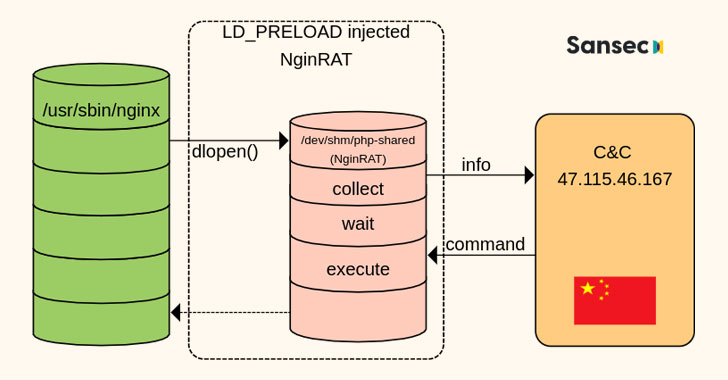
HTTP cache. NginRAT, as the advanced malware is called, works by
hijacking a host Nginx application to embed itself into the
webserver process.
The remote access trojan itself is delivered via CronRAT[2], another piece of
malware the Dutch cybersecurity firm disclosed last week as hiding
its malicious payloads in cron jobs scheduled to execute on
February 31st, a non-existent calendar day.
Both CronRAT and NginRAT are designed to provide a remote way
into the compromised servers, and the goal of the intrusions is to
make server-side modifications to the compromised e-commerce
websites in a manner that enable the adversaries to exfiltrate data
by skimming online payment forms.

The attacks, collectively known as Magecart[3] or web skimming[4], are the work of a
cybercrime syndicate comprised of dozens of subgroups that are
involved in digital credit card theft by exploiting software
vulnerabilities to gain access to an online portal’s source code
and insert malicious JavaScript code that siphons the data shoppers
enter into checkout pages.
“Skimmer groups are growing rapidly and targeting various
e-commerce platforms using a variety of ways to remain undetected,”
Zscaler researchers noted[5]
in an analysis of the latest Magecart trends published earlier this
year.
“The latest techniques include compromising vulnerable versions
of e-commerce platforms, hosting skimmer scripts on CDNs[6]
and cloud services, and using newly registered domains (NRDs)
lexically close to any legitimate web service or specific
e-commerce store to host malicious skimmer scripts.”
References
Read more https://thehackernews.com/2021/12/new-payment-data-sealing-malware-hides.html