
A number of rogue Android apps that have been cumulatively
installed from the official Google Play Store more than 50,000
times are being used to target banks and other financial
entities.
The rental banking trojan, dubbed Octo, is said
to be a rebrand of another Android malware called ExobotCompact,
which, in turn, is a “lite” replacement for its Exobot predecessor,
Dutch mobile security firm ThreatFabric said[1]
in a report shared with The Hacker News.
Exobot is also likely said to have paved the way for a separate
descendant called Coper, that was initially discovered[2]
targeting Colombian users around July 2021, with newer infections
targeting Android users in different European Countries.
“Coper malware apps are modular in design and include a
multi-stage infection method and many defensive tactics to survive
removal attempts,” Cybersecurity company Cyble noted[3]
in an analysis of the malware last month.
Like other Android banking trojans, the rogue apps are nothing
more than droppers, whose primary function is to deploy the
malicious payload embedded within them. The list of Octo and Coper
droppers used by multiple threat actors is below –
- Pocket Screencaster (com.moh.screen)
- Fast Cleaner 2021 (vizeeva.fast.cleaner)
- Play Store (com.restthe71)
- Postbank Security (com.carbuildz)
- Pocket Screencaster (com.cutthousandjs)
- BAWAG PSK Security (com.frontwonder2), and
- Play Store app install (com.theseeye5)
These apps, which pose as Play Store app installer, screen
recording, and financial apps, are “powered by inventive
distribution schemes,” distributing them through the Google Play
store and via fraudulent landing pages that purportedly alert users
to download a browser update.
The droppers, once installed, act as a conduit to launch the
trojans, but not before requesting users to enable the Accessibility Services[4]
that allow it a wide breadth of capabilities to exfiltrate
sensitive information from the compromised phones.
Octo, the revised version of ExobotCompact, is also equipped to
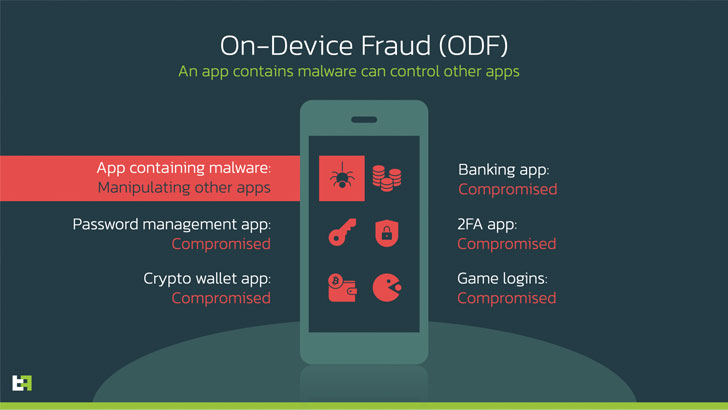
perform on-device fraud by gaining remote control over the devices
by taking advantage of the accessibility permissions as well as
Android’s MediaProjection API[5]
to capture screen contents in real-time.
The ultimate goal, ThreatFabric said, is to trigger the
“automatic initiation of fraudulent transactions and its
authorization without manual efforts from the operator, thus
allowing fraud on a significantly larger scale.”
Other notable features of Octo include logging keystrokes,
carrying out overlay attacks on banking apps to capture
credentials, harvesting contact information, and persistence
measures to prevent uninstallation and evade antivirus engines.
“Rebranding to Octo erases previous ties to the Exobot source
code leak, inviting multiple threat actors looking for opportunity
to rent an allegedly new and original trojan,” ThreatFabric
noted.
“Its capabilities put at risk not only explicitly targeted
applications that are targeted by overlay attack, but any
application installed on the infected device as ExobotCompact/Octo
is able to read content of any app displayed on the screen and
provide the actor with sufficient information to remotely interact
with it and perform on-device fraud (ODF).”
The findings come close on the heels of the discovery of a
separate Android bankbot named GodFather[6]
— sharing overlaps with the Cereberus and Medusa banking trojans —
that has been observed targeting banking users in Europe under the
guise of the default Settings app to transfer funds and steal SMS
messages, among others.
On top of that, a new analysis[7]
published by AppCensus found 11 apps with more than 46 million
installations that were implanted with a third-party SDK named
Coelib that made it possible to capture clipboard content, GPS
data, email addresses, phone numbers, and even the user’s modem
router MAC address and network SSID.
References
- ^
said
(threatfabric.com) - ^
discovered
(news.drweb.com) - ^
noted
(blog.cyble.com) - ^
Accessibility Services
(thehackernews.com) - ^
MediaProjection API
(developer.android.com) - ^
GodFather
(blog.cyble.com) - ^
new
analysis (blog.appcensus.io)
Read more https://thehackernews.com/2022/04/new-octo-banking-trojan-spreading-via.html