
Cybersecurity researchers on Thursday revealed details about a
new Mirai-inspired botnet called “mirai_ptea” that leverages an
undisclosed vulnerability in digital video recorders (DVR) provided
by KGUARD to propagate and carry out distributed denial-of-service
(DDoS) attacks.
Chinese security firm Netlab 360 pinned[1]
the first probe against the flaw on March 23, 2021, before it
detected active exploitation attempts by the botnet on June 22,
2021.
The Mirai botnet, since emerging on the scene[2]
in 2016, has been linked to a string of large-scale DDoS attacks,
including one against DNS service provider Dyn[3] in October 2016, causing
major internet platforms and services to remain inaccessible to
users in Europe and North America.
Since then, numerous[4]
variants[5]
of Mirai[6]
have sprung up[7]
on the scene, in part due to the availability of its source code on
the Internet. Mirai_ptea is no exception.
Not much has been disclosed about the security flaw in an
attempt to prevent further exploitation, but the researchers said
the KGUARD DVR[8]
firmware had vulnerable code prior to 2017 that enabled remote
execution of system commands without authentication. At least
approximately 3,000 devices exposed online are susceptible to the
vulnerability.
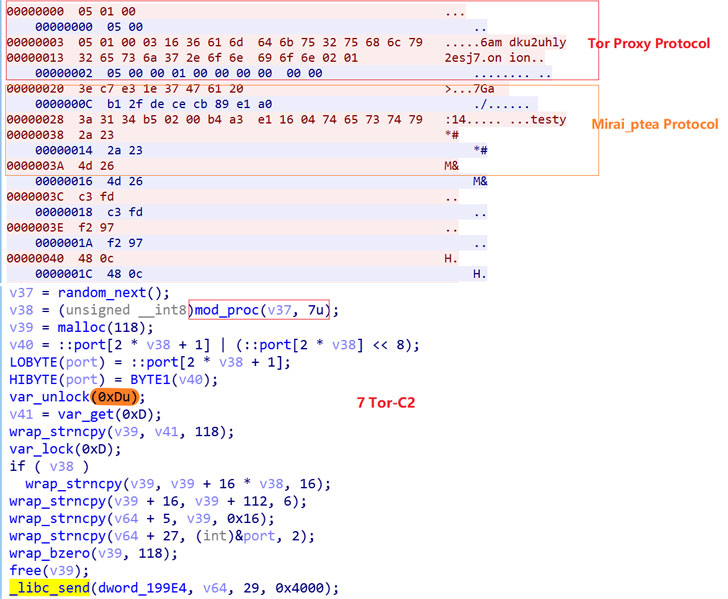
Besides using Tor Proxy to communicate with the
command-and-control (C2) server, an analysis of the mirai_ptea
sample revealed extensive encryption of all sensitive resource
information, which is decoded to establish a connection with the C2
server and retrieve attack commands for execution, including
launching DDoS attacks.
“The geographic distribution of bot source IPs is […] mainly
concentrated in the United States, Korea and Brazil,” the
researchers noted, with infections reported across Europe, Asia,
Australia, North and South America, and parts of Africa.
References
Read more http://feedproxy.google.com/~r/TheHackersNews/~3/GNF24HKcybw/new-mirai-inspired-botnet-could-be.html