A series of malicious campaigns have been leveraging fake
installers of popular apps and games such as Viber, WeChat,
NoxPlayer, and Battlefield as a lure to trick users into
downloading a new backdoor and an undocumented malicious Google
Chrome extension with the goal of stealing credentials and data
stored in the compromised systems as well as maintaining persistent
remote access.
Cisco Talos attributed the malware payloads to an unknown actor
that goes by the alias “magnat[1],” noting that “these two
families have been subject to constant development and improvement
by their authors.”
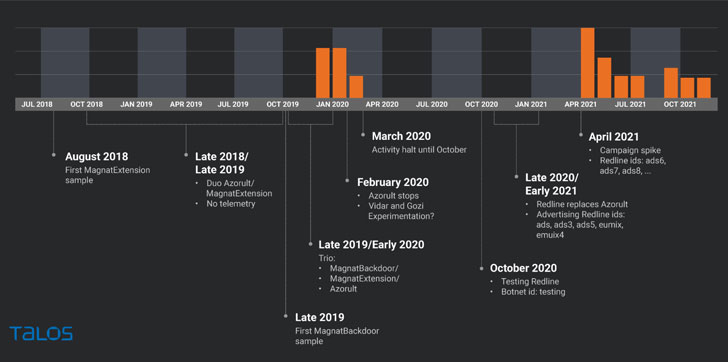
The attacks are believed to have commenced in late 2018, with
intermittent activity observed towards the end of 2019 and through
early 2020, followed by fresh spikes since April 2021, while mainly
singling out users in Canada, followed by the U.S., Australia,
Italy, Spain, and Norway.
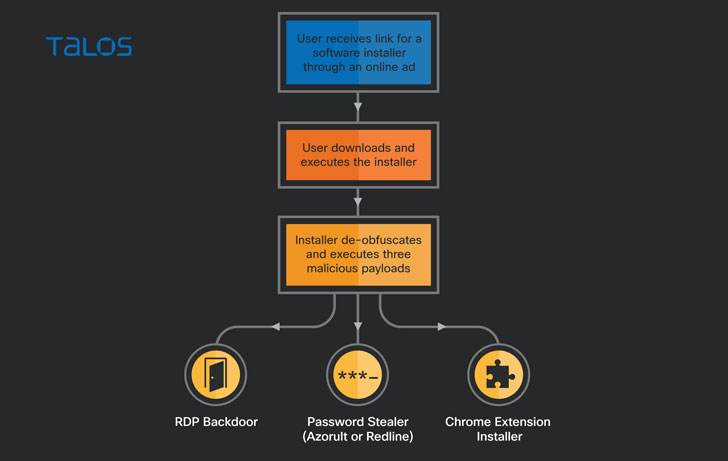
A noteworthy aspect of the intrusions is the use of malvertising
as a means to strike individuals who are looking for popular
software on search engines to present them links to download fake
installers that drop a password stealer called RedLine Stealer[2], a Chrome extension
dubbed “MagnatExtension” that’s programmed to record keystrokes and
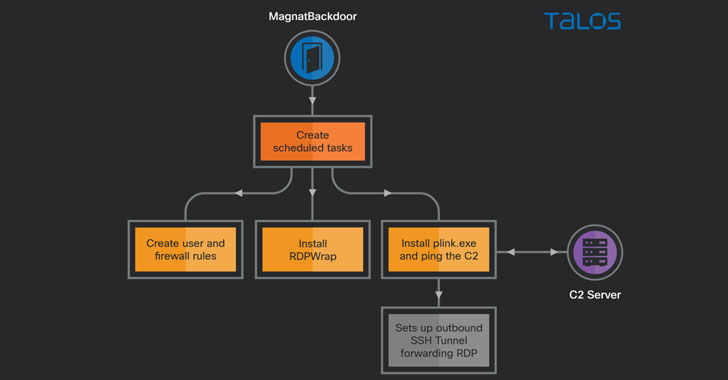
capture screenshots, and an AutoIt[3]-based backdoor that
establishes remote access to the machine.
MagnatExtension, which masquerades as Google’s Safe browsing[4], also packs other
features that are of use to the attackers, including the ability to
steal form data, harvest cookies, and execute arbitrary JavaScript
code. Telemetry data analyzed by Talos has revealed that the
first-ever sample of the browser add-on was detected in August
2018.
The extension’s command-and-control (C2) communications stand
out as well. While the C2 address is hard-coded, it can also be
updated by the current C2 with a list of additional C2 domains. But
in the event of failure, it falls back to an alternate method that
involves obtaining a new C2 address from a Twitter search for
hashtags like “#aquamamba2019” or “#ololo2019.”
The domain name is then constructed from the accompanying tweet
text by concatenating the first letter of each word, meaning
“Squishy turbulent areas terminate active round engines after dank
years. Industrial creepy units” becomes “stataready[.]icu.” Once an
active C2 server is available, the vacuumed data is exfiltrated in
the form of an encrypted JSON string in the body of an HTTP POST
request, the encryption key to which is hard-coded in the
decryption function.
“Based on the use of password stealers and a Chrome extension
that is similar to a banking trojan, we assess that the attacker’s
goals are to obtain user credentials, possibly for sale or for his
own use in further exploitation,” Cisco Talos researcher Tiago
Pereira said.
“The motive for the deployment of an RDP backdoor is unclear.
The most likely are the sale of RDP access, the use of RDP to work
around online service security features based on IP address or
other endpoint installed tools or the use of RDP for further
exploitation on systems that appear interesting to the
attacker.”
References
- ^
magnat
(blog.talosintelligence.com) - ^
RedLine
Stealer (malpedia.caad.fkie.fraunhofer.de) - ^
AutoIt
(en.wikipedia.org) - ^
Safe browsing
(safebrowsing.google.com)
Read more https://thehackernews.com/2021/12/new-malvertising-campaigns-spreading.html