University Abu Dhabi have uncovered security flaws in 4G LTE and 5G
networks that could potentially allow hackers to impersonate users
on the network and even sign up for paid subscriptions on their
behalf.
The impersonation attack — named “IMPersonation Attacks in 4G
NeTworks” (or IMP4GT[1]) — exploits the mutual
authentication method used by the mobile phone and the network’s
base station to verify their respective identities to manipulate
data packets in transit.
“The IMP4GT attacks exploit the missing integrity protection for
user data, and a reflection mechanism of the IP stack mobile
operating system. We can make use of the reflection mechanism to
build an encryption and decryption oracle. Along with the lack of
integrity protection, this allows to inject arbitrary packets and
to decrypt packets,” the researchers explained.
The research was presented at the Network Distributed System
Security Symposium (NDSS) on February 25 in San Diego.
The vulnerability impacts all devices that communicate with LTE,
which includes all smartphones, tablets, and IoT devices currently
being sold in the market.
“The Bochum-based team is attempting to close the security gap in
the latest mobile communication standard 5G, which is currently
rolled out,” the researchers said. The flaws were responsibly
disclosed to the telecom standards body GSM Association last May.
How does the IMP4GT attack work?
The researchers carried out the attacks using software-defined
radios, which are devices that can read messages between a
phone and the base station it’s connected to. The man-in-the-middle
attack, then, allows a hacker to impersonate a user towards the
network and vice versa.
In other words, the attacker tricks the network into thinking
the radio was, in fact, the phone (uplink impersonation), and also
dupes the phone into assuming that the software-defined radio is
the legitimate cell tower (downlink impersonation).
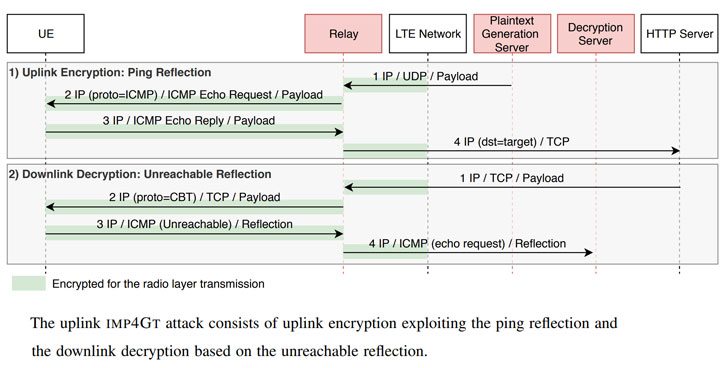
arbitrary IP connection towards the Internet, e. g., a TCP
connection to an HTTP server. With the downlink variant, the
attacker can build a TCP connection to the UE,” the researchers
said.
It’s to be noted that the adversary must be in close proximity —
in the range of 2km — to the victim’s mobile phone to mount the
IMP4GT attack. As a consequence, these attacks are no different
from those that involve cell-site simulators such as IMSI
catchers[4] (aka stingrays) that are
used by law enforcement agencies to intercept mobile phone
traffic.
Once this communication channel is compromised, the next stage
of the attack works by taking advantage of the missing integrity
protection in the LTE communication standard to arbitrarily modify
the data packets that are being exchanged.
By forging the internet traffic, the attack could allow a hacker to
make unauthorized purchases, access illegal websites, upload
sensitive documents using the victim’s identity, and even redirect
the user to a malicious site, a different form of attack called
“aLTEr attack.”
“This attack has far-reaching consequences for providers and
users,” the researchers said in the paper. “Providers can no longer
assume that an IP connection originates from the user. Billing
mechanisms can be triggered by an adversary, causing the exhaustion
of data limits, and any access control or the providers’ firewall
can be bypassed.”
Moreover, “by doing so, we show that an attacker can bypass the
provider’s firewall mechanism, and the phone is open to any
incoming connection. Such an attack is a stepping stone for further
attacks, such as malware deployment.”
What’s the solution?
The disclosure of the IMP4GT attack comes on the heels of similar research
undertaken by academics at Purdue University and the University
of Iowa, which uncovered three new security flaws in 4G and 5G
networks that can be used to eavesdrop on phone calls and track the
locations of cell phone users.
The incoming 5G standard, which is being rolled out in a handful
of countries, aims to offer faster speeds and long-needed security
features, including protection from
IMSI catchers[7]. But with hundreds of
millions impacted by these flaws, it’s imperative that 5G
implementations apply more robust security and data protection to
fix the vulnerabilities.
“Mobile network operators would have to accept higher costs, as
the additional protection generates more data during the
transmission,” David Rupprecht, one of the paper’s co-authors,
said. “In addition, all mobile phones would have to be replaced,
and the base station expanded. That is something that will not
happen in the near future.”
While the scrutiny of the 5G standard has made it possible to
catch and fix potential vulnerabilities before the 5G networks are
widely deployed, the latest research is a sign that cellular
network security needs further attention.
References
- ^
IMP4GT
(imp4gt-attacks.net) - ^
software-defined radios
(en.wikipedia.org) - ^
researchers said
(news.rub.de) - ^
IMSI catchers
(thehackernews.com) - ^
aLTEr attack
(thehackernews.com) - ^
similar research undertaken
(homepage.divms.uiowa.edu) - ^
protection from IMSI catchers
(infosec.sintef.no)
Read more http://feedproxy.google.com/~r/TheHackersNews/~3/gFyKpIR9-o4/lte-network-4g-vulnerability.html