A week after the US government issued an advisory about a
“global intelligence gathering mission” operated by North Korean
state-sponsored hackers[1], new findings have
emerged about the threat group’s spyware capabilities.
The APT — dubbed “Kimsuky[2]” (aka Black Banshee or
Thallium) and believed to be active as early as 2012 — has been now
linked to as many as three hitherto undocumented malware, including
an information stealer, a tool equipped with malware anti-analysis
features, and a new server infrastructure with significant overlaps
to its older espionage framework.
“The group has a rich and notorious history of offensive cyber
operations around the world, including operations targeting South
Korean think tanks, but over the past few years they have expanded
their targeting to countries including the United States, Russia
and various nations in Europe,” Cybereason researchers said in an
analysis[3]
yesterday.
Last week, the FBI and departments of Defense and Homeland
Security jointly released[4]
a memo detailing Kimsuky’s tactics, techniques, and procedures
(TTPs[5]).
Leveraging spear-phishing and social engineering tricks to gain
the initial access into victim networks, the APT has been known to
specifically target individuals identified as experts in various
fields, think tanks, the cryptocurrency industry, and South Korean
government entities, in addition to posing as journalists from
South Korea to send emails embedded with BabyShark[6]
malware.
In recent months, Kimsuky has been attributed to a number of
campaigns using coronavirus-themed email lures[7] containing weaponized
Word documents as their infection vector to gain a foothold on
victim machines and launch malware attacks.
“Kimsuky focuses its intelligence collection activities on
foreign policy and national security issues related to the Korean
peninsula, nuclear policy, and sanctions,” the Cybersecurity and
Infrastructure Security Agency (CISA) said.
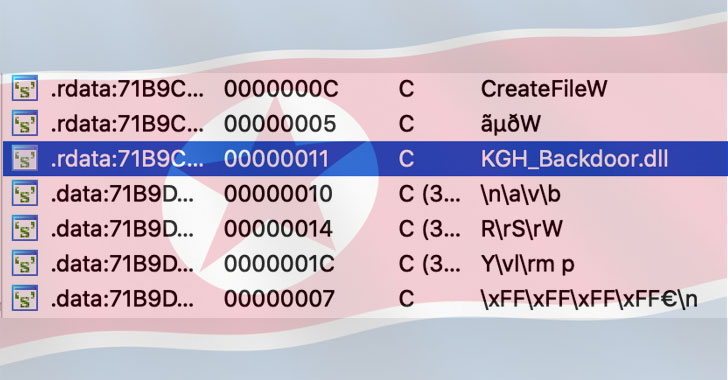
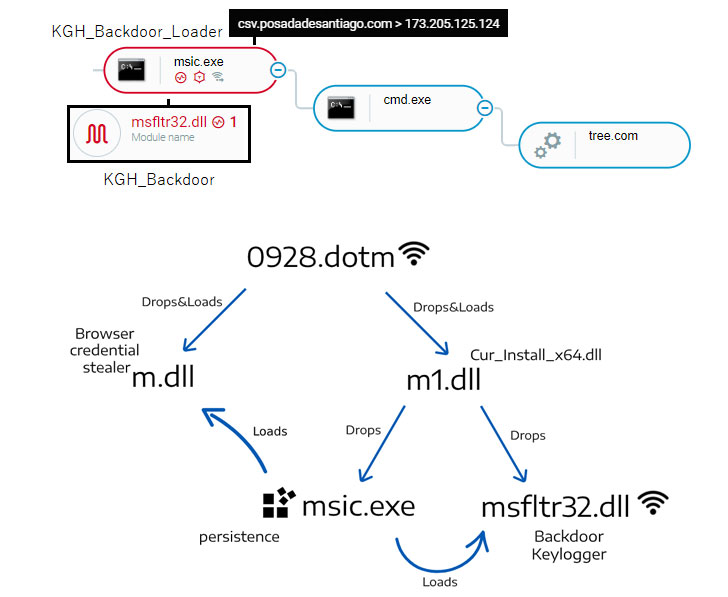
Now according to Cybereason, the threat actor has acquired new
capabilities via a modular spyware suite called “KGH_SPY,” allowing
it to carry out reconnaissance of target networks, capture
keystrokes, and steal sensitive information.
Besides this, the KGH_SPY backdoor can download secondary
payloads from a command-and-control (C2) server, execute arbitrary
commands via cmd.exe or PowerShell, and even harvest credentials
from web browsers, Windows Credential Manager, WINSCP and mail
clients.
Also of note is the discovery of a new malware named “CSPY
Downloader” that’s designed to thwart analysis and download
additional payloads.
Lastly, Cybereason researchers unearthed a new toolset
infrastructure registered between 2019-2020 that overlaps with the
group’s BabyShark malware used to previously target US-based think tanks[8].
“The threat actors invested efforts in order to remain under the
radar, by employing various anti-forensics and anti-analysis
techniques which included backdating the creation/compilation time
of the malware samples to 2016, code obfuscation, anti-VM and
anti-debugging techniques,” the researchers said.
“While the identity of the victims of this campaign remains
unclear, there are clues that can suggest that the infrastructure
targeted organizations dealing with human rights violations.”
References
- ^
state-sponsored hackers
(us-cert.cisa.gov) - ^
Kimsuky
(malpedia.caad.fkie.fraunhofer.de) - ^
analysis
(www.cybereason.com) - ^
jointly
released (us-cert.cisa.gov) - ^
TTPs
(attack.mitre.org) - ^
BabyShark
(malpedia.caad.fkie.fraunhofer.de) - ^
coronavirus-themed email lures
(blog.malwarebytes.com) - ^
US-based
think tanks (unit42.paloaltonetworks.com)
