Jan 16, 2023Ravie Lakshmanan
Unidentified threat actors have deployed a new backdoor that
borrows its features from the U.S. Central Intelligence Agency
(CIA)’s Hive[1]
multi-platform malware suite[2], the source code of
which was released[3]
by WikiLeaks in November 2017.
“This is the first time we caught a variant of the CIA Hive
attack kit in the wild, and we named it xdr33
based on its embedded Bot-side certificate CN=xdr33,” Qihoo Netlab
360’s Alex Turing and Hui Wang said[4]
in a technical write-up published last week.
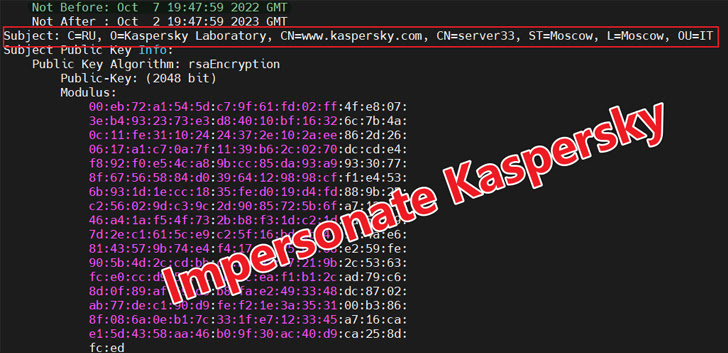
xdr33 is said to be propagated by exploiting a security
vulnerability in the F5 appliance and communicating with a
command-and-control (C2) server using SSL with forged Kaspersky
certificates.
The intent of the backdoor, per the Chinese cybersecurity firm,
is to harvest sensitive information and act as a launchpad for
subsequent intrusions. It improves upon Hive by adding new C2
instructions and functionalities, among other implementation
changes.
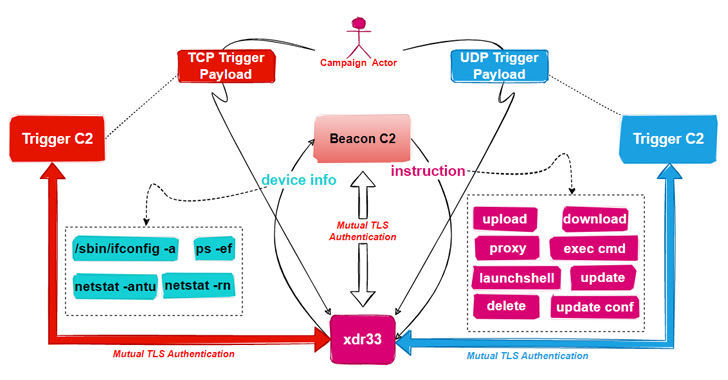
The ELF[5]
sample further operates as a Beacon by periodically exfiltrating
system metadata to the remote server and executing commands issued
by the C2.

This includes the ability to download and upload arbitrary
files, run commands using cmd, and launch shell, in addition to
updating and erasing traces of itself from the compromised
host.
The malware also incorporates a Trigger module that’s designed
to eavesdrop on network traffic for a specific “trigger” packet in
order to extract the C2 server mentioned in the IP packet’s
payload, establish connection, and wait for the execution of
commands issued by the C2.
“It is worth noting that Trigger C2 differs from Beacon C2 in
the details of communication; after establishing an SSL tunnel,
[the] bot and Trigger C2 use a Diffie-Helllman key exchange[6] to establish a shared
key, which is used in the AES algorithm to create a second layer of
encryption,” the researchers explained.
Found this article interesting? Follow us on Twitter [7]
and LinkedIn[8]
to read more exclusive content we post.
References
Read more https://thehackernews.com/2023/01/new-backdoor-created-using-leaked-cias.html