
A previously undocumented backdoor has been observed targeting
Linux systems with the goal of corralling the machines into a
botnet and acting as a conduit for downloading and installing
rootkits.
Qihoo 360’s Netlab security team called it B1txor20[1] “based on its
propagation using the file name ‘b1t,’ the XOR encryption
algorithm, and the RC4 algorithm key length of 20 bytes.”
First observed propagating through the Log4j vulnerability[2]
on February 9, 2022, the malware leverages a technique called DNS
tunneling to build communication channels with command-and-control
(C2) servers by encoding data in DNS queries and responses.
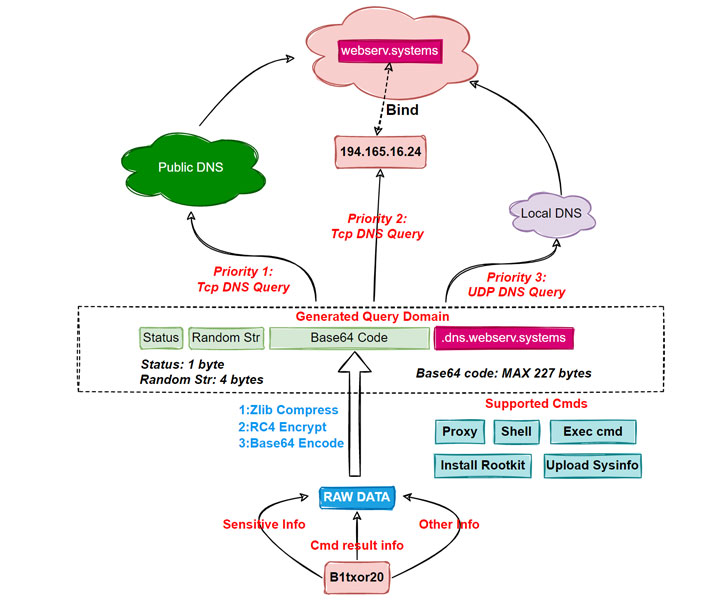
B1txor20, while also buggy in some ways, currently supports the
ability to obtain a shell, execute arbitrary commands, install a
rootkit, open a SOCKS5 proxy[3], and functions to upload
sensitive information back to the C2 server.
Once a machine is successfully compromised, the malware utilizes
the DNS tunnel to retrieve and execute commands sent by the
server.
“Bot sends the stolen sensitive information, command execution
results, and any other information that needs to be delivered,
after hiding it using specific encoding techniques, to C2 as a DNS
request,” the researchers elaborated.
“After receiving the request, C2 sends the payload to the Bot
side as a response to the DNS request. In this way, Bot and C2
achieve communication with the help of DNS protocol.”
A total of 15 commands are implemented, chief among them being
uploading system information, executing arbitrary system commands,
reading and writing files, starting and stopping proxy services,
and creating reverse shells.
References
- ^
B1txor20
(blog.netlab.360.com) - ^
Log4j
vulnerability (thehackernews.com) - ^
SOCKS5
proxy (en.wikipedia.org)
Read more https://thehackernews.com/2022/03/new-b1txor20-linux-botnet-uses-dns.html