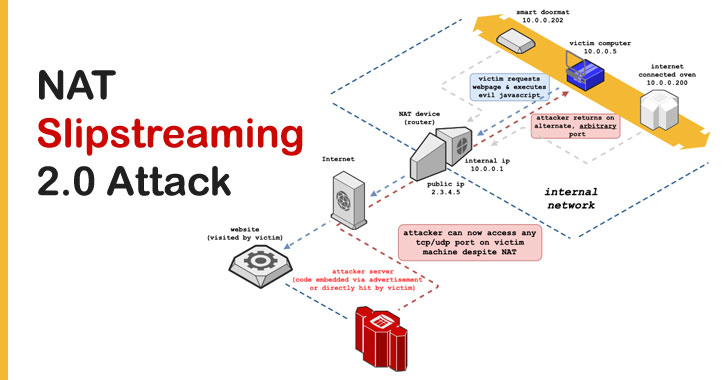
A newly devised variant of the NAT Slipstreaming attack[1] can be leveraged to
compromise and expose any device in an internal network, according
to the latest research.
Detailed by enterprise IoT security firm Armis, the new attack[2]
(CVE-2020-16043 and CVE-2021-23961) builds on the previously
disclosed technique to bypass routers and firewalls and reach any
unmanaged device within the internal network from the Internet.
First disclosed[3]
by security researcher Samy Kamkar in late October 2020, the
JavaScript-based attack relied on luring a user into visiting a
malicious website to circumvent browser-based port restrictions and
allow the attacker to remotely access TCP/UDP services on the
victim’s device, even those that were protected by a firewall or
NAT.
Although partial mitigations were released on November 11 to
thwart the attack in Chrome 87[4], Firefox 84[5], and Safari[6]
by preventing connections on port 5060 or 5061, Armis researchers
Ben Seri and Gregory Vishnipolsky revealed that “NAT Slipstreaming
2.0” puts “embedded, unmanaged, devices at greater risk, by
allowing attackers to expose devices located on internal networks,
directly to the Internet.”
Vulnerable devices that could be potentially exposed as a
consequence of this attack include office printers, industrial
controllers, IP cameras, and other unauthenticated interfaces that
could be exploited once the NAT/firewall is tricked into opening
network traffic to the victim device.
“Using the new variant of the NAT Slipstreaming attack to access
these types of interfaces from the Internet, can result in attacks
that range from a nuisance to a sophisticated ransomware threat,”
the researchers said.
Google, Apple, Mozilla, and Microsoft have all released patches
to Chrome (v87.0.4280.141[7]), Safari (v14.0.3[8]), Firefox (v85.0[9]), and Edge (v87.0.664.75[10]) browsers to address
the new attack.
Using H.323 Packets to facilitate NAT Slipstreaming
Put simply, NAT Slipstreaming[11] allows a bad actor to
bypass NAT/firewall and remotely access any TCP/UDP service bound
to a victim machine as a result of the target visiting a
malware-infected website specially crafted for this purpose.
Particularly, the malicious JavaScript code running on the
victim’s browser extracts the internal IP address and takes
advantage of TCP/IP packet segmentation to create large TCP/UDP
beacons and subsequently smuggle a Session Initiation Protocol
(SIP[12]) packet containing the
internal IP address inside an outbound HTTP POST request via TCP
port 5060.
“This is achieved by carefully setting the [Maximum Segment
Size] value of an attacker controlled TCP connection from the
victim browser to an attacker’s server, so that a TCP segment in
the ‘middle’ of the HTTP request will be entirely controlled by the
attacker,” the researchers explained.
As a consequence, this causes the NAT application-level gateway
(ALG) to open arbitrary ports for inbound connections to the
client’s device via the internal IP address.
NAT Slipstreaming 2.0 is similar to the aforementioned attack in
that it uses the same approach but relies on H.323[13] VoIP protocol instead
of SIP to send multiple fetch requests to the attacker’s server on
H.323 port (1720), thereby allowing the attacker to iterate through
a range of IP addresses and ports, and opening each one of them to
the Internet.
“A long lasting solution, unfortunately, would require some
[overhaul] of the Internet infrastructure we’re accustomed to,” the
researchers concluded.
“It is important to understand that security was not the
principal agenda for the creation of NATs, rather it was mainly a
by-product of the potential exhaustion of IPv4 addresses. Legacy
requirements such as ALGs are still a dominant theme in the design
of NATs today, and are the primary reason bypassing attacks are
found again and again.”
References
- ^
NAT
Slipstreaming attack (thehackernews.com) - ^
new
attack (www.armis.com) - ^
disclosed
(thehackernews.com) - ^
Chrome
87 (www.chromestatus.com) - ^
Firefox
84 (www.mozilla.org) - ^
Safari
(bugs.webkit.org) - ^
v87.0.4280.141
(chromereleases.googleblog.com) - ^
v14.0.3
(support.apple.com) - ^
v85.0
(www.mozilla.org) - ^
v87.0.664.75
(msrc.microsoft.com) - ^
NAT Slipstreaming
(samy.pl) - ^
SIP
(en.wikipedia.org) - ^
H.323
(en.wikipedia.org)