A previously undocumented Android-based remote access trojan
(RAT) has been found to use screen recording features to steal
sensitive information on the device, including banking credentials,
and open the door for on-device fraud.
Dubbed “Vultur” due to its use of Virtual Network Computing
(VNC)’s remote screen-sharing technology to gain full visibility on
targeted users, the mobile malware was distributed via the official
Google Play Store and masqueraded as an app named “Protection
Guard,” attracting over 5000 installations. Banking and
crypto-wallet apps from entities located in Italy, Australia, and
Spain were the primary targets.
“For the first time we are seeing an Android banking trojan that
has screen recording and keylogging as the main strategy to harvest
login credentials in an automated and scalable way,” researchers
from ThreatFabric said[1]
in a write-up shared with The Hacker News.
“The actors chose to steer away from the common HTML overlay
development we usually see in other Android banking Trojans: this
approach usually requires a larger time and effort investment from
the actors to create multiple overlays capable of tricking the
user. Instead, they chose to simply record what is shown on the
screen, effectively obtaining the same end result.”
While banking malware such as MysteryBot[2], Grandoreiro[3], Banker.BR[4], and Vizom[5]
have traditionally relied on overlay attacks[6]
— i.e., creating a false version of the bank’s login page and
overlaying it on top of the legitimate app — to trick victims into
revealing their passwords and other important private information,
evidence is mounting that threat actors are pivoting away from this
approach.

In a report published earlier this week, Italian cybersecurity
firm Cleafy uncovered UBEL[7], an updated variant of
Oscorp, that was observed using WebRTC to interact with the
compromised Android phone in real-time. Vultur adopts a similar
tactic in that it takes advantage of accessibility permissions to
capture keystrokes and leverages VNC’s screen recording feature to
stealthily log all activities on the phone, thus obviating the need
to register a new device and making it difficult for banks to
detect fraud.
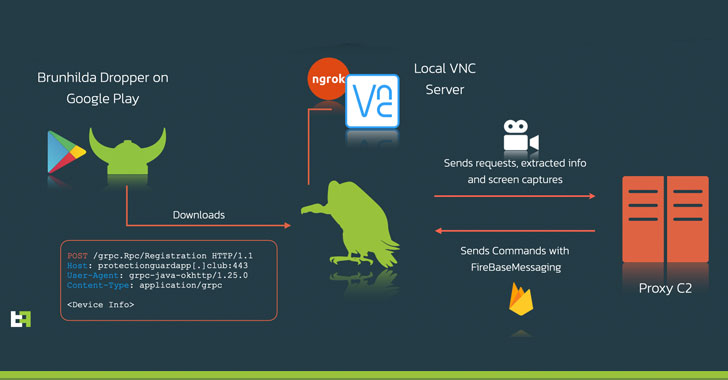
What’s more, the malware employs ngrok, a cross-platform utility
used to expose local servers behind NATs and firewalls to the
public internet over secure tunnels, to provide remote access to
the VNC server running locally on the phone. Additionally, it also
establishes connections with a command-and-control (C2) server to
receive commands over Firebase Cloud Messaging (FCM[8]), the results of which,
including extracted data and screen captures, are then transmitted
back to the server.
ThreatFabric’s investigation also connected Vultur with another
well-known piece of malicious software named Brunhilda[9], a dropper that utilizes
the Play Store to distribute different kinds of malware in what’s
called a “dropper-as-a-service” (DaaS) operation, citing overlaps
in the source code and C2 infrastructure used to facilitate
attacks.
These ties, the Amsterdam-based cybersecurity services company
said, indicate Brunhilda to be a privately operating threat actor
that has its own dropper and proprietary RAT Vultur.
“The story of Vultur shows one more time how actors shift from
using rented Trojans (MaaS) that are sold on underground markets
towards proprietary/private malware tailored to the needs of this
group,” the researchers concluded. “These attacks are scalable and
automated since the actions to perform fraud can be scripted on the
malware backend and sent in the form of commands sequence, making
it easy for the actor(s) to hit-and-run.”
References
- ^
said
(www.threatfabric.com) - ^
MysteryBot
(www.threatfabric.com) - ^
Grandoreiro
(securityintelligence.com) - ^
Banker.BR
(securityintelligence.com) - ^
Vizom
(securityintelligence.com) - ^
overlay
attacks (www.threatfabric.com) - ^
UBEL
(thehackernews.com) - ^
FCM
(firebase.google.com) - ^
Brunhilda
(www.prodaft.com)