
New research into 5G architecture[1]
has uncovered a security flaw in its network slicing and
virtualized network functions that could be exploited to allow data
access and denial of service attacks between different network
slices on a mobile operator’s 5G network.
AdaptiveMobile shared its findings with the GSM Association
(GSMA) on February 4, 2021, following which the weaknesses were
collectively designated as CVD-2021-0047.
5G is an evolution of current 4G broadband cellular network
technology, and is based on what’s called a service-based
architecture (SBA) that provides a modular framework to deploy a
set of interconnected network functions, allowing consumers to
discover and authorize their access to a plethora of services.
The network functions are also responsible for registering
subscribers, managing sessions and subscriber profiles, storing
subscriber data, and connecting the users (UE or user equipment) to
the internet via a base station (gNB). What’s more, each network
function of the SBA can offer a specific service but at the same
time can also request a service from another network function.
One of the ways the core SBA of the 5G network is orchestrated
is through a slicing[2]
model. As the name indicates, the idea is to “slice” the original
network architecture in multiple logical and independent virtual
networks that are configured to meet a specific business purpose,
which, in turn, dictates the quality of service (QoS[3]) requirements necessary
for that slice.
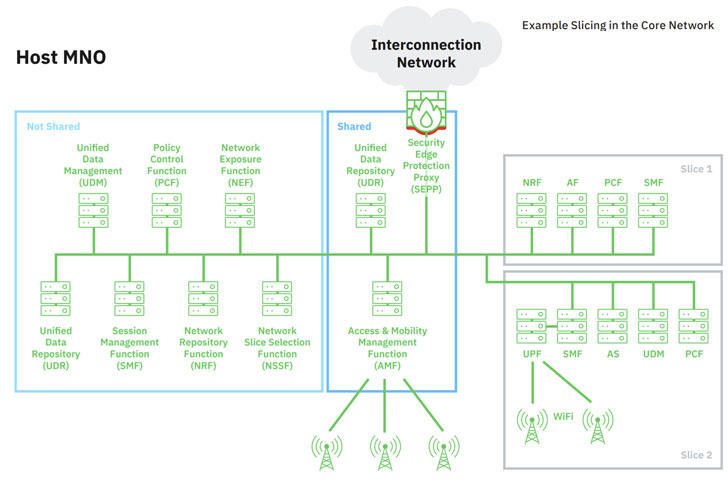
Additionally, each slice in the core network consists of a
logical group of network functions (NFs) that can be exclusively
assigned to that slice or be shared among different slices.
Put differently, by creating separate slices that prioritize
certain characteristics (e.g., large bandwidths), it enables a
network operator to carve out solutions that are customized to
particular industries.
For instance, a mobile broadband slice can be used to facilitate
entertainment and Internet-related services, an Internet of Things
(IoT) slice can be used to offer services tailored to retail and
manufacturing sectors, while a standalone low latency slice can be
designated for mission-critical needs such as healthcare and
infrastructure.
“The 5G SBA offers many security features which includes lessons
learned from previous generations of network technologies,”
AdaptiveMobile said[4]
in a security analysis of 5G core network slicing. “But on the
other hand, 5G SBA is a completely new network concept that opens
the network up to new partners and services. These all lead to new
security challenges.”
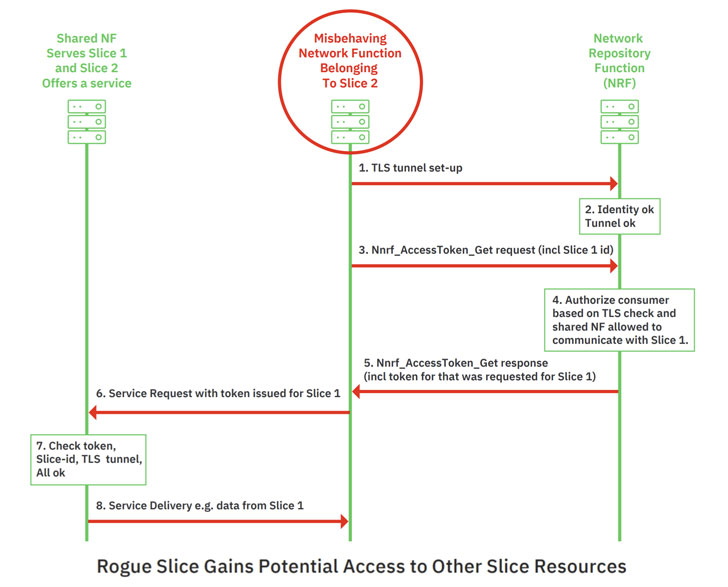
According to the mobile network security firm, this architecture
not only poses fresh security concerns that stem from a need to
support legacy functions but also from a “massive increase in
protocol complexity” as a consequence of migrating from 4G to 5G,
and in the process opening the door to a multitude of attacks,
including —
- Malicious access to a slice by brute-forcing its slice
differentiator, an optional value set by the network operator for
distinguishing between slices of the same type, thereby allowing a
rogue slice to gain unauthorized information from a second slice
like Access and Mobility Management Function (AMF), which maintains
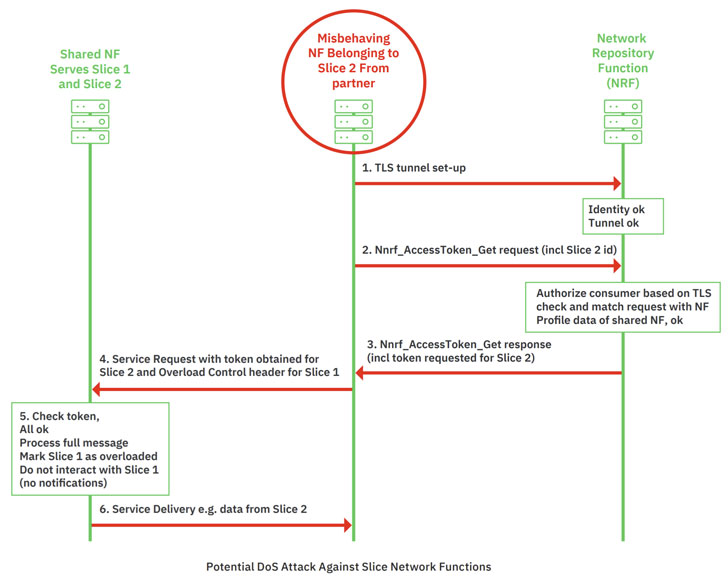
knowledge of a user equipment’s location. - Denial-of-service (DoS) against another network function by
taking advantage of a compromised slice.
The attacks hinge on a design quirk that there are no checks to
ensure that the slice identity in the signaling layer request
matches that used in the transport layer, thus permitting an
adversary connected to the 5G operator’s SBA through a rogue
network function to get hold of the core network as well as the
network slices.
It’s worth noting that the signaling layer is the telecommunication-specific application
layer[5] used for exchanging
signaling messages between network functions that are located in
different slices.
As countermeasures, AdaptiveMobile recommends partitioning the
network into different security zones by applying signaling
security filters between different slices, the core network, and
external partners, and the shared and not-shared network functions,
in addition to deploying a signaling layer protection solution to
safeguard against data leakage attacks that leverage the missing
correlation between layers.
While the current 5G architecture doesn’t support such a
protection node, the study suggests enhancing the Service
Communication Proxy (SCP[6]) to validate the
correctness of message formats, match the information between
layers and protocols, and provide load-related functionality to
prevent DoS attacks.
“This kind of filtering and validation approach allows division
of the network into security zones and safeguarding of the 5G core
network,” the researchers said. “Cross-correlation of attack
information between those security network functions maximizes the
protection against sophisticated attackers and allows better
mitigations and faster detection while minimizing false
alarms.”