Feb 21, 2023Ravie Lakshmanan
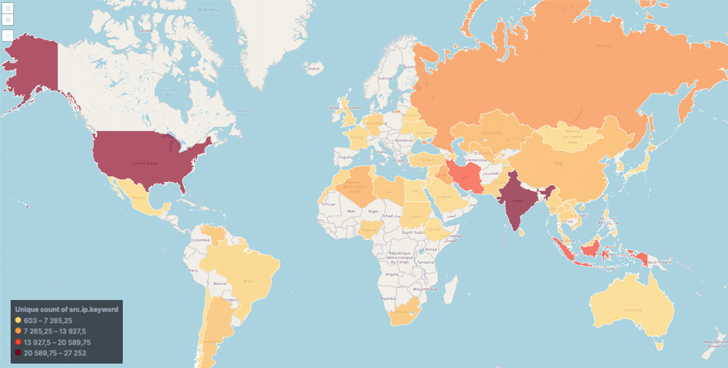
A sophisticated botnet known as MyloBot has compromised
thousands of systems, with most of them located in India, the U.S.,
Indonesia, and Iran.
That’s according to new findings from BitSight, which said[1]
it’s “currently seeing more than 50,000 unique infected systems
every day,” down from a high of 250,000 unique hosts in 2020.
Furthermore, an analysis of MyloBot’s infrastructure has found
connections to a residential proxy service called BHProxies,
indicating that the compromised machines are being used by the
latter.
MyloBot, which emerged on the threat landscape in 2017, was
first documented[2]
by Deep Instinct in 2018, calling out its anti-analysis techniques
and its ability to function as a downloader.
“What makes Mylobot dangerous is its ability to download and
execute any type of payload after it infects a host,” Lumen’s Black
Lotus Labs said[3]
in November 2018. “This means at any time it could download any
other type of malware the attacker desires.”
Last year, the malware was observed sending extortion emails[4] from hacked endpoints as
part of a financially motivated campaign seeking over $2,700 in
Bitcoin.
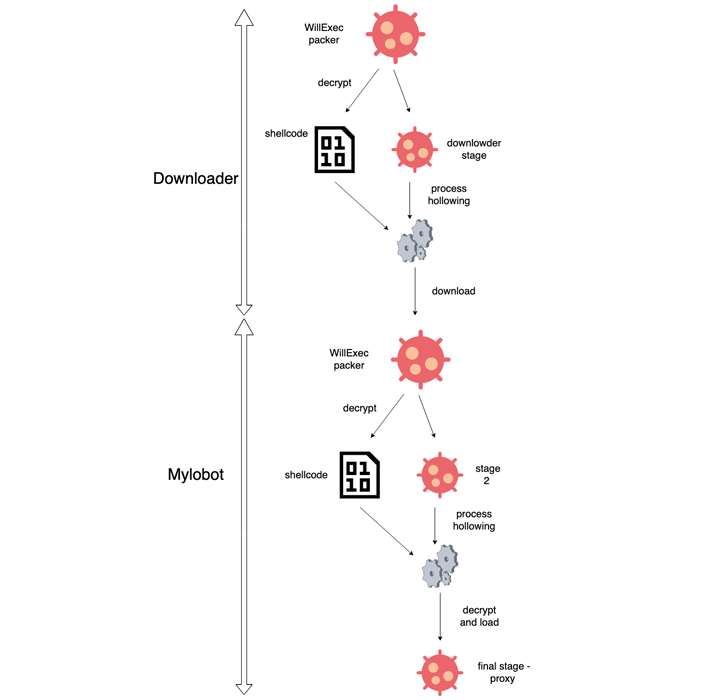
MyloBot is known to employ a multi-stage sequence to unpack and
launch the bot malware. Notably, it also sits idle for 14 days
before attempting to contact the command-and-control (C2) server to
sidestep detection.
The primary function of the botnet is to establish a connection
to a hard-coded C2 domain embedded within the malware and await
further instructions.
“When Mylobot receives an instruction from the C2, it transforms
the infected computer into a proxy,” BitSight said. “The infected
machine will be able to handle many connections and relay traffic
sent through the command-and-control server.”
Subsequent iterations of the malware have leveraged a downloader
that, in turn, contacts a C2 server, which responds with an
encrypted message containing a link to retrieve the MyloBot
payload.
The evidence that MyloBot could be a part of something bigger
stems from a reverse DNS lookup of one of the IP addresses
associated with the botnet’s C2 infrastructure has revealed ties to
a domain named “clients.bhproxies[.]com.”
The Boston-based cybersecurity company said it began sinkholing
MyloBot in November 2018 and that it continues to see the botnet
evolve over time.
Found this article interesting? Follow us on Twitter [5]
and LinkedIn[6]
to read more exclusive content we post.
References
Read more https://thehackernews.com/2023/02/mylobot-botnet-spreading-rapidly.html