
Mozi, a peer-to-peer (P2P) botnet known to target IoT devices,
has gained new capabilities that allow it to achieve persistence on
network gateways manufactured by Netgear, Huawei, and ZTE,
according to new findings.
“Network gateways are a particularly juicy target for
adversaries because they are ideal as initial access points to
corporate networks,” researchers at Microsoft Security Threat
Intelligence Center and Section 52 at Azure Defender for IoT
said[1]
in a technical write-up. “By infecting routers, they can perform
man-in-the-middle (MITM) attacks—via HTTP hijacking and DNS
spoofing—to compromise endpoints and deploy ransomware or cause
safety incidents in OT facilities.”
First documented[2]
by Netlab 360 in December 2019, Mozi has a history of infecting
routers and digital video recorders in order to assemble them into
an IoT botnet, which could be abused for launching distributed
denial-of-service (DDoS) attacks, data exfiltration, and payload
execution. The botnet is evolved from the source code of several
known malware families such as Gafgyt, Mirai, and IoT Reaper.
Mozi spreads[3]
via the use of weak and default telnet passwords as well as through
unpatched IoT vulnerabilities, with the IoT malware communicating
using a BitTorrent-like Distributed Hash Table (DHT[4]) to record the contact
information for other nodes in the botnet, the same mechanism used
by file-sharing P2P clients. The compromised devices listen for
commands from controller nodes and also attempt to infect other
vulnerable targets.
An IBM X-Force analysis published[5]
in September 2020 noted that Mozi accounted for nearly 90% of the
observed IoT network traffic from October 2019 through June 2020,
indicating that threat actors are increasingly taking advantage of
the expanding attack surface offered by the IoT devices. In a
separate investigation released[6]
last month, Elastic Security Intelligence and Analytics Team found
that at least 24 countries have been targeted to date, with
Bulgaria and India leading the pack.
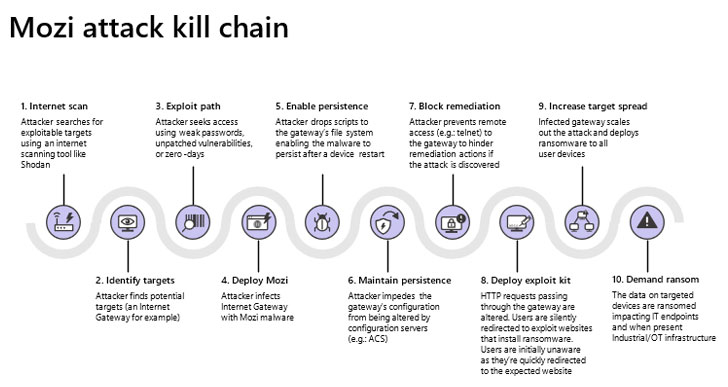
Now fresh research from Microsoft’s IoT security team has
discovered that the malware “takes specific actions to increase its
chances of survival upon reboot or any other attempt by other
malware or responders to interfere with its operation,” including
achieving persistence on targeted devices and blocking TCP ports
(23, 2323, 7547, 35000, 50023, and 58000) that are used to gain
remote access to the gateway.
What’s more, Mozi has been upgraded to support new commands that
enable the malware to hijack HTTP sessions and carry out DNS
spoofing so as to redirect traffic to an attacker-controlled
domain.
Businesses and users using Netgear, Huawei, and ZTE routers are
recommended to secure the devices using strong passwords and update
the devices to the latest firmware. “Doing so will reduce the
attack surfaces leveraged by the botnet and prevent attackers from
getting into a position where they can use the newly discovered
persistence and other exploit techniques,” Microsoft said.
References
Read more http://feedproxy.google.com/~r/TheHackersNews/~3/aCw0kPVCl50/mozi-iot-botnet-now-also-targets.html