
Web infrastructure and security company Cloudflare disclosed
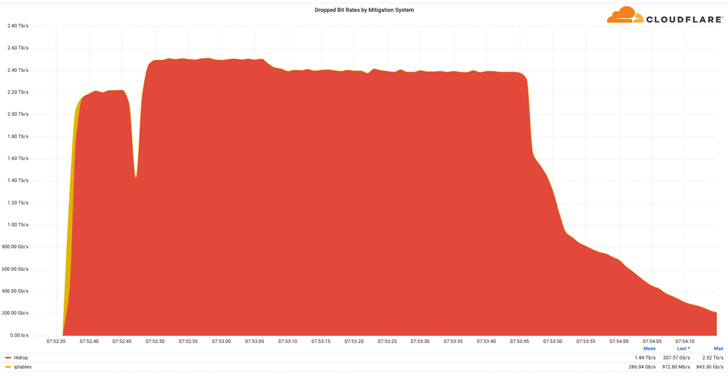
this week that it halted a 2.5 Tbps distributed denial-of-service
(DDoS) attack launched by a Mirai botnet.
Characterizing it as a “multi-vector attack consisting of UDP
and TCP floods,” researcher Omer Yoachimik said the DDoS attack
targeted the Minecraft server Wynncraft in Q3 2022.
“The entire 2.5 Tbps attack lasted about 2 minutes, and the peak
of the 26 million rps attack [was] only 15 seconds,” Yoachimik
noted[1]. “This is the largest
attack we’ve ever seen from the bitrate perspective.”
Cloudflare also pointed to a surge in multi-terabit DDoS attacks
as well as longer-lasting volumetric attacks during the time
period, not to mention an uptick in attacks targeting Taiwan and
Japan.
The disclosure comes almost 10 months after Microsoft said it
thwarted a record-breaking 3.47 Tbps DDoS
attack[2] in November 2021
directed against an unnamed Azure customer in Asia.
Other DDoS attacks[3]
of this scale and volume include a 2.5 Tbps DDoS attack absorbed by
Google in September 2017 and a 2.3 Tbps volumetric strike aimed at
Amazon Web Services in February 2020.
What’s more, ransom DDoS attacks – in which the threat actor
demands monetary compensation to stop the attack – have witnessed a
15% increase quarter-over-quarter and a 67% jump
year-over-year.
Application-layer DDoS attacks[4] (aka HTTP DDoS attacks),
on the other hand, have singled out companies in the U.S., China,
and Cyprus, with most of the attacks originating from China, India,
and the U.S.
Ukraine, which has been heavily pummeled by DDoS attacks since
the start of the Russo-Ukrainian war, has had its marketing,
education, and government sectors targeted the most during Q3, in
contrast to attacks on media companies the previous two
quarters.
Likewise, network-layer DDoS attacks[5] (aka Layer 3 DDoS
attacks) predominantly were recorded against gaming, telecom, IT
services sectors located in Singapore, U.S., and China.
A noteworthy trend highlighted by Cloudflare is a 1,221% QoQ
increase in DDoS attacks that leverage the BitTorrent[6]
communication protocol, which is traditionally used for
peer-to-peer (P2P) file sharing.
“Over the years, it has become easier, cheaper, and more
accessible for attackers and attackers-for-hire to launch DDoS
attacks,” Yoachimik said.
The disclosure also comes as application performance management
company Netscout revealed[7]
that threat actors are experimenting with different DDoS attack
vectors such as carpet bombing[8]
and DNS water torture[9]
attacks.
References
- ^
noted
(blog.cloudflare.com) - ^
record-breaking 3.47 Tbps DDoS
attack (thehackernews.com) - ^
DDoS
attacks (thehackernews.com) - ^
Application-layer DDoS attacks
(www.cloudflare.com) - ^
network-layer DDoS attacks
(www.cloudflare.com) - ^
BitTorrent
(en.wikipedia.org) - ^
revealed
(www.netscout.com) - ^
carpet
bombing (www.netscout.com) - ^
DNS
water torture (www.akamai.com)
Read more https://thehackernews.com/2022/10/mirai-botnet-hits-wynncraft-minecraft.html