
Microsoft this week revealed that it had fended off a record
number of distributed denial-of-service (DDoS) attacks aimed at its
customers in 2021, three of which surpassed 2.4 terabit per second
(Tbps).
One of the DDoS attacks took place in November, targeting an
unnamed Azure customer in Asia and lasted a total of 15 minutes. It
hit a peak throughput of 3.47 Tbps and a packet rate of 340 million
packets per second (pps), making it the largest attack ever
reported in history.
“This was a distributed attack originating from approximately
10,000 sources and from multiple countries across the globe,
including the United States, China, South Korea, Russia, Thailand,
India, Vietnam, Iran, Indonesia, and Taiwan,” Alethea Toh, product
manager of Azure Networking, said[1].
DDoS attacks occur when several compromised devices are employed
as a conduit to overwhelm a targeted server, service, or network
with a flood of internet traffic with the goal of overloading the
systems and disrupting its regular services.
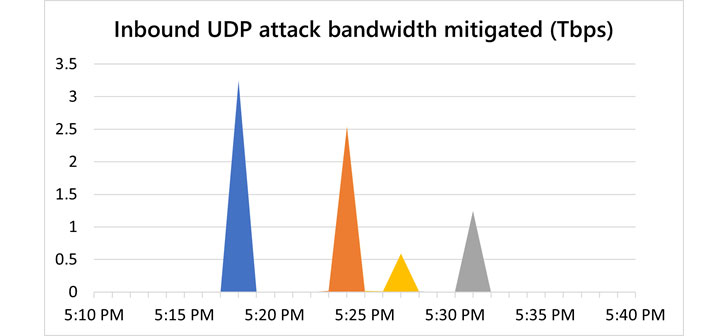
Then in December, Microsoft said it blocked two more attacks
that surpassed 2.5 Tbps, both of which were aimed at customers in
Asia. The first of the attacks was a 3.25 Tbps UDP attack, while
the other intrusion was a 2.55 Tbps UDP flood that lingered for
just a little over five minutes.
The report comes more than three months after the tech giant
disclosed[2]
it acted to blunt a 2.4 Tbps DDoS attack in August 2021 targeting a
European customer. Other previous record-breaking attacks include a
2.5 Tbps DDoS attack absorbed by Google in September 2017 and a
volumetric strike aimed at Amazon Web Services in February
2020.
Microsoft said it observed a rise in attacks that lasted longer
than an hour in the second half of 2021, whereas the proportion of
short-lived attacks that were 30 minutes or less dropped from 74%
to 57%. That said, the longer duration assaults are experienced as
a sequence of multiple short, repeated burst attacks.
The company also said it mitigated an average of 1,955 attacks
per day, with a maximum of 4,296 attacks recorded in a single day
on August 10, 2021. For the entirety of H2 2021, no fewer than
359,713 unique attacks against its infrastructure were blocked, a
43% increase from the first half of 2021.
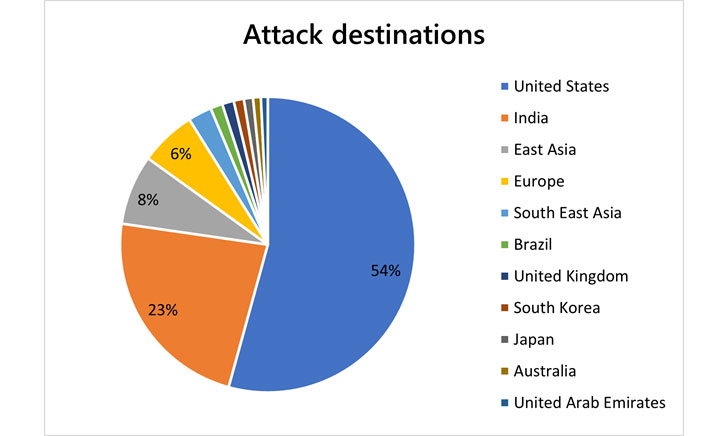
The gaming industry emerged as the hardest hit sector, followed
by financial institutions, media, internet service providers
(ISPs), retail, and supply chain entities. Most of the targeted
organizations were located in the U.S., India, East Asia (Hong
Kong), Brazil, the U.K., South Korea, Japan, Australia, and the
U.A.E.
“We saw a sharp uptick in attacks in India, from just 2% of all
attacks in the first half of 2021 to taking the second position at
23% of all attacks in the second half of 2021,” Toh said. “Another
driving factor may be that the acceleration of digital
transformation, for example, the ‘Digital India[3]‘ initiative, has
increased the region’s overall exposure to cyber risks.”
References
Read more https://thehackernews.com/2022/01/microsoft-mitigated-record-breaking-347.html