An unpatched design flaw in the implementation of Microsoft
Exchange’s Autodiscover protocol has resulted in the leak of
approximately 100,000 login names and passwords for Windows domains
worldwide.
“This is a severe security issue, since if an attacker can
control such domains or has the ability to ‘sniff’ traffic in the
same network, they can capture domain credentials in plain text
(HTTP basic authentication) that are being transferred over the
wire,” Guardicore’s Amit Serper said[1]
in a technical report.
“Moreover, if the attacker has DNS-poisoning capabilities on a
large scale (such as a nation-state attacker), they could
systematically syphon out leaky passwords through a large-scale DNS
poisoning campaign based on these Autodiscover TLDs [top-level
domains].”
The Exchange Autodiscover[2]
service enables users to configure applications such as Microsoft
Outlook with minimal user input, allowing just a combination of
email addresses and passwords to be utilized to retrieve other
predefined settings required to set up their email clients.
The weakness discovered by Guardicore resides in a specific
implementation of Autodiscover based on the POX[3]
(aka “plain old XML”) XML protocol that causes the web requests to
Autodiscover domains to be leaked outside of the user’s domain but
in the same top-level domain.
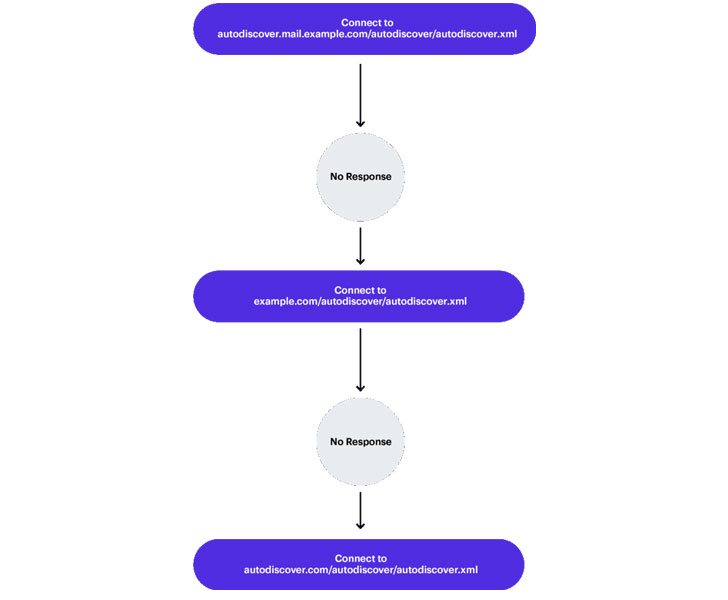
In a hypothetical example where a user’s email address is
“user@example.com,” the email client leverages the Autodiscover
service to construct a URL to fetch the configuration data using
any of the below combinations of the email domain, a subdomain, and
a path string, failing which it instantiates a “back-off” algorithm
—
- https://Autodiscover.example.com/Autodiscover/Autodiscover.xml
- https://Autodiscover.example.com/Autodiscover/Autodiscover.xml
- https://example.com/Autodiscover/Autodiscover.xml
- https://example.com/Autodiscover/Autodiscover.xml
“This ‘back-off’ mechanism is the culprit of this leak because
it is always trying to resolve the Autodiscover portion of the
domain and it will always try to ‘fail up,’ so to speak,” Serper
explained. “Meaning, the result of the next attempt to build an
Autodiscover URL would be:
‘https://Autodiscover.com/Autodiscover/Autodiscover.xml.’ This
means that whoever owns Autodiscover.com will receive all of the
requests that cannot reach the original domain.”
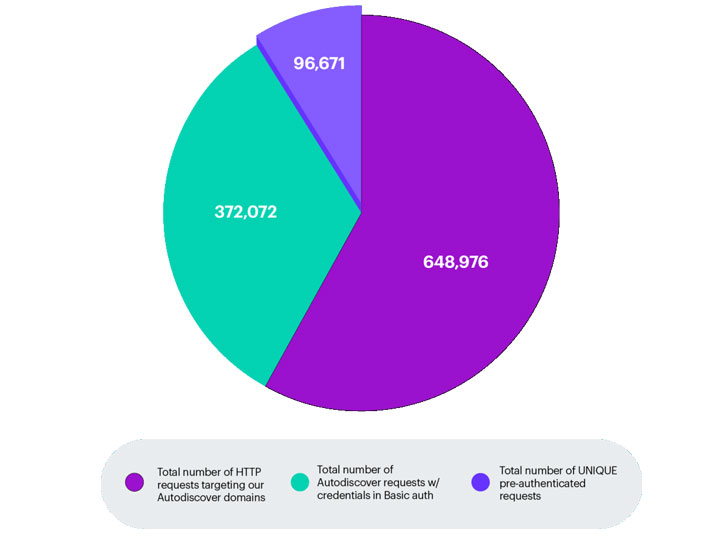
Armed with this discovery and by registering a number of
Autodiscover top-level domains (e.g., Autodiscover.com[.]br,
Autodiscover.com[.]cn, Autodiscover[.]in, etc.) as honeypots,
Guardicore said it was able to access requests to Autodiscover
endpoints from different domains, IP addresses, and clients,
netting 96,671 unique credentials sent from Outlook, mobile email
clients, and other applications interfacing with Microsoft’s
Exchange server over a four-month period between April 16, 2021,
and August 25, 2021.
The domains of those leaked credentials belonged to several
entities from multiple verticals spanning publicly traded
corporations in China, investment banks, food manufacturers, power
plants, and real estate firms, the Boston-based cybersecurity
company noted.
To make matters worse, the researchers developed an “ol’
switcheroo” attack that involved sending a request to the client to
downgrade to a weaker authentication scheme (i.e., HTTP Basic authentication[4]) in place of secure
methods like OAuth or NTLM, prompting the email application to send
the domain credentials in cleartext.
“Oftentimes, attackers will try to cause users to send them
their credentials by applying various techniques, whether technical
or through social engineering,” Serper said. “However, this
incident shows us that passwords can be leaked outside of the
organization’s perimeter by a protocol that was meant to streamline
the IT department’s operations with regards to email client
configuration without anyone from the IT or security department
even being aware of it, which emphasises the importance of proper
segmentation and Zero Trust.”
References
- ^
said
(www.guardicore.com) - ^
Autodiscover
(docs.microsoft.com) - ^
POX
(docs.microsoft.com) - ^
HTTP
Basic authentication (en.wikipedia.org)