
A Mac malware campaign targeting Xcode developers has been
retooled to add support for Apple’s new M1 chips and expand its
features to steal confidential information from cryptocurrency
apps.
XCSSET came into the spotlight in August 2020[1]
after it was found to spread via modified Xcode IDE projects,
which, upon the building, were configured to execute the payload.
The malware repackages payload modules to imitate legitimate Mac
apps, which are ultimately responsible for infecting local Xcode
projects and injecting the main payload to execute when the
compromised project builds.
XCSSET modules come with the capabilities to steal credentials,
capture screenshots, inject malicious JavaScript into websites,
plunder user data from different apps, and even encrypt files for a
ransom.
Then in March 2021, Kaspersky researchers uncovered[2]
XCSSET samples compiled for the new Apple M1 chips, suggesting that
the malware campaign was not only ongoing but also that adversaries
are actively[3]
adapting[4]
their executables and porting them to run on new Apple Silicon Macs
natively.
The latest research by Trend Micro shows that XCSSET continues
to abuse the development version of the Safari browser to plant
JavaScript backdoors onto websites via Universal Cross-site
Scripting (UXSS) attacks.
“It hosts Safari update packages in the [command-and-control]
server, then downloads and installs packages for the user’s OS
version,” Trend Micro researchers said[5]
in an analysis published on Friday. “To adapt to the newly-released
Big Sur, new packages for ‘Safari 14’ were added.”
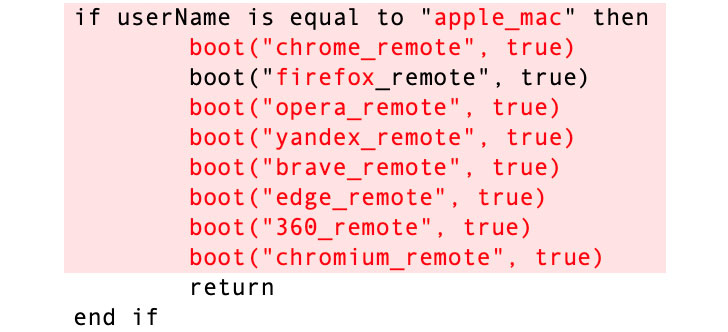
In addition to trojanizing Safari to exfiltrate data, the
malware is also known for exploiting the remote debugging mode[6]
in other browsers such as Google Chrome, Brave, Microsoft Edge,
Mozilla Firefox, Opera, Qihoo 360 Browser, and Yandex Browser to
carry out UXSS attacks.
What’s more, the malware now even attempts to steal account
information from multiple websites, including cryptocurrency
trading platforms Huobi, Binance, NNCall.net, Envato, and 163.com,
with abilities to replace the address in a user’s cryptocurrency
wallet with those under the attacker’s control.
XCSSET’s mode of distribution via doctored Xcode projects poses
a serious threat, as affected developers who unwittingly share
their work on GitHub could pass on the malware to their users in
the form of the compromised Xcode projects, leading to “a supply-chain-like attack[7] for users who rely on
these repositories as dependencies in their own projects.”
References
- ^
August
2020 (www.trendmicro.com) - ^
uncovered
(securelist.com) - ^
actively
(thehackernews.com) - ^
adapting
(thehackernews.com) - ^
said
(www.trendmicro.com) - ^
remote
debugging mode (www.trendmicro.com) - ^
supply-chain-like attack
(thehackernews.com)