Researchers have disclosed significant security weaknesses in
popular software applications that could be abused to deactivate
their protections and take control of allow-listed applications to
perform nefarious operations on behalf of the malware to defeat
anti-ransomware defenses.
The twin attacks, detailed[1] by academics from the
University of Luxembourg and the University of London, are aimed at
circumventing the protected folder feature offered by antivirus
programs to encrypt files (aka “Cut-and-Mouse”) and disabling their
real-time protection by simulating mouse “click” events (aka “Ghost
Control”).
“Antivirus software providers always offer high levels of
security, and they are an essential element in the everyday
struggle against criminals,” said[2]
Prof. Gabriele Lenzini, chief scientist at the Interdisciplinary
Center for Security, Reliability, and Trust at the University of
Luxembourg. “But they are competing with criminals which now have
more and more resources, power, and dedication.”
Put differently, shortcomings in malware mitigation software
could not just permit unauthorized code to turn off their
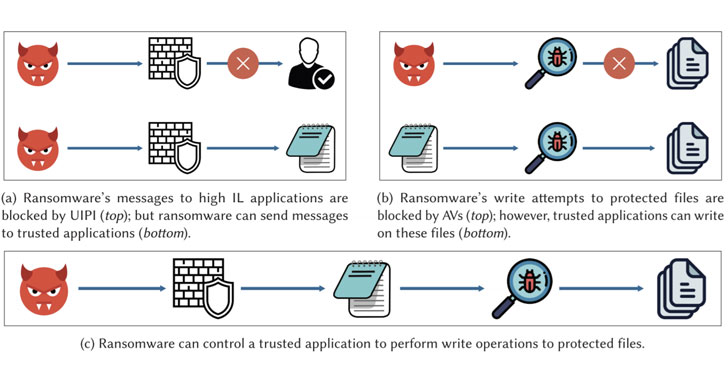
protection features, design flaws in Protected Folders solution
provided by antivirus vendors could be abused by, say, ransomware
to change the contents of files using an that’s provisioned write
access to the folder and encrypt user data, or a wipeware to
irrevocably destroy personal files of victims.
Protected Folders allow[3]
users[4]
to specify folders that require an additional layer of protection
against destructive software, thereby potentially blocking any
unsafe access to the protected folders.
“A small set of whitelisted applications is granted privileges
to write to protected folders,” the researchers said. “However,
whitelisted applications themselves are not protected from being
misused by other applications. This trust is therefore unjustified,
since a malware can perform operations on protected folders by
using whitelisted applications as intermediaries.”
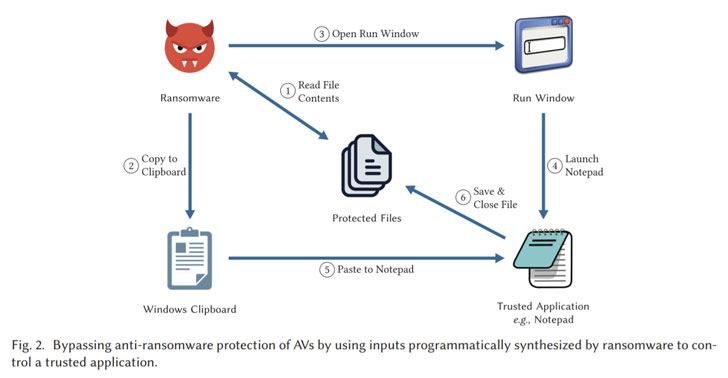
An attack scenario devised by the researchers revealed that
malicious code could be used to control a trusted application like
Notepad to perform write operations and encrypt the victim’s files
stored in the protected folders. To this end, the ransomware reads
the files in the folders, encrypts them in memory, and copies them
to the system clipboard, following which the ransomware launches
Notepad to overwrite the folder contents with the clipboard
data.
Even worse, by leveraging Paint as a trusted application, the
researchers found that the aforementioned attack sequence could be
used to overwrite user’s files with a randomly generated image to
destroy them permanently.
Ghost Control attack, on the other hand, could have serious
consequences of its own, as turning off real-time malware
protection by simulating legitimate user actions performed on the
user interface of an antivirus solution could permit an adversary
to drop and execute any rogue program from a remote server under
their control.
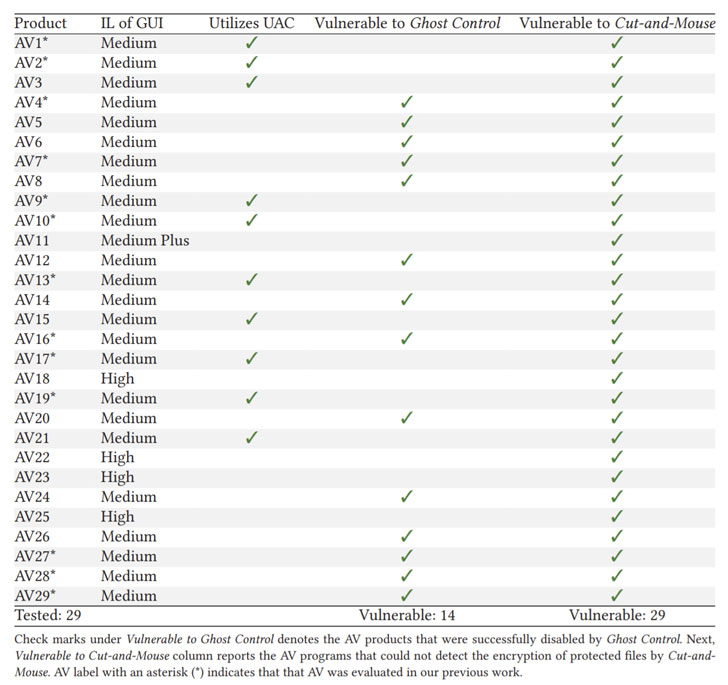
Of the 29 antivirus solutions evaluated during the study, 14 of
them were found vulnerable to the Ghost Control attack, while all
29 antivirus programs tested were found to be at risk from the
Cut-and-Mouse attack. The researchers didn’t name the vendors who
were affected.
If anything, the findings are a reminder that even security
solutions that are explicitly designed to safeguard digital assets
from malware attacks can suffer from weaknesses themselves, thus
defeating their very purpose. Even as antivirus software providers
continue to step up defenses, malware authors have sneaked past
such barriers through evasion and obfuscation tactics, not to
mention even bypassing their behavioral detection using adversarial inputs[5]
via poisoning attacks.
“Secure composability is a well-known problem in security
engineering,” the researchers said. “Components that, when taken in
isolation, offer a certain known attack surface do generate a wider
surface when integrated into a system. Components interact one
another and with other parts of the system create a dynamic with
which an attacker can interact too and in ways that were not
foreseen by the designer.”