
An adversary known for its watering hole attacks[1]
against government entities has been linked to a slew of newly
detected intrusions targeting various organizations in Central Asia
and the Middle East.
The malicious activity, collectively named “EmissarySoldier,”
has been attributed to a threat actor called LuckyMouse, and is
said to have happened in 2020 with the goal of obtaining
geopolitical insights in the region. The attacks involved deploying
a toolkit dubbed SysUpdate (aka Soldier) in a number of
breached organizations, including government and diplomatic
agencies, telecom providers, a TV media company, and a commercial
bank.
LuckyMouse[2], also referred to as
APT27 and Emissary Panda, is a sophisticated cyberespionage group
that has a history of breaching multiple government networks in
Central Asia and the Middle East. The actor has also been linked to
cyberattacks aimed at transnational organizations such as the
International Civil Aviation Organization (ICAO[3]) in 2019 and recently
attracted attention for exploiting ProxyLogon flaws[4]
to compromise the email server of a governmental entity in the
Middle East.
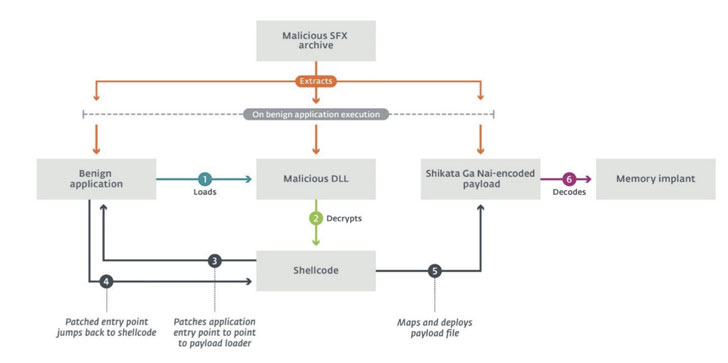
EmissarySoldier is only the latest in a series of
surveillance efforts aimed at the targets.
“In order to compromise victims, LuckyMouse typically uses
watering holes, compromising websites likely to be visited by its
intended targets, ESET malware researcher Matthieu Faou said in a
report[5]
published today. “LuckyMouse operators also perform network scans
to find vulnerable internet-facing servers run by their intended
victims.”
What’s more, ESET also found a few infected internet-facing
systems running Microsoft SharePoint, which the researchers suspect
occurred by taking advantage of remote code execution
vulnerabilities in the application.
Regardless of the method used to gain an initial foothold, the
attack chain culminates in the deployment of custom post-compromise
implants, SysUpdate or HyperBro[6], both of which leverage
DLL search order hijacking[7] to load malicious
payloads and thwart detection. “The trident model features a
legitimate application vulnerable to DLL hijacking, a custom DLL
that loads the payload, and a raw Shikata Ga Nai-encoded binary
payload,” Faou noted.
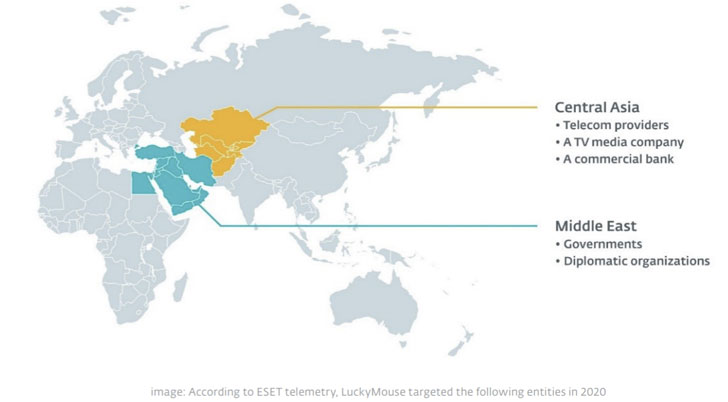
For its part, SysUpdate functions as a modular tool, with each
component devoted to a particular operational purpose. It involves
abusing a benign application as a loader for a malicious DLL, which
in turn loads the first-stage payload that ultimately decodes and
deploys the memory implant on the compromised system. Since its
discovery in 2018, the toolkit has undergone numerous revisions
devoted to adding new functionalities, indicating that the
operators are actively working to revamp their malware arsenal.
“LuckyMouse was increasingly active throughout 2020, seemingly
going through a retooling process in which various features were
being incrementally integrated into the SysUpdate toolkit,” Faou
said. “This may be an indicator that the threat actors behind
LuckyMouse are gradually shifting from using HyperBro to
SysUpdate.”
References
- ^
watering
hole attacks (thehackernews.com) - ^
LuckyMouse
(malpedia.caad.fkie.fraunhofer.de) - ^
ICAO
(www.cbc.ca) - ^
ProxyLogon flaws
(thehackernews.com) - ^
report
(www.welivesecurity.com) - ^
HyperBro
(attack.mitre.org) - ^
DLL
search order hijacking (attack.mitre.org)
Read more http://feedproxy.google.com/~r/TheHackersNews/~3/Y7CPVO3mJQI/luckymouse-hackers-target-banks.html