
Linus Torvalds, the creator of Linux and Git, has his own law in
software development, and it goes like this: “given enough
eyeballs, all bugs are shallow.” This phrase puts the finger
on the very principle of open source: the more, the merrier – if
the code is easily available for anyone and everyone to fix bugs,
it’s pretty safe. But is it? Or is the saying “all bugs are
shallow” only true for shallow bugs and not ones that lie
deeper? It turns out that security flaws in open source can be
harder to find than we thought. Emil Wåreus, Head of R&D at
Debricked[1], took it upon himself to
look deeper into the community’s performance. As the data scientist
he is, he, of course, asked the data: how good is the open
source community at finding vulnerabilities in a timely
manner?
The thrill of the (vulnerability) hunt
Finding open source vulnerabilities is typically done by the
maintainers of the open source project, users, auditors, or
external security researchers. But despite these great
code-archaeologists helping secure our world, the community still
struggles to find security flaws.
On average, it takes over 800 days to discover a
security flaw in open source projects. For instance, the infamous
Log4shell (CVE-2021-44228) vulnerability was undiscovered for a
whopping 2649 days.
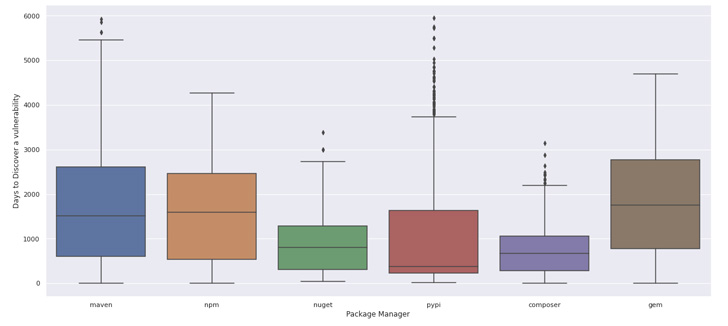
The analysis shows that 74% of security flaws are actually
undiscovered for at least one year! Java and Ruby seem to have the
most challenges here, as it takes the community more than 1000 days
to find and disclose vulnerabilities. Our [white] hats go off to
the PHP/Composer community, which slightly outperforms the
others.
The needle in a techstack
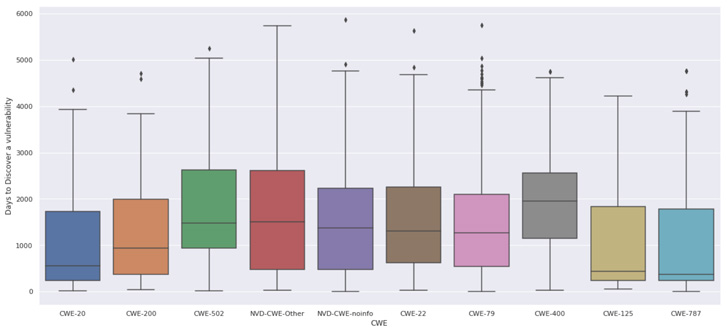
Other interesting factors are that some of the different
weakness types (CWE) seem to be harder to find and disclose, which
actually contradicts Linus’s law. The weakness types CWE-400
(Uncontrolled Resource Consumption) and CWE-502 (Deserialization of
Untrusted Data) typically aren’t localized to a single function or
may appear as intended logic in the application. In other words, it
can’t be considered “a shallow bug.”
It also seems that the developer community is a bit better at
finding CWE-20 (Improper Input Validation), where the flaw most of
the time is just a few lines of code in a single function.
Solve vulnerabilities with powerful
remediation
Why does this matter? As consumers of open source, and that’s
about every company in the whole world, the problem of
vulnerabilities in open source is an important one. The data tells
us that we can’t fully trust Linus’ Law – not because open source
is less secure than other software, but because not all
bugs are shallow.
Luckily, there are powerful tools to perform at-scale analysis
of a lot of open source projects at once. There have been [white knight hackers disclose
1000’s[2]] of vulnerabilities at
once using these methods. It would be naive to not assume that
ill-minded organizations and individuals do the same. As an
ecosystem that lays the foundation for our software-centric world,
the community must improve its ability to find, disclose, and fix
security flaws in open source significantly.
Last year, Google committed $10 billion[3] to an open source fund
to help secure open source with a specific curator role to work
alongside the maintainers with specific security efforts.
Furthermore, Debricked helps companies make these
vulnerabilities actionable by scanning all your software, every
branch, every push, and every commit, for new (open source)
vulnerabilities. Debricked even continuously scans all your old
commits for every new vulnerability, to make sure they bring
up-to-date, accurate, and actionable intelligence on the open
source you consume. Debricked even helps developers fix your
security flaws with automated pull requests that won’t cause
dependency hell; pretty neat!
The truth lies in the data
So, knowing all this, what is the best way to protect your
project or company against open source vulnerabilities? As we’ve
seen in the case of Log4j and Spring4shell as well as the numbers,
we can never really trust that the community will find and fix all
risks. There’s a good chance that there are lots and lots of
undiscovered and undisclosed vulnerabilities in your code today,
and there’s not much you can do about it.
According to Debricked, the best way to mitigate this is by
implementing continuous vulnerability scanning to your SDLC. By
automatically scanning at every push of code, in combination with
the machine learning-powered vulnerability database. This makes sure
you’re updated in real-time, you’ll know about new vulnerabilities
before anyone else does. As soon as there’s a fix, you can generate
a Fix Pull Request automatically or solve
it manually with Debricked’s help. Currently, Debricked offers
remediation for JavaScript and Go, with more language support is to
come shortly.[4][5]
References
- ^
Debricked
(debricked.com) - ^
white
knight hackers disclose 1000’s
(www.youtube.com) - ^
Google
committed $10 billion (blog.google) - ^
vulnerability database
(debricked.com) - ^
Fix Pull
Request (debricked.com)
Read more https://thehackernews.com/2022/11/last-years-open-source-tomorrows.html