
instance of Android malware hidden under the guise of legitimate
applications to stealthily subscribe unsuspecting users for premium
services without their knowledge.
In a report published by Check Point research today, the malware
— infamously called Joker (or Bread) — has found another trick to
bypass Google’s Play Store protections: obfuscate the malicious DEX
executable inside the application as Base64 encoded strings, which
are then decoded and loaded on the compromised device.
Following responsible disclosure by Check Point researchers, the
11 apps in question were removed by Google from the Play Store on
April 30, 2020.
“The Joker malware is tricky to detect, despite Google’s
investment in adding Play Store protections,” said Check Point’s
Aviran Hazum, who identified the new modus operandi of Joker
malware. “Although Google removed the malicious apps from the Play
Store, we can fully expect Joker to adapt again.”
Joker: A Large-Scale Billing Fraud Family
First discovered in 2017, Joker is one of the most prevalent kinds
of Android malware, notorious for perpetrating billing fraud and
its spyware capabilities, including stealing SMS messages, contact
lists, and device information.
Campaigns involving Joker gained more foothold last year, with a
number of malware-infected Android apps uncovered by CSIS Security
Group, Trend Micro,
Dr.Web, and Kaspersky, repeatedly
finding unique ways to exploit gaps in
Play Store security checks.
To mask their true nature, the malware authors behind the
large-scale operation have resorted to a variety of methods —
encryption to hide strings from analysis engines, fake reviews to
lure users into downloading the apps, and a technique called
versioning, which refers to uploading a clean version of the app to
the Play Store to build trust among users and then sneakily adding
malicious code at a later stage via app updates.
“As the Play Store has introduced new policies and Google Play
Protect has scaled defenses, Bread apps were forced to continually
iterate to search for gaps,” Android’s Security & Privacy Team[6] said earlier this year.
“They have at some point used just about every cloaking and
obfuscation technique under the sun in an attempt to go
undetected.”
As of January 2020, Google has removed more than 1,700 apps
submitted to the Play Store over the past three years that had been
infected with the malware.
Using Android Manifest to Hide Malicious DEX File
The new variant spotted by Check Point has the same goal but goes
about it by leveraging the app’s manifest
file, which it uses to load a Base64 encoded DEX file.
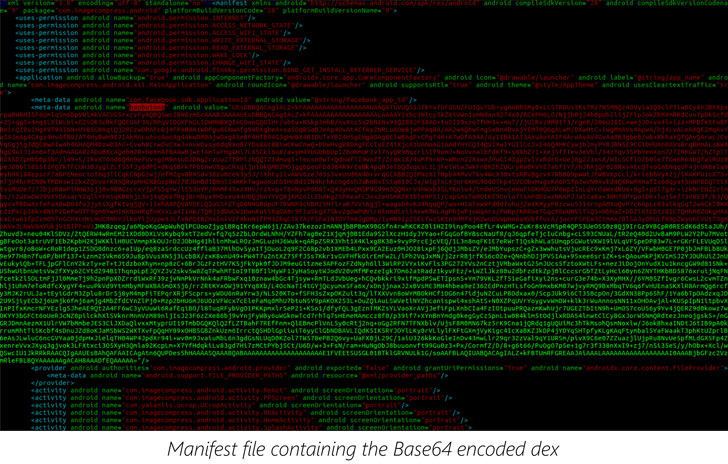
similar technique of hiding the .dex file as Base64 strings but
adds them as an inner class in the main application and loads it
via reflection APIs.
“To achieve the capability of subscribing the users to premium
services without their knowledge or consent, the Joker utilized two
main components — the Notification Listener as a part of the
original application, and a dynamic dex file loaded from the
C&C server to perform the registration,” Hazum noted in his
analysis.
Furthermore, the variant comes equipped with a new feature that
allows the threat actor to remotely issue a “false” status code
from a C&C server under their control to suspend the malicious
activity.
If anything, the latest Joker scheme represents less of a
critical threat than it does a reminder of how Android malware is
continually evolving and has to be protected continuously.
For users who’ve installed any of the infected apps, it’s worth
checking your mobile and transaction history to see if there are
any suspicious payments that you don’t recognize. Also, make sure
to carefully scrutinize your permissions for every app installed on
your Android device.
References
- ^
CSIS Security Group
(medium.com) - ^
Trend Micro
(blog.trendmicro.com) - ^
Dr.Web
(twitter.com) - ^
Kaspersky
(twitter.com) - ^
gaps in Play Store security
(thehackernews.com) - ^
Android’s Security & Privacy Team
(security.googleblog.com) - ^
manifest file
(developer.android.com) - ^
reflection APIs
(www.oracle.com)
Read more http://feedproxy.google.com/~r/TheHackersNews/~3/XH6GIqWnLaE/joker-android-mobile-virus.html