An Iranian advanced persistent threat (APT) actor known as
Agrius has been attributed as behind a set of data
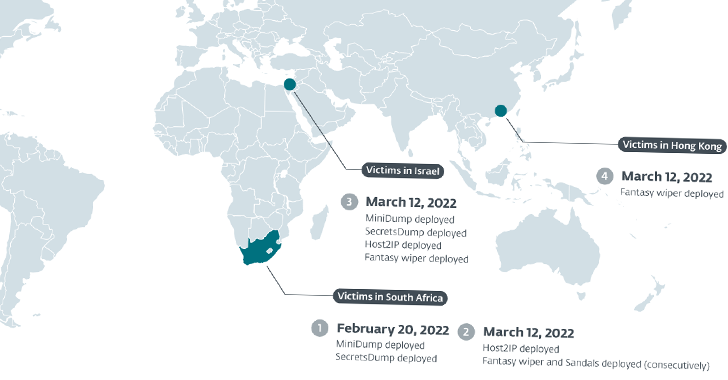
wiper attacks aimed at diamond industries in South Africa, Israel,
and Hong Kong.
The wiper, codenamed Fantasy by ESET, is believed to have been
delivered via a supply chain attack targeting an Israeli software
suite developer as part of a campaign that began in February
2022.
Victims include HR firms, IT consulting companies, and a diamond
wholesaler in Israel; a South African entity working in the diamond
industry; and a jeweller based in Hong Kong.
“The Fantasy wiper is built on the foundations of the previously
reported Apostle wiper but does not attempt to masquerade as
ransomware, as Apostle originally did, ESET researcher Adam Burgher
disclosed[1]
in a Thursday analysis. “Instead, it goes right to work wiping
data.”
Apostle was first documented[2]
by SentinelOne in May 2021 as a wiper-turned-ransomware that was
deployed in destructive attacks against Israeli targets.
Agrius, the Iran-aligned group behind the intrusions, has been
active since at least December 2020 and leverages known security
flaws in internet-facing applications to drop web shells that are,
in turn, used to facilitate reconnaissance, lateral movement, and
the delivery of final-stage payloads.
The Slovak cybersecurity company said the first attack was
detected on February 20, 2022, aimed at a South African
organization, when the actor deployed credential harvesting
tools.
Agrius subsequently initiated the wiping attack via Fantasy on
March 12, 2022, before striking other companies in Israel and Hong
Kong on the same date.
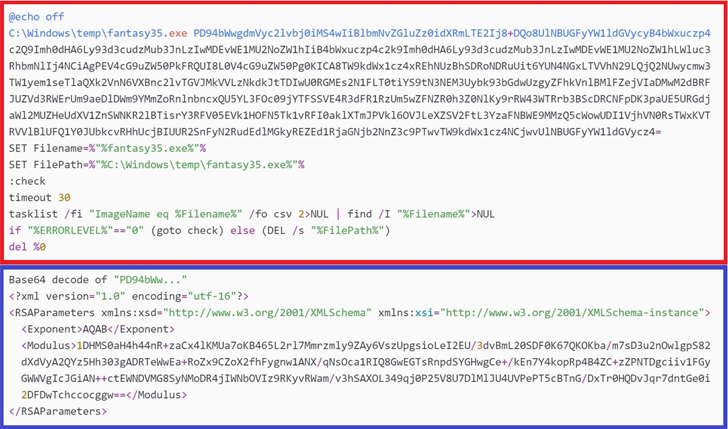
Fantasy is executed by means of another tool called Sandals, a
32-bit Windows executable written in C#/.NET. It’s said to be
deployed on the compromised host through a supply-chain attack
using the Israeli developer’s software update mechanism.
This is substantiated by ESET’s assessment that all victims are
customers of the affected software developer and that the wiper
binary follows a naming convention (“fantasy45.exe” and
“fantasy35.exe”) similar to that of its legitimate
counterpart[3].
The wiper, for its part, works by recursively retrieving the
directory listing for each drive, overwriting every file in those
directories with garbage data, assigning a future timestamp to the
files, and then deleting them.
“This is presumably done to make recovery and forensic analysis
more difficult,” Burgher explained.
In a further attempt to erase all traces of the activity,
Fantasy clears all Windows event logs, recursively purges all files
in the system drive, overwrites the system’s Master Boot Record,
self-deletes itself, and finally reboots the machine.
The campaign, which lasted no more than three hours, was
ultimately unsuccessful, with ESET stating that it was able to
block the wiper’s execution. The developer of the software has
since pushed out clean updates to plug the attacks.
The name of the Israeli company that fell victim to the supply
chain attack was not disclosed by ESET, but evidence points to it
being Rubinstein Software, which markets an enterprise resource
planning (ERP[4]) solution called
Fantasy[5]
that’s used for jewelry stock management.
“Since its discovery in 2021, Agrius has been solely focused on
destructive operations,” Burgher concluded.
“To that end, Agrius operators probably executed a supply-chain
attack by targeting an Israeli software company’s software updating
mechanisms to deploy Fantasy, its newest wiper, to victims in
Israel, Hong Kong, and South Africa.”
Agrius is far from the first threat group linked to Iran that
has been spotted deploying destructive wiper malware.
The APT33[6]
hacking group (aka Elfin, Holmium[7], or Refined Kitten),
which is suspected of operating at the behest of the Iranian
government, is said to have been behind multiple attacks that used
the Shamoon wiper[8]
against targets located in the Middle East.
Data-wiping malware codenamed ZeroCleare[9]
has also been employed by Iran-backed threat actors tracked as
APT34 (aka Oilrig or Helix Kitten) in attacks directed against
organizations from the energy and industrial sector in the Middle
East.
Found this article interesting? Follow us on Twitter [10] and LinkedIn[11] to read more exclusive
content we post.
References
- ^
disclosed
(www.welivesecurity.com) - ^
first
documented (thehackernews.com) - ^
legitimate counterpart
(www.fantasy.mn) - ^
ERP
(en.wikipedia.org) - ^
Fantasy
(www.fantasy.mn) - ^
APT33
(www.mandiant.com) - ^
Holmium
(www.microsoft.com) - ^
Shamoon
wiper
(symantec-enterprise-blogs.security.com) - ^
ZeroCleare
(thehackernews.com) - ^
Twitter
(twitter.com) - ^
LinkedIn
(www.linkedin.com)
Read more https://thehackernews.com/2022/12/iranian-hackers-strike-diamond-industry.html