A threat actor working to further Iranian goals is said to have
been behind a set of disruptive cyberattacks against Albanian
government services in mid-July 2022.
Cybersecurity firm Mandiant said[1]
the malicious activity against a NATO state represented a
“geographic expansion of Iranian disruptive cyber operations.”
The July 17 attacks[2], according to Albania’s
National Agency of Information Society, forced the government to
“temporarily close access to online public services and other
government websites” because of a “synchronized and sophisticated
cybercriminal attack from outside Albania.”
The politically motivated disruptive operation, per Mandiant,
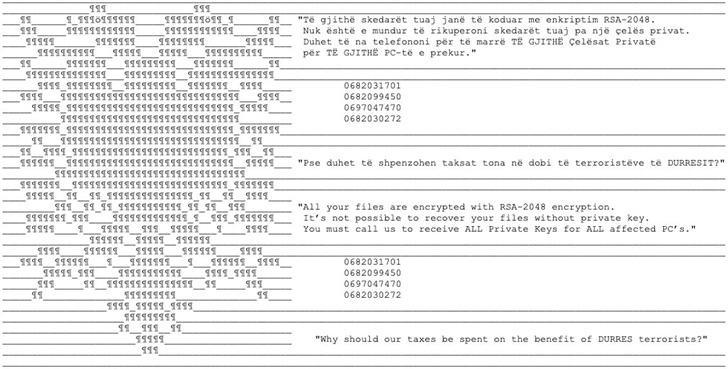
entailed the deployment of a new ransomware family called ROADSWEEP
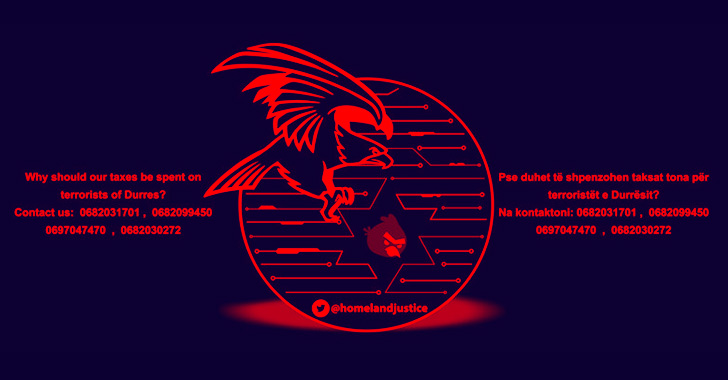
that included a ransom note with the text: “Why should our taxes be
spent on the benefit of DURRES terrorists?”
A front named HomeLand Justice has since claimed credit for the
cyber offensive, with the group also allegedly claiming to have
used a wiper malware in the attacks. Although the exact nature of
the wiper is unclear as yet, Mandiant said an Albanian user
submitted a sample for what’s called ZeroCleare on July 19,
coinciding with the attacks.
ZeroCleare, first documented[3]
by IBM in December 2019 as part of a campaign targeting the
industrial and energy sectors in the Middle East, is designed to
wipe the master boot record (MBR) and disk partitions on
Windows-based machines. It’s believed to be a collaborative effort
between different Iranian nation-state actors, including OilRig[4]
(aka APT34[5], ITG13, or Helix
Kitten).
Also deployed in the Albanian attacks was a previously unknown
backdoor dubbed CHIMNEYSWEEP that’s capable of taking screenshots,
listing and collecting files, spawning a reverse shell, and
supporting keylogging functionality.
The implant, besides sharing numerous code overlaps with
ROADSWEEP, is delivered to the system via a self-extracting archive
alongside decoy Microsoft Word documents that contain images of
Massoud Rajavi[6], the erstwhile leader of
People’s Mojahedin Organization of Iran (MEK).
The earliest iterations of CHIMNEYSWEEP date back to 2012 and
indications are that the malware may have been utilized in attacks
aimed at Farsi and Arabic speakers.
The cybersecurity firm, which was acquired by Google earlier
this year, said it didn’t have enough evidence linking the
intrusions to a named adversarial collective, but noted with
moderate confidence that one or more bad actors operating in
support of Iran’s objectives are involved.
The connections to Iran stem from the fact that the attacks took
place less than a week prior to the World Summit of Free Iran
conference on July 23-24 near the port city of Durres by entities
opposing the Iranian government, particularly the members of the
MEK.
“The use of ransomware to conduct a politically motivated
disruptive operation against the government websites and citizen
services of a NATO member state in the same week an Iranian
opposition groups’ conference was set to take place would be a
notably brazen operation by Iran-nexus threat actors,” the
researchers said.
The findings also come two months after the Iranian advanced
persistent threat (APT) group tracked as Charming Kitten (aka
Phosphorus) was linked[7]
to an attack directed against an unnamed construction company in
the southern U.S.
References
- ^
said
(www.mandiant.com) - ^
July 17
attacks (albaniandailynews.com) - ^
documented
(malpedia.caad.fkie.fraunhofer.de) - ^
OilRig
(www.ironnet.com) - ^
APT34
(thehackernews.com) - ^
Massoud
Rajavi (en.wikipedia.org) - ^
linked
(www.deepinstinct.com)
Read more https://thehackernews.com/2022/08/iranian-hackers-likely-behind.html