
attack that could allow a malicious app installed on your iOS
device to steal sensitive information from other apps by exploiting
certain implementations of Custom URL Scheme.
By default on Apple’s iOS operating system, every app runs
inside a sandbox of its own, which prevent all apps installed on
the same device from accessing each other’s data.
However, Apple offers some methods that facilitate sending and
receiving very limited data between applications.
One such mechanism is called URL Scheme, also known as Deep
Linking, that allows developers to let users launch their apps
through URLs, like facetime://, whatsapp://,
fb-messenger://.
For example, when you click “Sign in with Facebook” within an
e-commerce app, it directly launches the Facebook app installed on
your device and automatically process the authentication.
In the background, that e-commerce app actually triggers the URL
Scheme for the Facebook app (fb://) and passes some context
information required to process your login.
Researchers at Trend Micro noticed that since Apple does not
explicitly define which app can use what keywords for their Custom
URL Scheme, multiple apps on an iOS device can use single URL
Scheme—which eventually could trigger and pass sensitive data to a
completely different app unexpectedly or maliciously.
“This vulnerability is particularly critical if the login process
of app A is associated with app B,” the researchers said.
attack scenario[1], as shown in the image
above, using an example of a Chinese retailer app “Suning” and its
implementation of “Login with WeChat” feature, explaining how it is
susceptible to hacking.
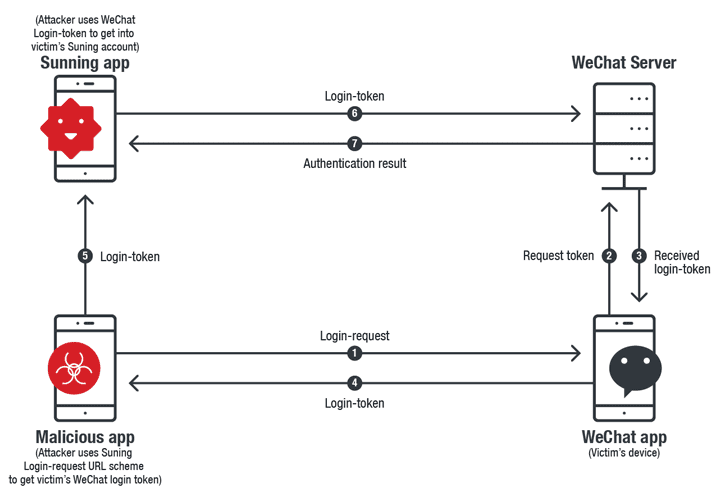
e-commerce account using WeChat, it generates a login-request and
sends it to the WeChat app installed on the same device using the
iOS URL Scheme for the messaging app. WeChat app then requests a
secret login token from its server and sends it back to the Suning
app for authentication.
Researchers found that since Suning always uses the same
login-request query to request the secret token and WeChat does not
authenticate the source of the login request, the implementation is
vulnerable to the app-in-the-middle attack via the iOS URL Scheme,
eventually allowing attackers gain unauthorized access to users’
accounts.
“With the legitimate WeChat URL Scheme, a fake-WeChat can be
crafted, and Suning will query the fake one for Login-Token. If the
Suning app sends the query, then the fake app can capture its
Login-Request URL Scheme.
“WeChat recognizes it, but it will not authenticate the source of
the Login-Request. Instead, it will directly respond with a
Login-Token to the source of the request. Unfortunately, the source
could be a malicious app that is abusing the Suning URL scheme.”
targeted application can trick other apps into sharing users’
sensitive data with it or can perform unauthorized actions,
potentially resulting in the loss of privacy, bill fraud, or
exposure to pop-up ads.
“In our research, plenty of apps that our system audited were found
taking advantage of this feature to show ads to victims.
Potentially malicious apps would intentionally claim the URL Scheme
associated with popular apps: wechat://, line://, fb://,
fb-messenger://, etc. We identified some of these malicious apps,”
the researchers said.
the way a URL Scheme has been implemented, app developers and
popular platforms are recommended to review their apps and validate
fix for untrusted requests.
References
- ^
illustrated an attack scenario
(blog.trendmicro.com)
Read more http://feedproxy.google.com/~r/TheHackersNews/~3/vrNOD5m3p7c/ios-custom-url-scheme.html