that could be exploited against modern Intel processors to leak
sensitive information from the CPU’s trusted execution environments
(TEE).
Called SGAxe[1], the first of the flaws
is an evolution of the previously uncovered CacheOut
attack[2] (CVE-2020-0549) earlier
this year that allows an attacker to retrieve the contents from the
CPU’s L1 Cache.
“By using the extended attack against the Intel-provided and
signed architectural SGX enclaves, we retrieve the secret
attestation key used for cryptographically proving the genuinity of
enclaves over the network, allowing us to pass fake enclaves as
genuine,” a group of academics from the University of Michigan
said.
The second line of attack, dubbed CrossTalk by researchers from the VU
University Amsterdam, enables attacker-controlled code executing on
one CPU core to target SGX enclaves running on a completely
different core, and determine the enclave’s private keys.
[3]
A TEE, like Intel’s Software Guard Extensions (SGX[4]), refers to a secure
enclave, an area within a processor that ensures confidentiality
and integrity of code and data. It offers safeguards against the
modification of sensitive software and data by malicious actors
that may have broken into the target (virtual) machine.
SGAxe Attack: Extracting Sensitive Data From SGX Enclaves
SGAxe builds on the CacheOut speculative execution attack to steal
SGX data. According to the researchers, while Intel took steps to
address side-channel attacks against SGX via several microcode
updates and new architectures, the mitigations have proven
ineffective.
That exploit, as a result, results in a transient execution
attack[5] that can recover SGX
cryptographic keys from a fully updated Intel machine, which is
trusted by Intel’s attestation server.
Attestation[6]
is a mechanism offered as part of SGX that lets enclaves prove to
third parties that they have been correctly initialized on a
genuine Intel processor. The idea is to ensure that the software
running inside the CPU hasn’t tampered with and to have increased
confidence that the software is running inside the enclave.
“In a nutshell, we use CacheOut to recover the sealing keys from
within the address space of Intel’s production quoting enclave,”
the researchers stated. “Finally, we use the recovered sealing keys
in order to decrypt the long term storage of the quoting enclave,
obtaining the machines EPID attestation keys.”
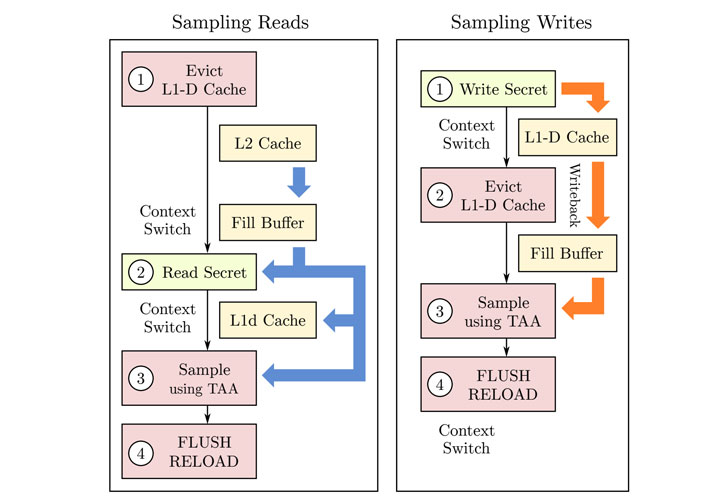
create a rogue enclave that passes Intel’s attestation mechanism,
resulting in loss of security guarantees.
“With the machine’s production attestation keys compromised, any
secrets provided by [the] server are immediately readable by the
client’s untrusted host application, while all outputs allegedly
produced by enclaves running on the client cannot be trusted for
correctness,” the researchers said. “This effectively renders
SGX-based DRM applications useless, as any provisioned secret can
be trivially recovered.”
Although Intel issued fixes for CacheOut back in January
via a microcode update to OEM vendors and subsequently via BIOS
updates to end-users, mitigations for SGAxe will require patching
the root cause behind CacheOut (aka L1D Eviction
Sampling).
[7][8]
“It is important to note that SGAxe relies on CVE-2020-0549 which
has been mitigated in microcode (confirmed by the researchers in
their updated CacheOut paper) and distributed out to the
ecosystem,” Intel said in a security
advisory[9].
The chipmaker will also perform a Trusted Compute Base (TCB)
recovery to invalidate all previously signed attestation keys.
“This process will ensure that your system is in a secure state
such that your system is able to use remote attestation again,” the
researchers stated.
CrossTalk Attack: Leaking Information Across CPU cores
CrossTalk (CVE-2020-0543[10]), the second SGX
exploit, is what the VU University calls an MDS[11] (Microarchitectural
Data Sampling) attack. It takes advantage of a “staging” buffer
that’s readable across all CPU cores to mount transient execution
attacks across the cores and extract the entire ECDSA private key
of a secure enclave running on a separate CPU core.
“The staging buffer retains the results of previously executed
offcore-instructions across all CPU cores,” the researchers
observed. “For instance, it contains the random numbers returned by
the offcore hardware DRNG, bootguard status hashes, and other
sensitive data.”
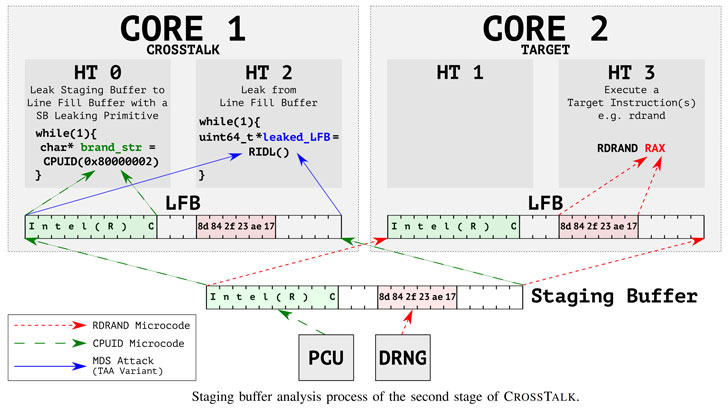
during transient execution in order to leak sensitive data accessed
by previously executed victim instructions.
The fact that the buffer retains output from RDRAND and
RDSEED[12] instructions makes it
possible for an unauthorized party to track the random numbers
generated, and therefore compromise the cryptographic operations
that underpin the SGX enclave, including the aforementioned remote
attestation process[13].
With Intel CPUs released from 2015 to 2019, counting Xeon E3 and E
CPUs, susceptible to the attacks, VU University researchers said it
shared with Intel a proof-of-concept demonstrating the leakage of
staging buffer content in September 2018, followed by a PoC
implementing cross-core RDRAND/RDSEED leakage in July 2019.
“Mitigations against existing transient execution attacks are
largely ineffective,” the team summarized. “The majority of current
mitigations rely on spatial isolation on boundaries which are no
longer applicable due to the cross-core nature of these attacks.
New microcode updates which lock the entire memory bus for these
instructions can mitigate these attacks—but only if there are no
similar problems which have yet to be found.”
In response to the findings, Intel addressed the flaw in a
microcode update distributed to software vendors yesterday after a
prolonged 21-month disclosure period due to the difficulty in
implementing a fix.
The company has recommended users of affected processors update
to the latest version of the firmware provided by system
manufacturers to address the issue.
References
- ^
SGAxe
(sgaxe.com) - ^
CacheOut attack
(thehackernews.com) - ^
CrossTalk
(www.vusec.net) - ^
SGX
(software.intel.com) - ^
transient execution attack
(en.wikipedia.org) - ^
Attestation
(software.intel.com) - ^
back in January
(www.intel.com) - ^
L1D Eviction Sampling
(software.intel.com) - ^
security advisory
(blogs.intel.com) - ^
CVE-2020-0543
(www.intel.com) - ^
MDS
(mdsattacks.com) - ^
RDRAND and RDSEED
(software.intel.com) - ^
remote attestation process
(download.01.org)
Read more http://feedproxy.google.com/~r/TheHackersNews/~3/LY6CEh6f1mw/intel-sgaxe-crosstalk-attacks.html