Cybersecurity company Imperva on Friday said it recently
mitigated a ransom distributed denial-of-service (DDoS) attack
targeting an unnamed website that peaked at 2.5 million requests
per second (RPS).
“While ransom DDoS attacks are not new, they appear to be
evolving and becoming more interesting with time and with each new
phase,” Nelli Klepfish, security analyst at Imperva, said[1]. “For example, we’ve
seen instances where the ransom note is included in the attack
itself embedded into a URL request.”
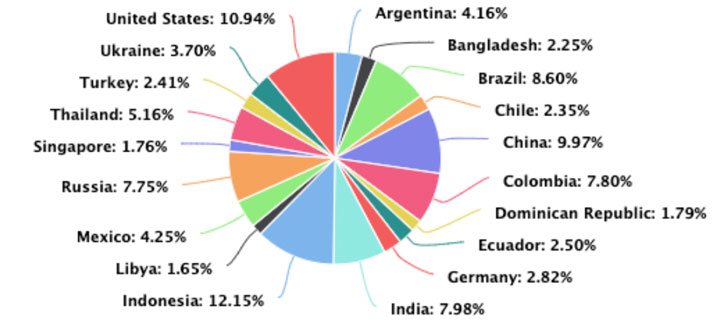
The top sources of the attacks came from Indonesia, followed by
the U.S., China, Brazil, India, Colombia, Russia, Thailand, Mexico,
and Argentina.
Distributed denial-of-service (DDoS) attacks are a subcategory
of denial-of-service (DoS) attacks in which an army of connected
online devices, known as a botnet, is used to overwhelm a target
website with fake traffic in an attempt to render it unavailable to
legitimate users.
The California-headquartered firm said that the affected entity
received multiple ransom notes included as part of the DDoS
attacks, demanding the company make a bitcoin payment to stay
online and avoid losing “hundreds of millions in market cap.”
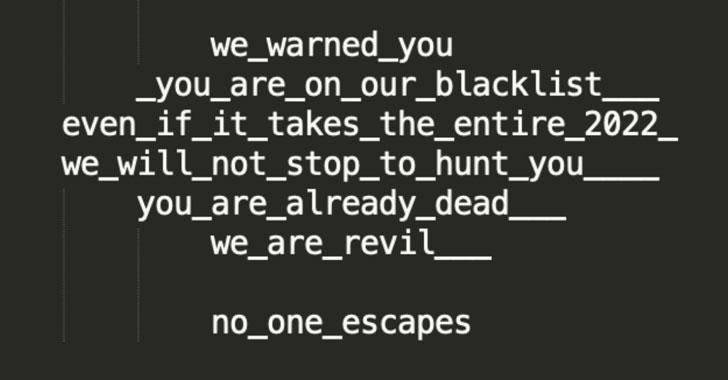
In an interesting twist, the attackers are calling themselves
REvil, the infamous ransomware-as-a-service cartel that suffered a major setback[2] after a number of its
operators were arrested by Russian law enforcement authorities
earlier this January.
“It is not clear however whether the threats were really made by
the original REvil group or by an imposter,” Klepfish noted.
 |
| Attack origins |
The 2.5 million RPS attack is said to have lasted less than a
minute, with one of the sister sites operated by the same company
sustaining a similar attack that lasted approximately 10 minutes,
even as the tactics employed were constantly changed to avert
possible mitigation.
Evidence gathered by Imperva points to the DDoS attacks
originating from the Mēris botnet[3], which has continued to
leverage a now-addressed security vulnerability in Mikrotik routers
(CVE-2018-14847[4]) to strike targets,
including Yandex.
“The types of sites the threat actors are after appear to be
business sites focusing on sales and communications,” Klepfish
said. “Targets tend to be U.S.- or Europe-based with the one thing
they all have in common being that they are all exchange-listed
companies and the threat actors use this to their advantage by
referring to the potential damage a DDoS attack could do to the
company stock price.”
The findings come as malicious actors have been spotted
weaponizing a new amplification technique called TCP Middlebox Reflection[5] for the very first time
in the wild to hit banking, travel, gaming, media, and web hosting
industries with a flood of fake traffic.
The ransom DDoS attack is also the second botnet-related
activity averted by Imperva since the start of the year, what with
the company detailing a web scraping attack that targeted an
unidentified job listing platform in late January.
“The attacker used a large-scale botnet, generating no less than
400 million bot requests from nearly 400,000 unique IP addresses
over four days with the intent of harvesting job seekers’
profiles,” the security firm said[6].
References
- ^
said
(www.imperva.com) - ^
suffered
a major setback (thehackernews.com) - ^
Mēris
botnet (thehackernews.com) - ^
CVE-2018-14847
(blog.mikrotik.com) - ^
TCP
Middlebox Reflection (thehackernews.com) - ^
said
(www.imperva.com)
Read more https://thehackernews.com/2022/03/imperva-thwarts-25-million-rps-ransom.html