In the midst of ‘The Great Resignation,’ the damage from
employees (or contractors) leaving an organization might be one of
the greatest risks facing IT teams today. The reality is that in
the busy enterprise computing environment, user onboarding and
offboarding is a fact of daily life.
When employee counts range into the five-figure territory — and
entire networks of contractors have to be accounted for as well —
it’s easy to lose track of who’s, literally, coming and going.
Oftentimes, there are “offboarding” steps that are forgotten about
— disabling or removing the user from Active Directory or IAM is
not sufficient as the user may have local credentials on some of
the SaaS platforms or other sensitive systems.
Technically speaking, there are ways to automate offboarding
using protocols such as SCIM and JIT mapping; however, it requires
a high level of maturity in an IT environment and the staff to
implement it.
For organizations not implementing SCIM or JIT, offboarded
employees may still have local credentials on some of their
regularly used SaaS platforms or other sensitive systems. Leaving
these users’ access in place exposes organizations to unauthorized
data access.
When it comes to taking old users off systems – deprovisioning –
there are a few best practices that should be borne in mind and
followed.
Best Practices in Deprovisioning
Keep an Inventory — It’s essential that
IT teams keep an up-to-date record, at all times, of all users with
access to company systems. A channel of communication with human
resources should be established for keeping abreast of events
impacting the user inventory such as employee terminations. To be
effective from a security standpoint, these systems need to be
capable of scrutinizing both internal and external users. The
vendor landscape can be constantly shifting.
Always be on the lookout — In addition
to keeping track of intended system users, IT teams need to have a
capability for user discovery that accounts for the full breadth of
systems they may be accessing – both those in legacy environments,
like on-premises systems, and in the mushrooming cloud
environment.
Rigorous access control — It’s
imperative that IT teams develop onboarding and offboarding
protocols that account for the full extent of privileged employee
computing access. If an employee has access to 3 internal systems
and 30 cloud-hosted ones, then clearly limiting access to those
on-premises will leave a gaping information hole that they will
retain access to.
How to Automate the Deprovisioning
Process
The meticulous mapping and security work that this process
demands from a security team is vast. A SaaS Security Posture Management[1] solution, like Adaptive Shield[2], can streamline this
process — a simple query in Adaptive Shield’s user inventory can
reveal the user posture of the deprovisioned users’ accounts across
the entire SaaS stack.
When it comes to deprovisioning these accounts, orchestration
tools give security teams an easy way to integrate Adaptive
Shield’s capabilities into an automated deprovisioning workflow.
This vastly simplifies the process, reducing the amount of time it
takes to fully deprovision users, and ensuring that no accounts are
left active.
 |
| Screenshot provided by Torq |
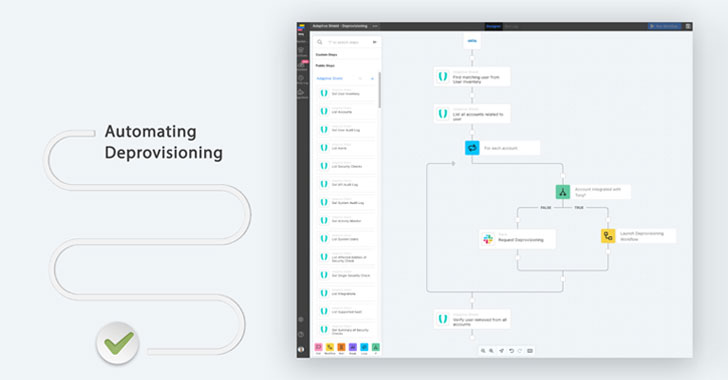
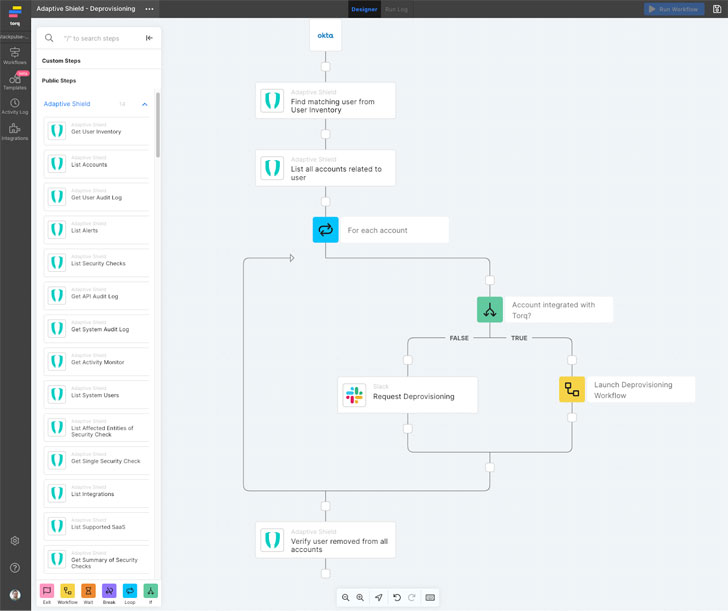
In the figure above, you can can see a potential workflow
where:
- The initial IAM deprovisioning can be used as the hook to
notify Adaptive Shield that a deprovisioning event has
occurred. - Adaptive Shield can probe the organization’s integrated SaaS
landscape for records for that user, - When Adaptive Shield detects an active account, it triggers a
workflow in the automation tool that identifies the account, and
deactivates it.
If the account cannot be directly deactivated, it sends a message
via Slack to an administrator, asking them to confirm the
deactivation.
- The automation tool then re-runs the security check in Adaptive
Shield, to verify account deactivation.
This workflow is just one example of how Adaptive Shield’s
integration with an orchestration tool streamlines the
deprovisioning process through automation; not only to ease the
burden of manual auditing and deactivating accounts, but also
providing continuous visibility and control increasing the
organization’s SaaS security posture.
Learn more[3]
about how to automate deprovisioning for your organization.
References
- ^
SaaS
Security Posture Management
(www.adaptive-shield.com) - ^
Adaptive
Shield (www.adaptive-shield.com) - ^
Learn
more (www.adaptive-shield.com)
Read more https://thehackernews.com/2022/03/how-to-automate-offboarding-to-keep.html