
legitimate concerns for all organizations. APTs are threat actors
that breach networks and infrastructures and stealthily lurk within
them over extended spans of time.
They typically perform complex hacks that allow them to steal or
destroy data and resources.
According to Accenture[1], APTs have been organizing
themselves[2] into groups that enable
them to share tactics and tools to carry out attacks at scale.
Russian group Silence APT, for instance, has been reported to be
actively targeting financial
institutions[3] and have successfully
stolen millions of dollars from various banks worldwide.
Smaller organizations also need to be wary of such threats. APT
groups also use automated tools and botnets to gain access to
networks, and these tactics don’t discriminate based on size,
industry, or value. Any vulnerable infrastructure can be breached.
It is now critical for all organizations to understand how APTs
operate and implement the necessary security measures to mitigate
them as threats.
Signs that an APT may be lurking
APTs operate covertly, so organizations may not even realize that
they have been breached until something really goes awry. InfoTrax Systems,
for example, was only able to detect years-long breach after its
servers’ storage was maxed
out. IT teams have to look out for the indications that an APT
might be lurking within the network.
A few distinct signs include:
Excessive logins — APTs typically rely on compromised
access credentials to gain routine access to networks. They can
either brute force attempts using login name and password
credential dumps or legitimate credentials stolen from social
engineering and phishing attacks. Excessive or suspicious login
activities, especially in odd hours, are often attributable to
APTs.
Explosion of malware — APTs also use various malware to
perform their hacks. So, if antivirus tools often detect and remove
malware, it is possible that an APT is continuously implanting
trojans and remote access tools into the network.
Increased usage of computing resources — These threat
actors will also have to use the network’s computing resources to
perform their hacks. Active malware will use computing power and
memory within endpoints. Hackers may also temporarily store their
stolen data within servers. Exfiltrating large volumes of data
would also show up as excessive outgoing traffic.
Heightened Monitoring
Spotting these signs isn’t straightforward, so IT teams must
actively search for these signs. Fortunately, modern security
solutions now provide capabilities that enable IT teams to monitor
the potential APT presence and their activities.
Log Analysis — Logs can accurately show the various
activities, events, and tasks that transpired in devices, systems,
and applications. However, going through logs, which are often in
unformatted plain text format, can be tedious. To help IT teams
sort through the information, advanced log analysis tools now
feature algorithms that can search for patterns across all IT
infrastructure components.
Log management and analysis solution XpoLog, for instance, can consolidate
all logs across various infrastructure components. Xpolog can
automatically parse and tag the information contained in these log
files. Using artificial intelligence (AI), Xpolog can then identify
anomalous patterns and generate insights, including those that are
indicative of security concerns.
[6]
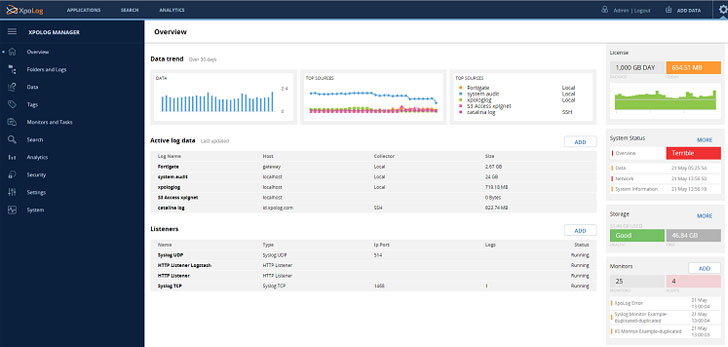
distribution of network traffic, can all be used to reveal the
presence of threats. All the data can even be visualized for easier
presentation and review.
Through these findings, the platform can readily alert IT teams
of potential APT attacks so that immediate action can be taken.
Breach and Attack Simulations — Breach and attack
simulation (BAS) platforms can run routine tests that mimic actual
cyberattacks to check if security measures are working as intended.
They serve as alternatives to traditional penetration testing,
which are challenging to perform on a routine basis.
BAS platform Cymulate, for
example, offers a wide variety of tests that cover the potential
vectors of attack to an infrastructure. It can test web gateways
and web application firewalls for vulnerabilities. It can also
deploy dummy malware into endpoints to check if anti-malware or
antiviruses can detect malicious files and processes. It also has
phishing attack simulations that can identify which users are
susceptible to social engineering attacks.
[7]
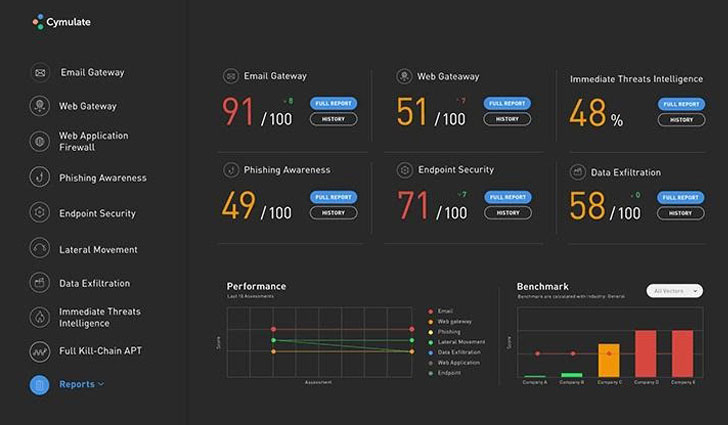
an organization’s implemented security measures and tools work as
intended. APTs turn off security solutions like antiviruses and
firewalls, so routine tests would readily indicate if something is
tampering with these solutions.
Defenses Must Be Improved
Monitoring and early detection are key to keeping a secure
defensive perimeter. Organizations must integrate these efforts as
part of a broader security strategy.
Increase vigilance — Actively analyzing logs and
performing routine tests of security measures can inform IT teams
of the potential presence of APTs, allowing them to deal with these
threats immediately.
Adopt enterprise-grade security — Organizations must also
use capable security solutions. The malware used by APTs can
feature a polymorphic code that allows them to evade common free or
cheap anti-malware solutions.
Keep systems and apps updated — APTs exploit
vulnerabilities of devices and systems for many of their tactics.
Developers regularly release patches and fixes to ensure that
critical vulnerabilities are addressed.
Organizations must ensure that these updates are quickly applied
when they become available.
Train people — APTs can also try to exploit human
weaknesses through social engineering attacks. Organizations must
train staff on the best security practices, including accurately
identifying phishing emails and attempts, using strong passphrases,
and avoiding password reuse.
Security is an Investment
Organizations must realize that security is a critical investment
when operating in today’s environment. APTs can cause irreparable
damage to companies. Falling victim to an attack can cause
downtime, lost business, and the erosion of customer trust.
The average security breach estimated by IBM[8]
cost organizations $3.92 million[9]. It is, therefore,
critical for companies to adopt security measures that are capable
of detecting and mitigating such threats before they can cause any
significant damage. As such, organizations must now be ready to
shift more resources to enhance their security.
References
- ^
Accenture
(accenture.com) - ^
organizing themselves
(www.accenture.com) - ^
targeting financial institutions
(thehackernews.com) - ^
InfoTrax Systems
(www.infotraxsys.com) - ^
storage was maxed out
(thehackernews.com) - ^
XpoLog
(www.xplg.com) - ^
Cymulate
(cymulate.com) - ^
IBM
(www.ibm.com) - ^
$3.92 million
(www.ibm.com)
Read more http://feedproxy.google.com/~r/TheHackersNews/~3/G3u8mYL36vY/apt-cyber-attacks.html