
warning enterprises of an unpatched, highly critical zero-day
vulnerability in Oracle WebLogic server application that
some attackers might have already started exploiting in the wild.
Oracle WebLogic is a scalable, Java-based multi-tier enterprise
application server that allows businesses to quickly deploy new
products and services on the cloud. It’s popular across both, cloud
environment and conventional environments.
Oracle WebLogic application reportedly contains a critical
deserialization remote code execution vulnerability that affects
all versions of the software, which can be triggered if the
“wls9_async_response.war” and “wls-wsat.war” components are
enabled.
The vulnerability, spotted[1] by the researchers from
KnownSec 404, allows attackers to remotely execute arbitrary
commands on the affected servers just by sending a specially
crafted HTTP request—without requiring any authorization.
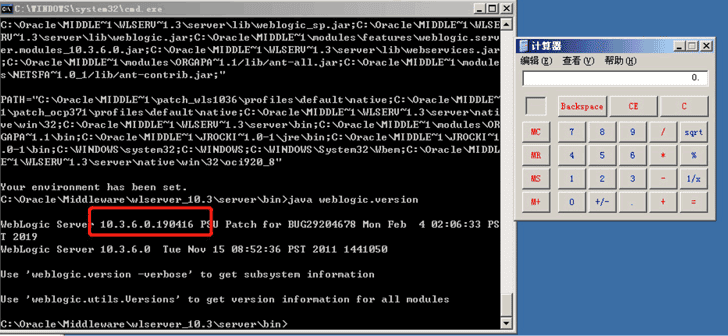
“Since the WAR package has a defect in deserializing the input
information, the attacker can obtain the authority of the target
server by sending a carefully constructed malicious HTTP request,
and execute the command remotely without authorization,” explains[2] Chinese National
Information Security Vulnerability Sharing Platform (CNVD).
vulnerability, tracked as CNVD-C-2019-48814, with the Oracle’s
team, but the company has not yet released a patch. The affected
Oracle WebLogic versions are as follows:
- WebLogic 10.X
- WebLogic 12.1.3
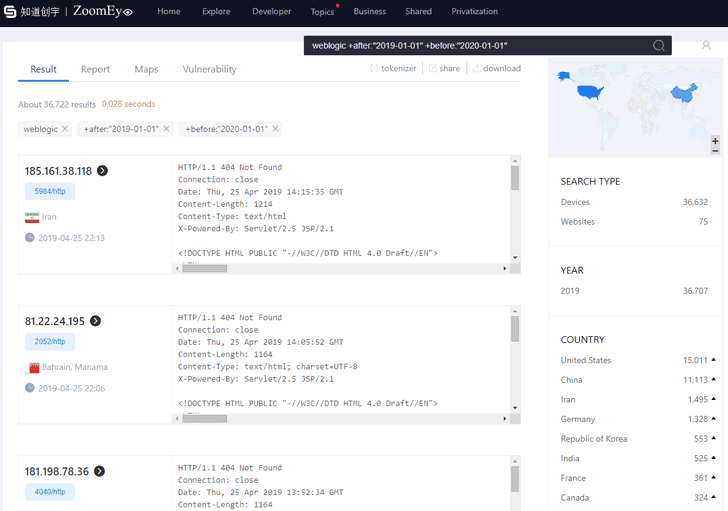
According to the ZoomEye[3] cyberspace search
engine, more than 36,000 WebLogic servers are publicly accessible
on the Internet, though it’s unknown how many of these have the
vulnerable components enabled.
A maximum number of Oracle WebLogic servers are deployed in the
United States and China, with a lesser number in Iran, Germany,
India, and so on.
had already released a Critical Patch
Update[4] just this month, this
zero-day issue is unlikely to be patched anytime soon (i.e., not
before July), unless the company decides to roll out an out-of-band
security update.
So, until the company releases an update to patch the
vulnerability, server administrators are highly recommended to
prevent their systems from exploitation by changing either of the
two following settings:
- Finding and deleting wls9_async_response.war, wls-wsat.war and
restarting the Weblogic service, or - Preventing access to the /_async/* and /wls-wsat/* URL paths
via access policy control.
Since Oracle WebLogic servers are an often target of attackers,
there will be no surprise if attackers have already started
exploiting this zero-day and then use vulnerable servers for their
nefarious purposes.
References
Read more http://feedproxy.google.com/~r/TheHackersNews/~3/qbLI8833eUM/oracle-weblogic-hacking.html