A “persistent attacker group” with alleged ties to Hezbollah has
retooled its malware arsenal with a new version of a remote access
Trojan (RAT) to break into companies worldwide and extract valuable
information.
In a new report[1]
published by the ClearSky research team on Thursday, the Israeli
cybersecurity firm said it identified at least 250 public-facing
web servers since early 2020 that have been hacked by the threat
actor to gather intelligence and steal the company’s databases.
The orchestrated intrusions hit a slew of companies located in
the U.S., the U.K., Egypt, Jordan, Lebanon, Saudi Arabia, Israel,
and the Palestinian Authority, with a majority of the victims
representing telecom operators (Etisalat, Mobily, Vodafone Egypt),
internet service providers (SaudiNet, TE Data), and hosting and
infrastructure service providers (Secured Servers LLC, iomart).
First documented in 2015, Volatile Cedar[2]
(or Lebanese Cedar) has been known to penetrate a large number of
targets using various attack techniques, including a custom-made
malware implant codenamed Explosive.
Volatile Cedar has been previously suspected of Lebanese origins
— specifically Hezbollah’s cyber unit — in connection with a
cyberespionage campaign in 2015 that targeted military suppliers,
telecom companies, media outlets, and universities.

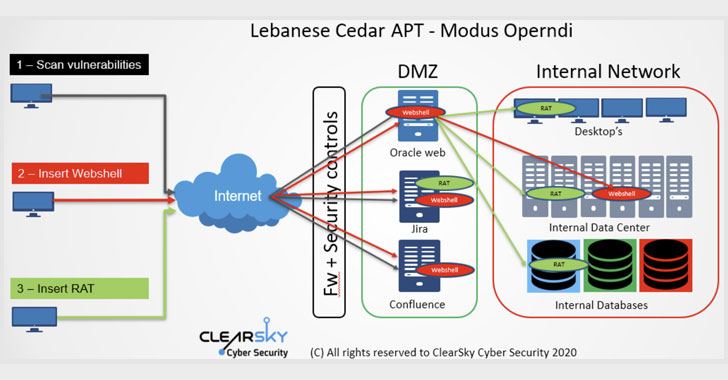
The 2020 attacks were no different. The hacking activity
uncovered by ClearSky matched operations attributed to Hezbollah
based on code overlaps between the 2015 and 2020 variants of the
Explosive RAT, which is deployed onto victims’ networks by
exploiting known 1-day vulnerabilities in unpatched Oracle and
Atlassian web servers.
Using the three flaws in the servers (CVE-2019-3396,
CVE-2019-11581, and CVE-2012-3152) as an attack vector to gain an
initial foothold, the attackers then injected a web
shell[3] and a JSP file
browser[4], both of which were used
to move laterally across the network, fetch additional malware, and
download the Explosive RAT, which comes with capabilities to record
keystrokes, capture screenshots, and execute arbitrary
commands.
“The web shell is used to carry out various espionage operations
over the attacked web server, including potential asset location
for further attacks, file installation server configuration and
more,” the researchers noted, but not before obtaining escalated
privileges to carry out the tasks and transmit the results to a
command-and-control (C2) server.
In the five years since the Explosive RAT was first seen,
ClearSky said new anti-debugging features were added to the implant
in its latest iteration (V4), with the communications between the
compromised machine and the C2 server now encrypted.
While it’s not surprising for threat actors to keep a low
profile, the fact that Lebanese Cedar managed to stay hidden since
2015 without attracting any attention whatsoever implies the group
may have ceased operations for prolonged periods in between to
avoid detection.
ClearSky noted that the group’s use of web shell as its primary
hacking tool could have been instrumental in leading researchers to
a “dead-end in terms of attribution.”
“Lebanese Cedar has shifted its focus significantly. Initially
they attacked computers as an initial point of access, then
progressed to the victim’s network then further progressing (sic)
to targeting vulnerable, public facing web servers,” the
researchers added.
References
- ^
new
report (www.clearskysec.com) - ^
Volatile
Cedar (malpedia.caad.fkie.fraunhofer.de) - ^
web
shell (en.wikipedia.org) - ^
JSP file
browser (www.vonloesch.de)
Read more http://feedproxy.google.com/~r/TheHackersNews/~3/QN-avU6vY4g/hezbollah-hacker-group-targeted.html