Feb 23, 2023Ravie Lakshmanan
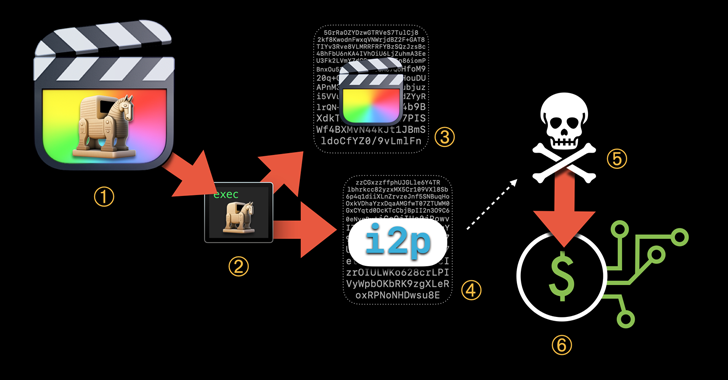
Trojanized versions of legitimate applications are being used to
deploy evasive cryptocurrency mining malware on macOS systems.
Jamf Threat Labs, which made the discovery, said the XMRig coin
miner was executed as Final Cut Pro, a video editing software from
Apple, which contained an unauthorized modification.
“This malware makes use of the Invisible Internet Project (i2p)
[…] to download malicious components and send mined currency to
the attacker’s wallet,” Jamf researchers Matt Benyo, Ferdous
Saljooki, and Jaron Bradley said[1]
in a report shared with The Hacker News.
An earlier iteration of the campaign was documented[2]
exactly a year ago by Trend Micro, which pointed out the malware’s
use of i2p to conceal network traffic and speculated that it may
have been delivered as a DMG file for Adobe Photoshop CC 2019.
The Apple device management company said the source of the
cryptojacking apps can be traced to Pirate Bay, with the earliest
uploads dating all the way back to 2019.
The result is the discovery of three generations of the malware,
observed first in August 2019, April 2021, and October 2021, that
charts the evolution of the campaign’s sophistication and
stealth.
One example of the evasion technique is a shell script that
monitors the list of running processes to check for the presence of
Activity Monitor[3], and if so, terminate
the mining processes.

The malicious mining process banks on the user launching the
pirated application, upon which the code embedded in the executable
connects to an actor-controlled server over i2p to download the
XMRig component.
The malware’s ability to fly under the radar, coupled with the
fact that users running cracked software are willingly doing
something illegal, has made the distribution vector a highly
effective one for many years.
Apple, however, has taken steps to combat such abuse by
subjecting notarized apps to more stringent Gatekeeper checks[4]
in macOS Ventura, thereby preventing tampered apps from being
launched.
“On the other hand, macOS Ventura did not prevent the miner from
executing,” Jamf researchers noted. “By the time the user receives
the error message, that malware has already been installed.”
“It did prevent the modified version of Final Cut Pro from
launching, which could raise suspicion for the user as well as
greatly reduce the probability of subsequent launches by the
user.”
Found this article interesting? Follow us on Twitter [5]
and LinkedIn[6]
to read more exclusive content we post.
References
- ^
said
(www.jamf.com) - ^
documented
(www.trendmicro.com) - ^
Activity
Monitor (support.apple.com) - ^
Gatekeeper checks
(thehackernews.com) - ^
Twitter
(twitter.com) - ^
LinkedIn
(www.linkedin.com)
Read more https://thehackernews.com/2023/02/hackers-using-trojanized-macos-apps-to.html