
The operators of RomCom RAT are continuing to evolve their
campaigns with rogue versions of software such as SolarWinds
Network Performance Monitor, KeePass password manager, and PDF
Reader Pro.
Targets of the operation consist of victims in Ukraine and
select English-speaking countries like the U.K.
“Given the geography of the targets and the current geopolitical
situation, it’s unlikely that the RomCom RAT threat actor is
cybercrime-motivated,” the BlackBerry Threat Research and
Intelligence Team said[1]
in a new analysis.
The latest findings come[2]
a week after the Canadian cybersecurity company disclosed a
spear-phishing campaign aimed at Ukrainian entities to deploy a
remote access trojan called RomCom RAT.
The unknown threat actor has also been observed leveraging
trojanized variants of Advanced IP Scanner and pdfFiller as
droppers to distribute the implant.
The latest iteration of the campaign entails setting up decoy
lookalike websites with a similar domain name, followed by
uploading a malware-laced installer bundle of the malicious
software, and then sending phishing emails to targeted victims.
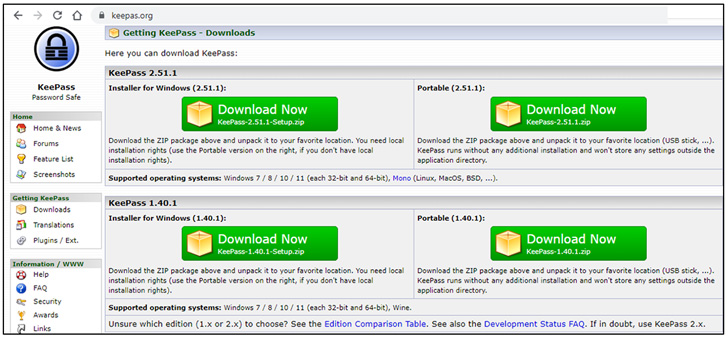 |
| Fake Keypass website |
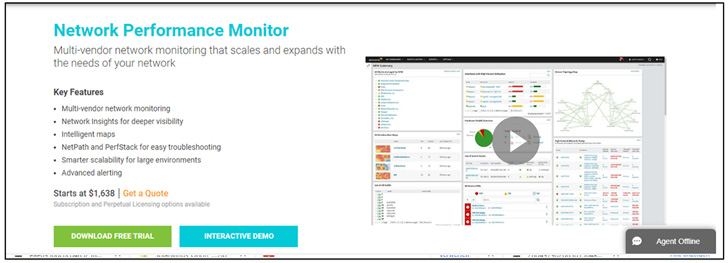 |
| Fake SolarWinds website |
“While downloading a free trial from the spoofed SolarWinds
site, a legitimate registration form appears,” the researchers
explained.
“If filled out, real SolarWinds sales personnel might contact
the victim to follow up on the product trial. That technique
misleads the victim into believing that the recently downloaded and
installed application is completely legitimate.”
It’s not just SolarWinds software. Other impersonated versions
involve the popular password manager KeePass and PDF Reader Pro,
including in the Ukrainian language.
The use of RomCom RAT has also been linked to threat actors
associated with the Cuba ransomware[3]
and Industrial Spy[4], according to Palo Alto
Networks Unit 42, which is tracking the ransomware group under the
constellation-themed moniker Tropical Scorpius.
Given the interconnected nature of the cybercriminal ecosystem,
it’s not immediately evident if the two sets of activities share
any connections or if the malware is offered for sale as a service
to other threat actors.
References
- ^
said
(blogs.blackberry.com) - ^
come
(thehackernews.com) - ^
Cuba
ransomware (thehackernews.com) - ^
Industrial Spy
(www.zscaler.com)
Read more https://thehackernews.com/2022/11/hackers-using-rogue-versions-of-keepass.html