A pay-per-install (PPI) malware service known as PrivateLoader
has been spotted distributing a “fairly sophisticated” framework
called NetDooka, granting attackers complete control over the
infected devices.
“The framework is distributed via a pay-per-install (PPI)
service and contains multiple parts, including a loader, a dropper,
a protection driver, and a full-featured remote access trojan (RAT)
that implements its own network communication protocol,” Trend
Micro said[1]
in a report published Thursday.
PrivateLoader, as documented by Intel 471 in February 2022,
functions as a downloader responsible for downloading and
installing additional malware onto the infected system, including
SmokeLoader, RedLine Stealer, Vidar, Raccoon, GCleaner, and
Anubis[2].
Featuring anti-analysis techniques, PrivateLoader is written in
the C++ programming language and is said to be in active
development, with the downloader malware family gaining traction
among multiple threat actors.
PrivateLoader infections are typically propagated through
pirated software downloaded from rogue websites that are pushed to
the top of search results via search engine optimization (SEO)
poisoning techniques.
“PrivateLoader is currently used to distribute ransomware,
stealer, banker, and other commodity malware,” Zscaler noted[3]
last week. “The loader will likely continue to be updated with new
features and functionality to evade detection and effectively
deliver second-stage malware payloads.”
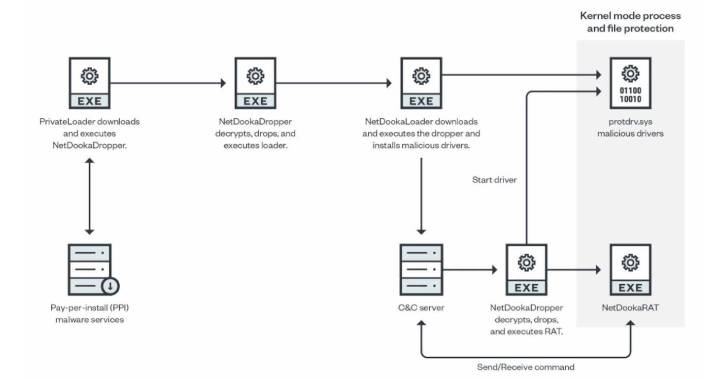
The framework, still in its development phase, contains
different modules: a dropper, a loader, a kernel-mode process and
file protection driver, and a remote access trojan that uses a
custom protocol to communicate with the command-and-control (C2)
server.
The newly observed set of infections involving the NetDooka
framework commences with PrivateLoader acting as a conduit to
deploy a dropper component, which then decrypts and executes a
loader that, in turn, retrieves another dropper from a remote
server to install a full-featured trojan as well as a kernel
driver.
“The driver component acts as a kernel-level protection for the
RAT component,” researchers Aliakbar Zahravi and Leandro Froes
said. “It does this by attempting to prevent the file deletion and
process termination of the RAT component.”
The backdoor, dubbed NetDookaRAT, is notable for its breadth of
functionality, enabling it to run commands on the target’s device,
carry out distributed denial-of-service (DDoS) attacks, access and
send files, log keystrokes, and download and execute additional
payloads.
This indicates that NetDooka’s capabilities not only allow it to
act as an entry point for other malware, but can also be weaponized
to steal sensitive information and form remote-controlled
botnets.
“PPI malware services allow malware creators to easily deploy
their payloads,” Zahravi and Froes concluded.
“The use of a malicious driver creates a large attack surface
for attackers to exploit, while also allowing them to take
advantage of approaches such as protecting processes and files,
bypassing antivirus programs, and hiding the malware or its network
communications from the system.”
Read more https://thehackernews.com/2022/05/hackers-using-privateloader-ppi-service.html