A new, sophisticated phishing attack has been observed
delivering the AsyncRAT trojan as part of a malware campaign that’s
believed to have commenced in September 2021.
“Through a simple email phishing tactic with an html attachment,
threat attackers are delivering AsyncRAT (a remote access trojan)
designed to remotely monitor and control its infected computers
through a secure, encrypted connection,” Michael Dereviashkin,
security researcher at enterprise breach prevention firm Morphisec,
said[1]
in a report.
The intrusions commence with an email message containing an HTML
attachment that’s disguised as an order confirmation receipt (e.g.,
Receipt-<digits>.html). Opening the decoy file redirects the
message recipient to a web page prompting the user to save an ISO
file.
But unlike other attacks that route the victim to a phishing
domain set up explicitly for downloading the next-stage malware,
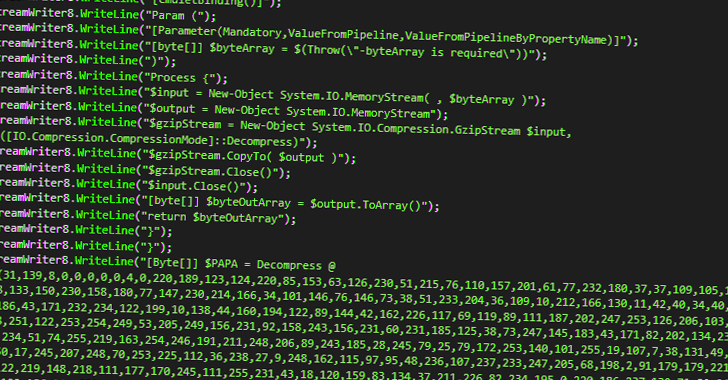
the latest RAT campaign cleverly uses JavaScript to locally create
the ISO file from a Base64-encoded string and mimic the download
process.
“The ISO download is not generated from a remote server but from
within the victim’s browser by a JavaScript code that’s embedded
inside the HTML receipt file,” Dereviashkin explained.
When the victim opens the ISO file, it is automatically mounted
as a DVD Drive on the Windows host and includes either a .BAT or a
.VBS file, which continues the infection chain to retrieve a
next-stage component via a PowerShell command execution.
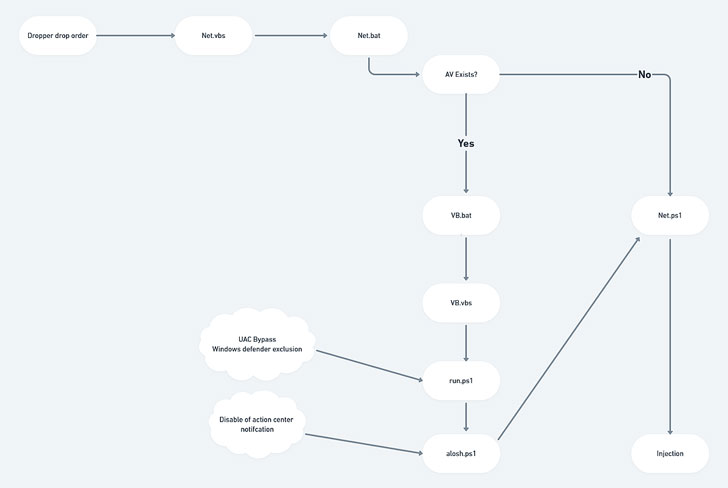
This results in the execution of a .NET module in-memory that
subsequently acts as a dropper for three files — one acting as a
trigger for the next — to finally deliver AsyncRAT as the final
payload, while also checking for antivirus software and setting up
Windows Defender exclusions.
RATs such as AsyncRAT are typically used to forge a remote link
between a threat actor and a victim device, steal information, and
conduct surveillance through microphones and cameras. They provide
an array of advanced capabilities that give the attackers the
ability to fully monitor and control the compromised machines.
Morphisec also pointed out the campaign’s advanced tactics,
which it said allowed the malware to slip through virtually[2]
undetected[3]
by most antimalware engines despite the operation being in effect
for close to five months.
References
Read more https://thehackernews.com/2022/01/hackers-using-new-evasive-technique-to.html