
Threat actors are abusing Microsoft Build Engine (MSBuild) to
filelessly deliver remote access trojans and password-stealing
malware on targeted Windows systems.
The actively ongoing campaign is said to have emerged last
month, researchers from cybersecurity firm Anomali said[1]
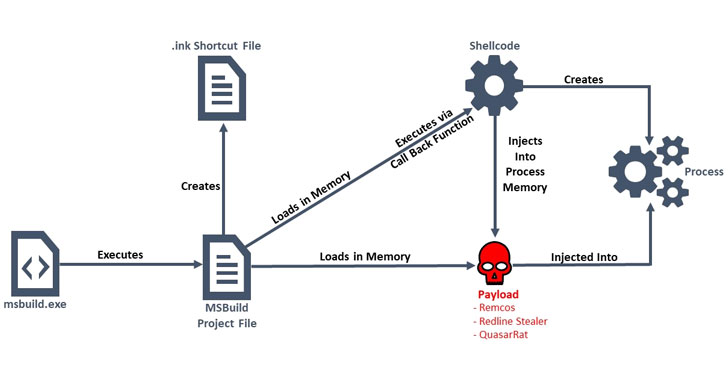
on Thursday, adding the malicious build files came embedded with
encoded executables and shellcode that deploy backdoors[2], allowing the
adversaries to take control of the victims’ machines and steal
sensitive information.
MSBuild is an open-source build tool for .NET and Visual Studio
developed by Microsoft that allows for compiling source code,
packaging, testing, deploying applications.
In using MSBuild to filelessly compromise a machine, the idea is
to stay under the radar and thwart detection, as such malware makes
use of a legitimate application to load the attack code into
memory, thereby leaving no traces of infection on the system and
giving attackers a high level of stealth.
As of writing, only two security vendors flag one of the MSBuild
.proj files (“vwnfmo.lnk[3]“) as malicious, while a
second sample (“72214c84e2.proj[4]“) uploaded to VirusTotal
on April 18 remains undetected by every anti-malware engine. The
majority of the samples analyzed by Anomali were found to deliver
the Remcos[5]
RAT, with a few others also delivering the Quasar[6]
RAT and RedLine Stealer[7].
Remcos (aka Remote Control and Surveillance software), once
installed, grants full access to the remote adversary, its features
ranging from capturing keystrokes to executing arbitrary commands
and recording microphones and webcams, while Quasar is an
open-source .NET-based RAT capable of keylogging, password
stealing, among others. Redline Stealer, as the name indicates, is
a commodity malware that harvests credentials from browsers, VPNs,
and messaging clients, in addition to stealing passwords and
wallets associated with cryptocurrency apps.
“The threat actors behind this campaign used fileless delivery
as a way to bypass security measures, and this technique is used by
actors for a variety of objectives and motivations,” Anomali
researchers Tara Gould and Gage Mele said. “This campaign
highlights that reliance on antivirus software alone is
insufficient for cyber defense, and the use of legitimate code to
hide malware from antivirus technology is effective and growing
exponentially.”
References
- ^
said
(www.anomali.com) - ^
backdoors
(www.zscaler.com) - ^
vwnfmo.lnk
(www.virustotal.com) - ^
72214c84e2.proj
(www.virustotal.com) - ^
Remcos
(malpedia.caad.fkie.fraunhofer.de) - ^
Quasar
(malpedia.caad.fkie.fraunhofer.de) - ^
RedLine
Stealer (malpedia.caad.fkie.fraunhofer.de)